
Updated August 2026
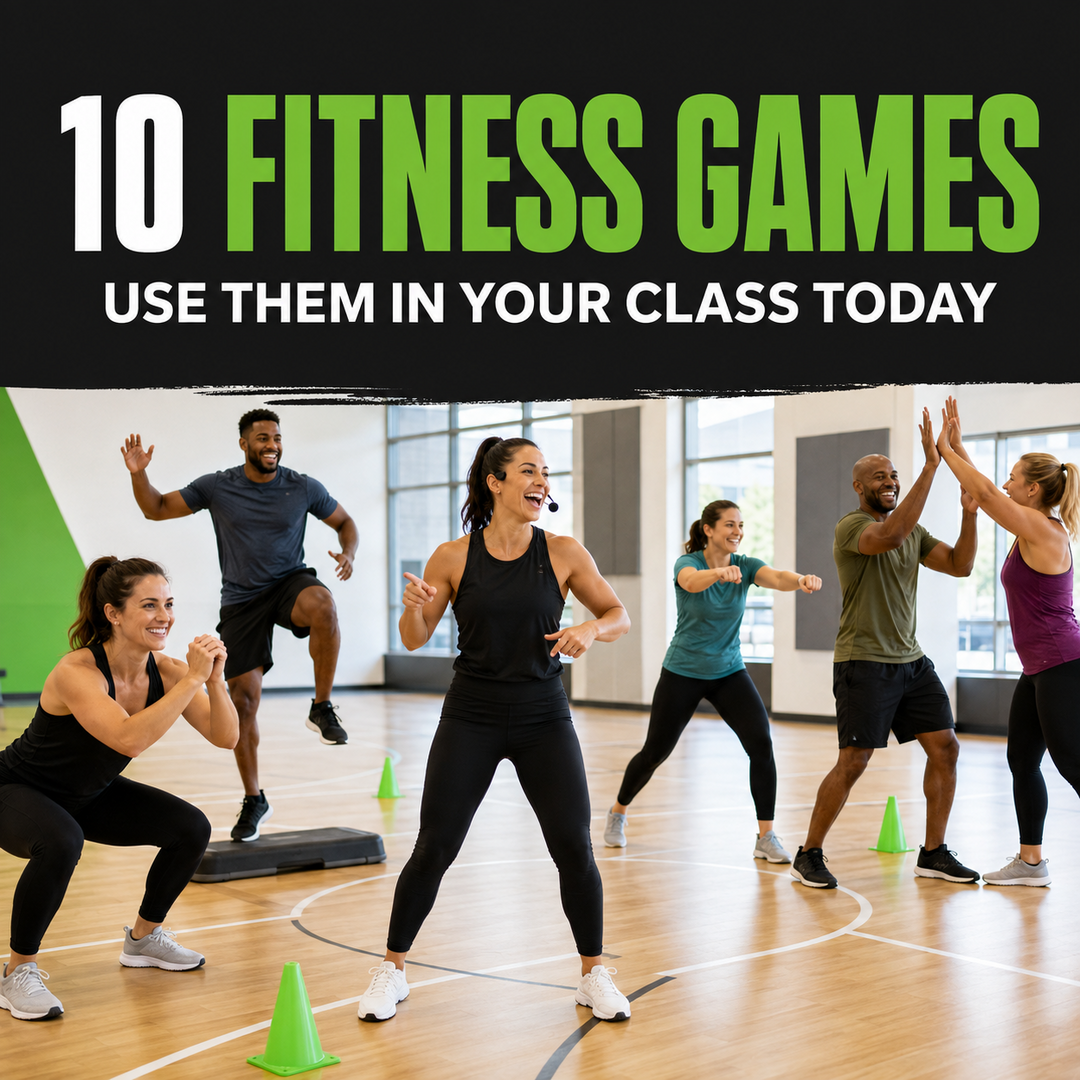
Fitness games can turn a standard workout into a class people talk about afterward. A clear goal, team challenge, or element of chance can make familiar exercises feel fresh—without forcing the instructor to build a complicated new program.
These 10 group fitness games are designed for personal trainers, bootcamp coaches, group fitness instructors, and wellness leaders. Each one includes equipment, timing, setup, rules, coaching tips, and options for mixed fitness levels. Pick one as a warm-up, main workout, or finisher and use it in your next class.
Quick answer: What are fun fitness games for group classes?
Try BoardGains, Fitness Relay, Four Corners, Fitness Tic-Tac-Toe, Workout Bingo, Partner Rep Ladder, Roll-the-Dice Workout, Team AMRAP, Musical Movement Stations, or Rock-Paper-Scissors Fitness. Use short rounds, simple rules, and multiple exercise options so everyone stays active.
Table of contents
- Why use games in fitness classes?
- Choose the right game
- Five-minute setup checklist
- 10 fun fitness games for your classes
- Mixed-level exercise options
- Ready-to-use 45-minute class
- Coaching and safety tips
- Frequently asked questions
Why use games in group fitness classes?
A fitness game gives participants something to do beyond counting repetitions. They may work toward a team total, solve a strategy challenge, respond to a random roll, or complete a shared mission. That extra purpose can increase conversation, laughter, and effort.
- More class energy: short challenges create natural changes in pace.
- Easy variety: the same movement menu can produce many different sessions.
- Stronger connection: partner and team goals help members interact.
- Flexible intensity: participants can share the same rules while choosing different movement levels.
- Less instructor talking: once the rules are understood, the game helps guide the workout.
The game should support the workout—not distract from safe movement. Avoid long explanations, complicated scoring, punishment exercises, and elimination. The best rule set can be explained in under two minutes and keeps every participant involved.
Choose the right fitness game for your class
| Game | Time | Group size | Equipment | Best use |
|---|---|---|---|---|
| 1. BoardGains | 10–35 min | Small groups to 60+ | Game set | Main workout or complete class |
| 2. Fitness Relay | 10–18 min | 8–30 | Cones | Team cardio |
| 3. Four Corners | 10–16 min | 8+ | Four signs | Large mixed-level groups |
| 4. Fitness Tic-Tac-Toe | 10–15 min | 6–30 | Hoops, markers | Strategy and movement |
| 5. Workout Bingo | 12–20 min | Any | Bingo cards | Choice and variety |
| 6. Partner Rep Ladder | 8–15 min | Pairs | None | Strength and cooperation |
| 7. Roll-the-Dice | 10–18 min | 4–30 | Large dice | Fast, simple intervals |
| 8. Team AMRAP | 10–16 min | 6+ | Timer | Endurance and pacing |
| 9. Musical Stations | 10–15 min | Any | Music, station cards | Warm-up or circuit |
| 10. Rock-Paper-Scissors | 6–10 min | Pairs | None | Warm-up or finisher |
Five-minute setup checklist
- Clear the space. Check the floor, equipment, travel lanes, walls, and workout zones.
- Choose the movement menu. Use three to six exercises that match the goal of the class.
- Demonstrate the options. Show a lower-impact or supported version, a standard version, and an advanced progression.
- Explain the win condition. Tell participants how to earn points, complete a round, or reach the team goal.
- Run a practice round. Use 30–60 seconds without scoring to confirm that everyone understands.
10 fun fitness games to use in your classes today
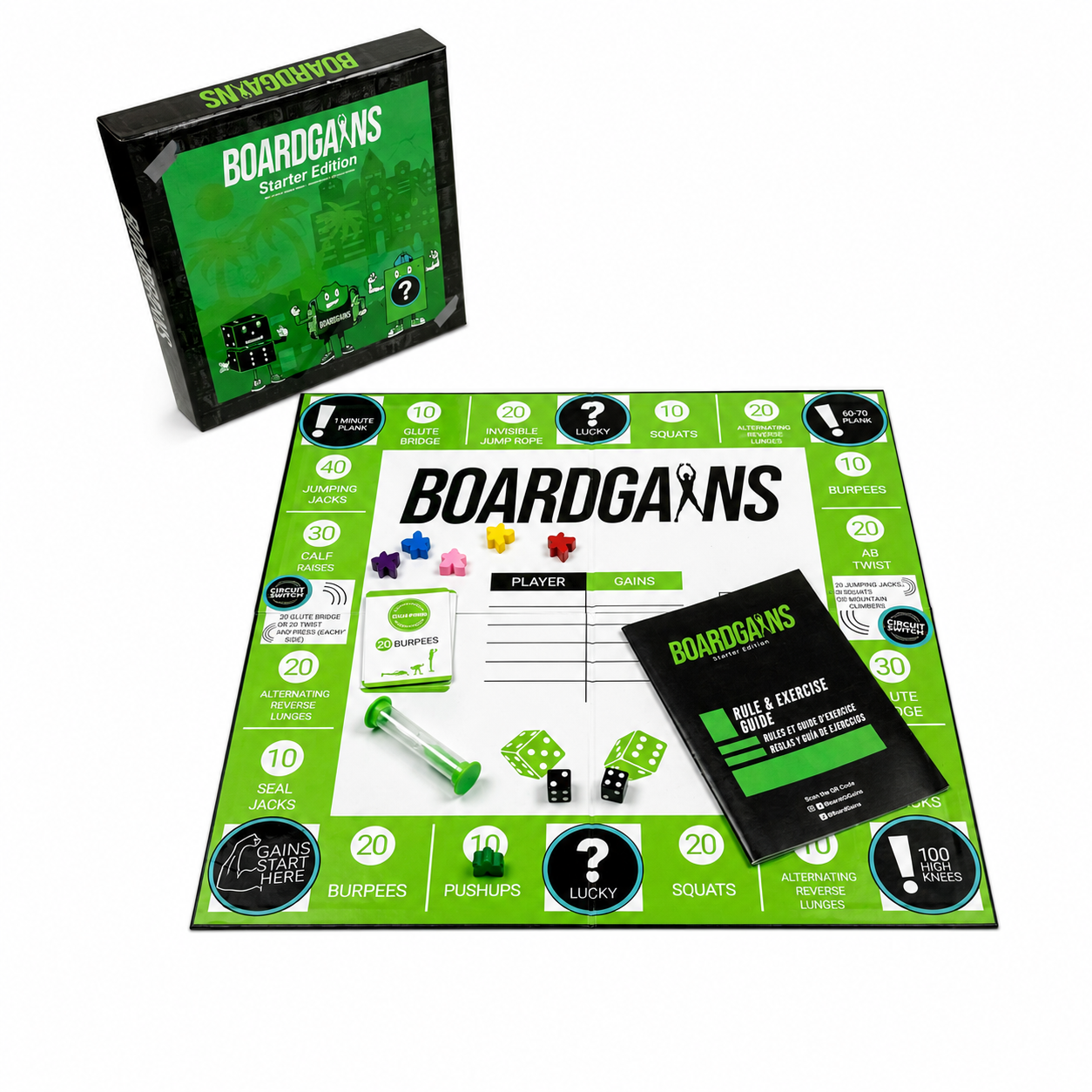
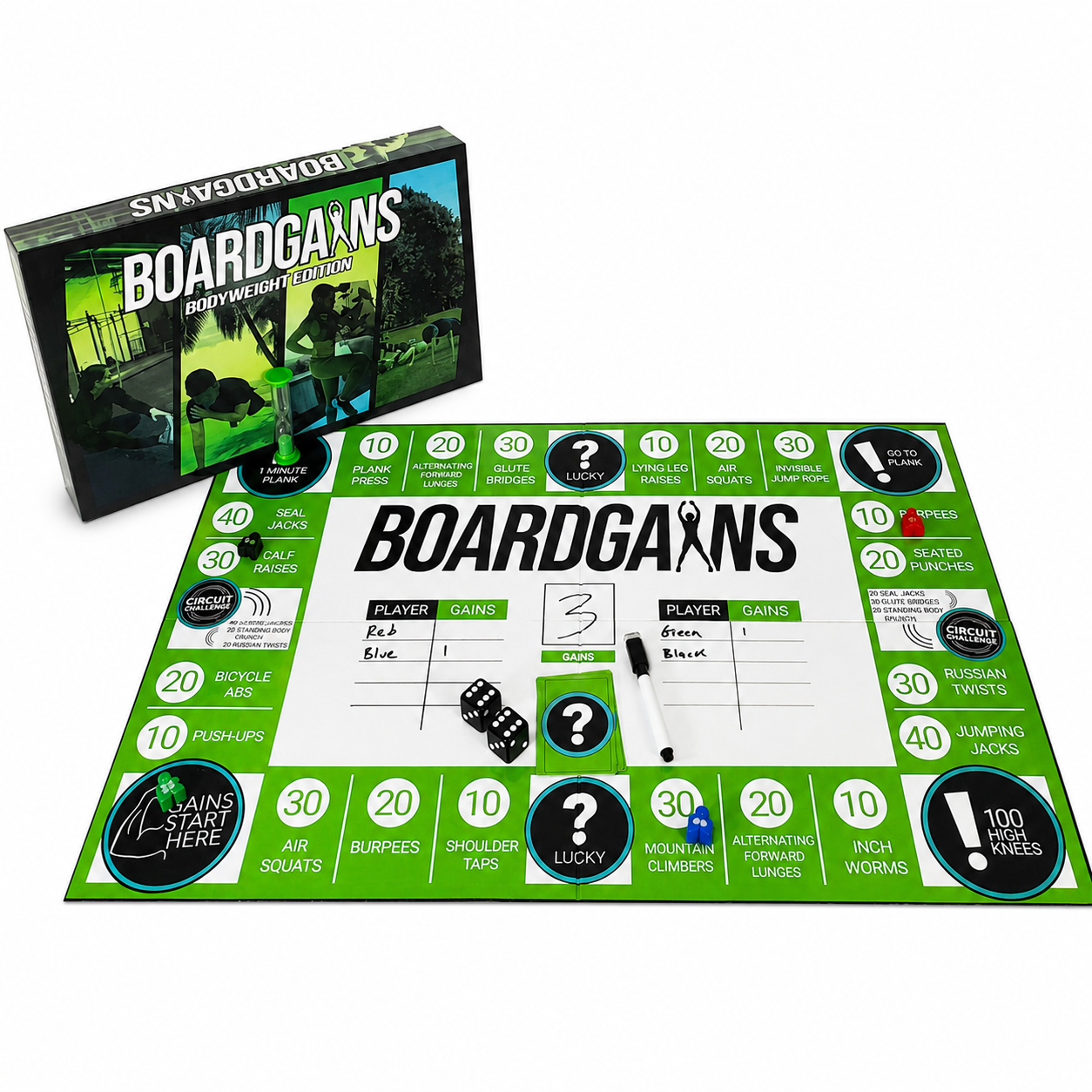
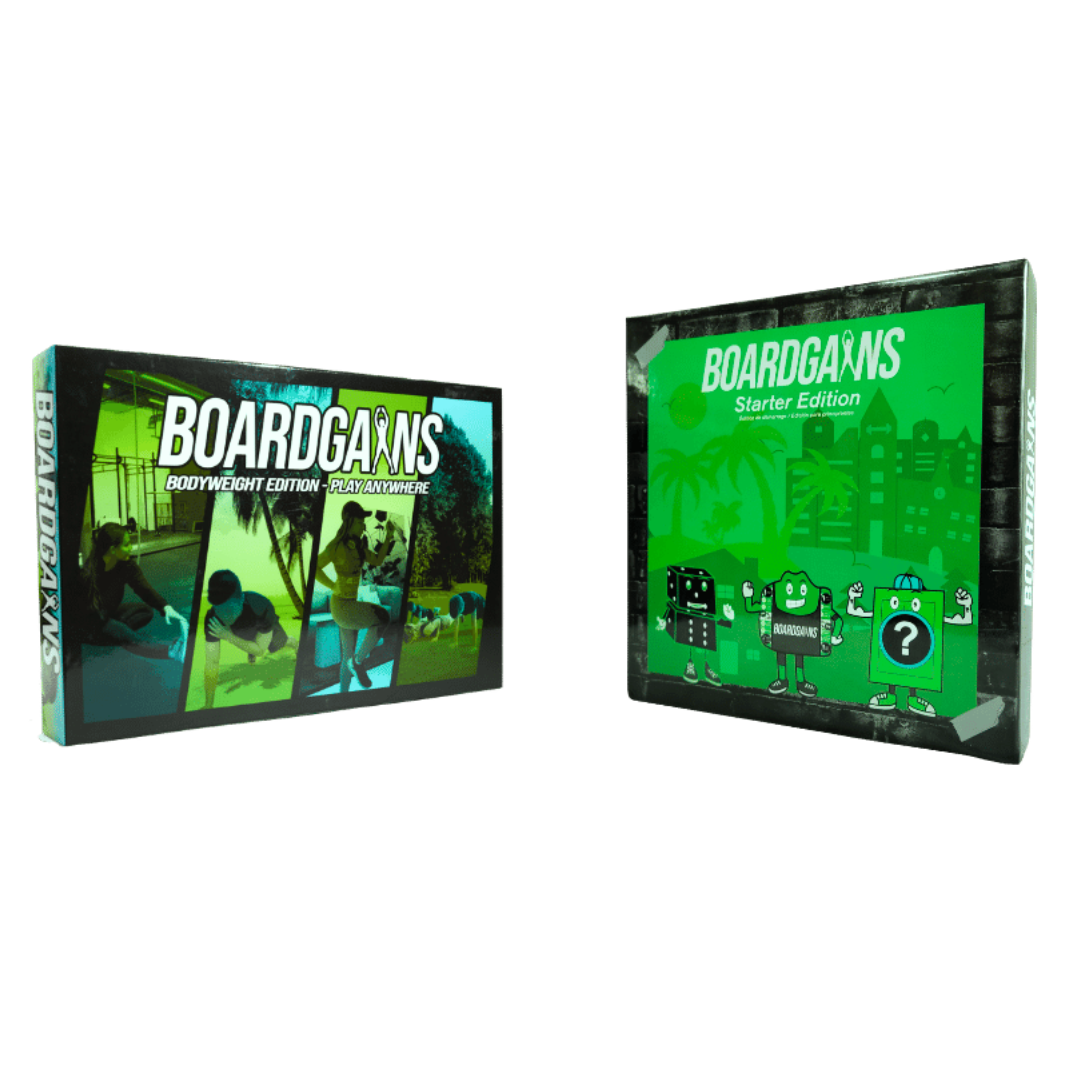
1. BoardGains Fitness Game
Best for: bootcamps, group fitness, team building, and full-class workouts
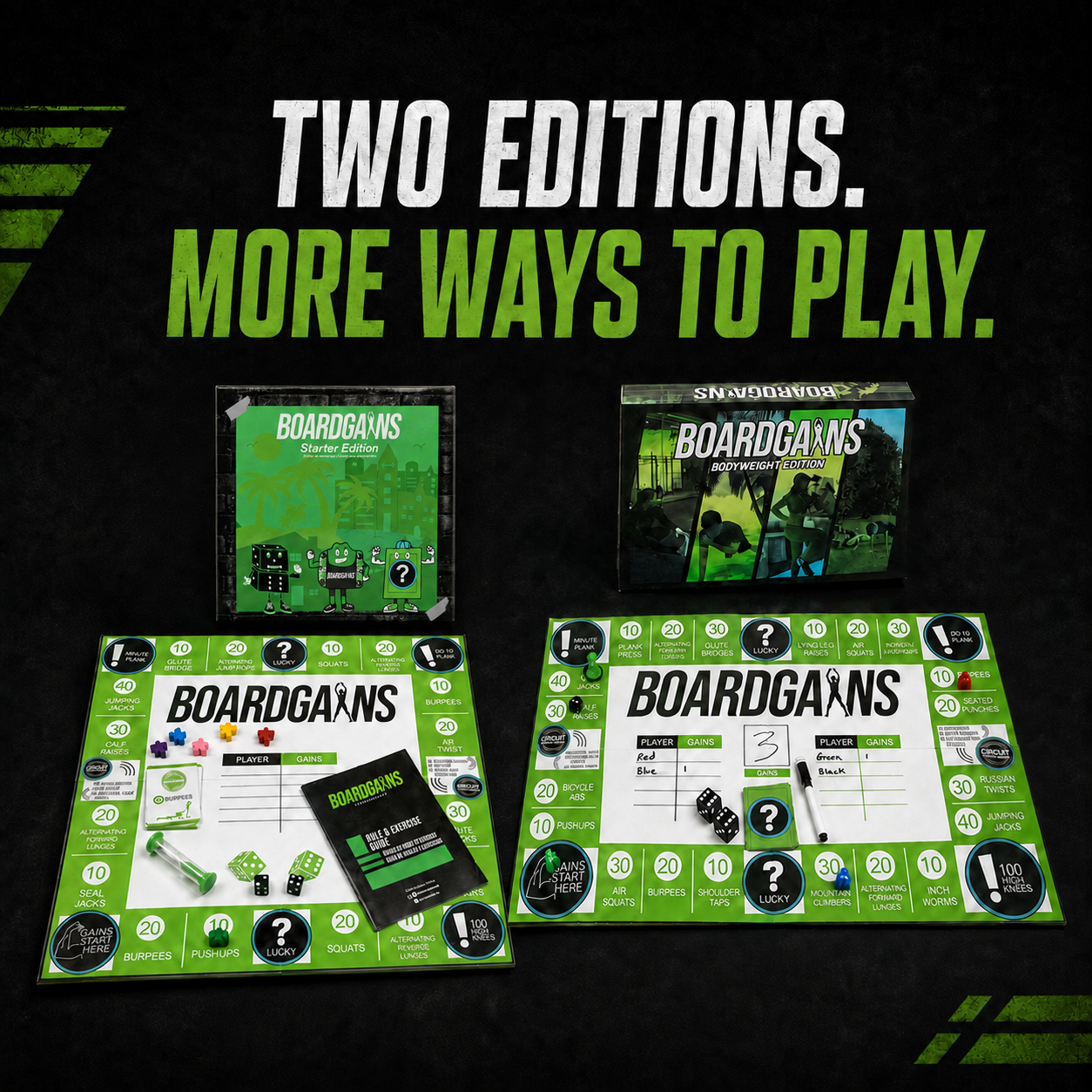
Equipment: BoardGains game set
Time: 10–35 minutes
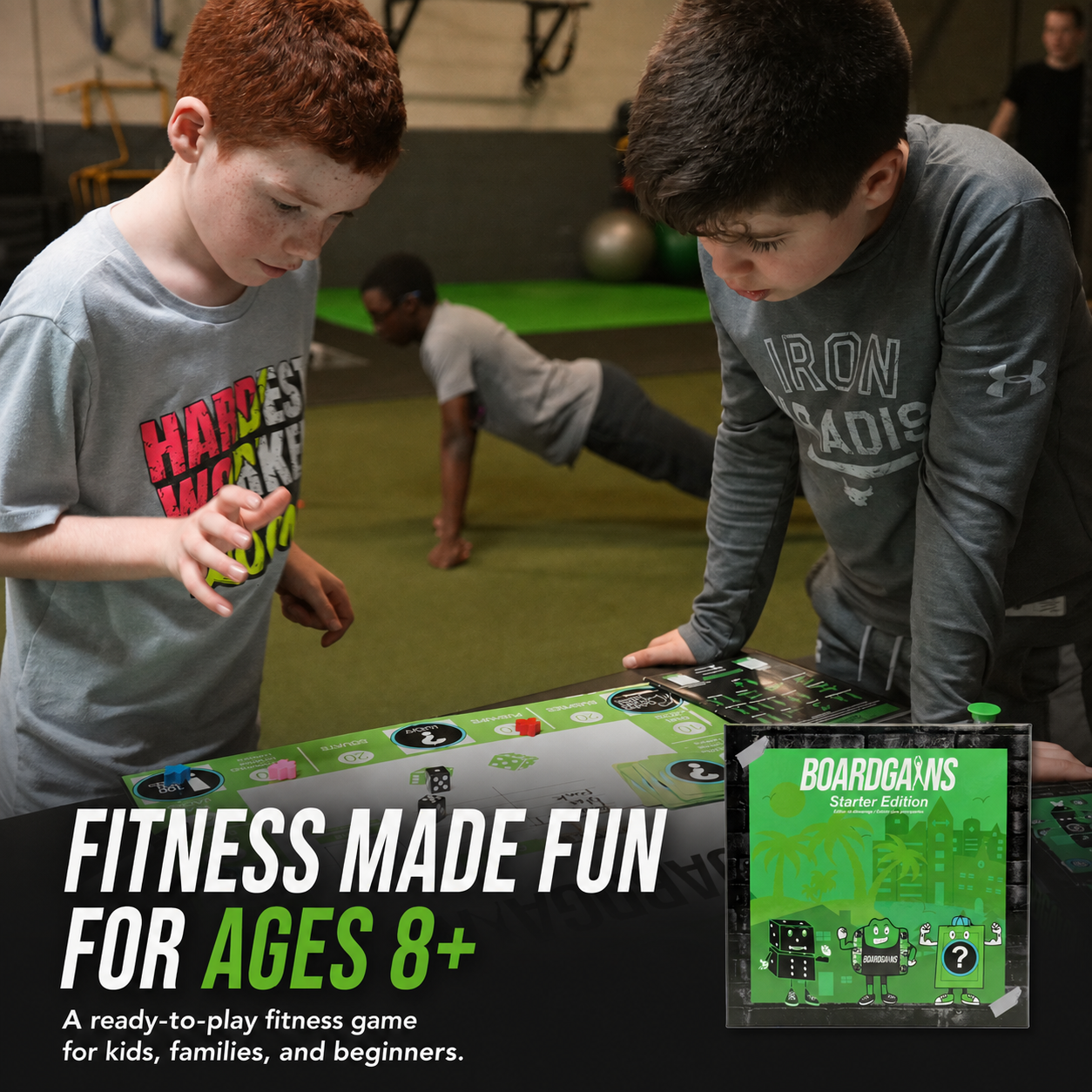
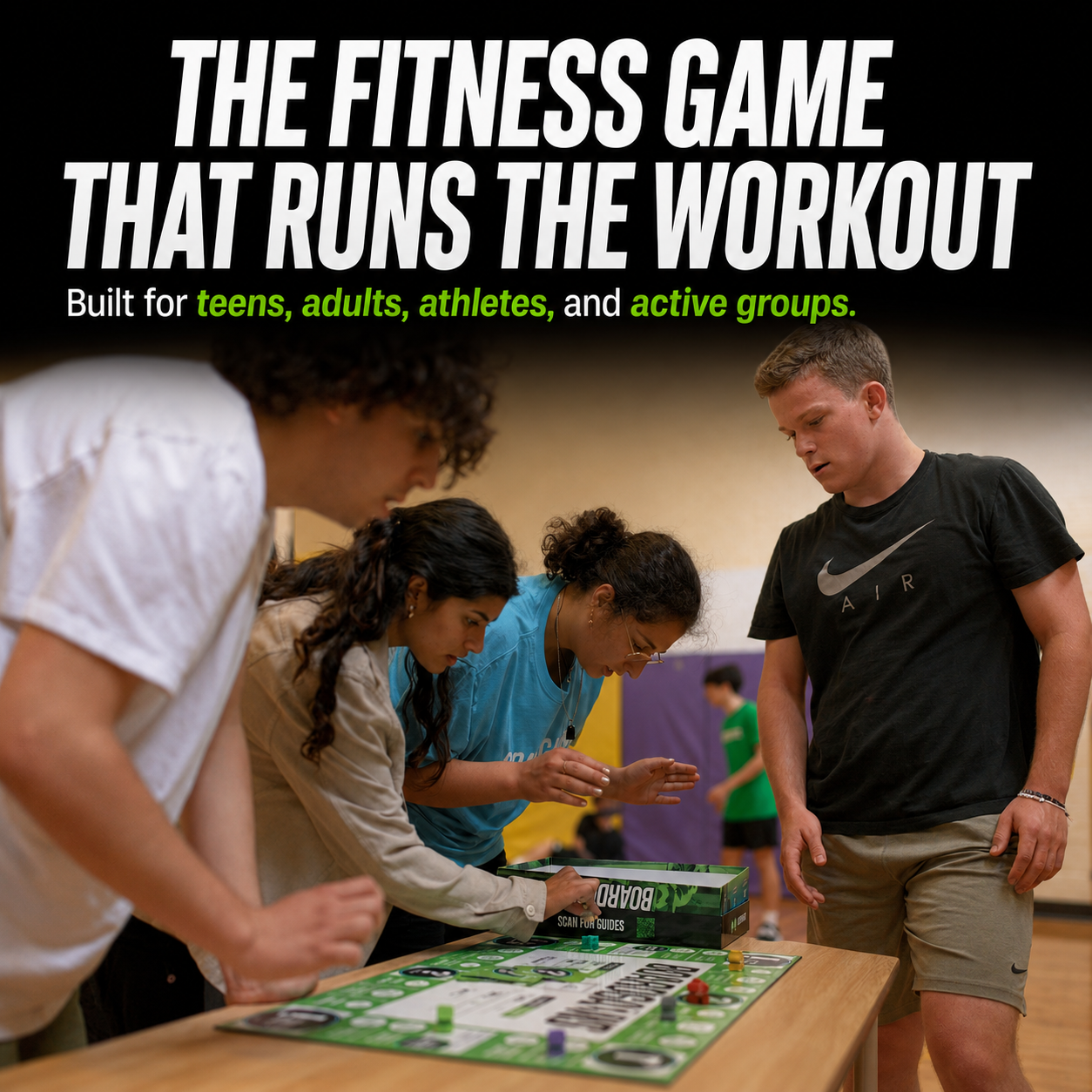
How to play: Choose a Gains Goal before starting. One lap around the board equals one Gain. Set up participants as individuals or small teams and give each a game piece and workout space. Everyone rolls, moves, completes the bodyweight exercise they land on, and repeats. The first player or team to reach the Gains Goal wins.
- 3 Gains: about 10–15 minutes for a warm-up or finisher
- 5 Gains: about 20–25 minutes for the main workout
- 7 Gains: about 25–35 minutes for a longer session
Mixed-level option: Assign a standing, seated, supported, or advanced choice to every exercise before play. Each approved version counts equally.
Instructor tip: Everyone plays at the same time. Let the board guide the workout while you circulate, coach technique, and manage intensity. Explore BoardGains for group fitness and bootcamps or review the complete how-to-play guide.
2. Team Fitness Relay
Best for: high-energy cardio and teamwork
Equipment: cones or floor markers
Time: 10–18 minutes
How to play: Create teams of three to five and mark a short lane for each team. The active participant completes 20 seconds of an exercise, travels to a cone, returns, and tags the next teammate. Rotate through movements such as squats, step jacks, standing punches, and knee drives.
Mixed-level option: Make each turn the same length instead of requiring the same distance or repetitions. Walking, marching, wheeling, or an in-place movement can replace running.
Instructor tip: Use one-way lanes, wide spacing, and controlled travel. Score team completion or improvement instead of rewarding risky speed.
3. Fitness Four Corners
Best for: large groups and limited equipment
Equipment: four signs
Time: 10–16 minutes
How to play: Label the corners Strength, Cardio, Core, and Mobility. Participants select a corner and complete the posted movement for 40 seconds. Allow 20 seconds to recover and travel, then start the next round. Change the exercises after two rounds.
Mixed-level option: Put two or three choices on every sign. Cardio may include seated jacks, step jacks, or jumping jacks. Core may include a wall plank, incline plank, or floor plank.
Instructor tip: Do not eliminate the least popular corner. Give the whole class one point when every participant has visited all four areas.
4. Fitness Tic-Tac-Toe
Best for: strategy, teamwork, and short bursts
Equipment: nine hoops or a taped grid, two colours of markers
Time: 10–15 minutes
How to play: Build a three-by-three grid. Split participants into small teams and give each team three matching markers. One person completes 15–20 seconds of a movement, travels to the grid, places a marker, and returns. After all markers are placed, the next turn moves one existing marker. The first team to create a row of three wins.
Mixed-level option: Participants choose their movement and travel method. Place the start line at different distances when needed; every approved option earns one turn.
Instructor tip: Create several grids to avoid long lines. Run two-minute rounds and rotate team roles.
5. Workout Bingo
Best for: participant choice and self-paced training
Equipment: printed or handwritten bingo cards
Time: 12–20 minutes
How to play: Fill each square with a task such as 30 seconds of squats, 20 marches, 10 wall push-ups, a balance hold, or a mobility flow. Participants complete the squares in any order. Play for one line, four corners, or a full card.
Mixed-level option: Write tasks in time instead of fixed repetitions, or place two exercise choices in each square. Seated movements can include punches, knee extensions, heel taps, and overhead reaches.
Instructor tip: Use a cooperative finish: after the first person gets bingo, the class works together until everyone completes one line.
6. Partner Rep Ladder
Best for: strength endurance and partner coaching
Equipment: none
Time: 8–15 minutes
How to play: Partners choose two movements. Partner A completes two repetitions while Partner B holds a comfortable active recovery. Switch, then complete four repetitions each, followed by six, eight, and ten. Reverse the ladder if time allows.
Mixed-level option: Partners do not need matching movements. One may perform wall push-ups while the other does floor push-ups. Both complete the same ladder level at their own pace.
Instructor tip: Use small jumps in repetitions and stop the ladder before form drops. A time ladder—10, 20, 30, then 40 seconds—may work better for mixed abilities.
7. Roll-the-Dice Workout
Best for: fast setup and unpredictable intervals
Equipment: one large die per group, or a digital die
Time: 10–18 minutes
How to play: Assign a movement to each number: 1 = squat, 2 = push-up, 3 = reverse lunge, 4 = plank, 5 = step jack, and 6 = participant choice. Roll, then perform the selected movement for 30 seconds followed by 15 seconds of recovery. Rotate the roller each round.
Mixed-level option: Display all movement levels on a board. The roll chooses the movement family; each person chooses the version.
Instructor tip: Do not let the die choose a large number of repetitions. Timed work keeps the class together and is easier to scale.
8. Team AMRAP Challenge
Best for: muscular endurance, pacing, and strategy
Equipment: timer and score sheet
Time: 10–16 minutes
How to play: Teams of three or four complete as many quality rounds as possible. Try 20 total squats, 20 alternating knee drives per side, 12 total push-up variations, and 20 standing punches per side. Teammates divide the work and switch whenever they choose.
Mixed-level option: Count all approved exercise versions equally. Participants can contribute fewer repetitions to one movement and more to another.
Instructor tip: Score full rounds plus extra repetitions, but also recognize steady form, communication, and smart pacing.
9. Musical Movement Stations
Best for: a warm-up, circuit, or music-based class
Equipment: music and station cards
Time: 10–15 minutes
How to play: Place enough station cards around the room for the group. While music plays, participants travel using a safe movement such as marching or step-touch. When the music stops, everyone goes to the closest open station and completes its task for 30 seconds.
Mixed-level option: Include standing, seated, mobility, strength, and recovery stations. Participants may switch to a nearby option that better suits their needs.
Instructor tip: Never remove stations or eliminate participants. The music signals a new movement—it does not decide who is out.
10. Rock-Paper-Scissors Fitness
Best for: a social warm-up or quick finisher
Equipment: none
Time: 6–10 minutes
How to play: Partners play rock-paper-scissors. Rock leads to 20 seconds of squats, paper to 20 seconds of step jacks, and scissors to 20 seconds of alternating knee drives. Both partners complete the movement, high-five, and find someone new.
Mixed-level option: Show seated and standing choices for all three results. The hand game selects the category, not the difficulty.
Instructor tip: Nobody loses or sits out. Keep rounds fast and use the game to help new members meet the group.
Mixed-level exercise modification guide
| Movement | Supported or lower impact | Standard | Progression |
|---|---|---|---|
| Squat | Chair sit-to-stand or shallow squat | Bodyweight squat | Pause or tempo squat |
| Push-up | Wall or high-bench push-up | Knee or toe push-up | Slow lowering or pause |
| Jumping jack | Seated jack or step jack | Jumping jack | Fast controlled jack |
| Lunge | Supported split stance or toe tap | Reverse lunge | Reverse lunge with knee drive |
| Plank | Wall or bench plank | Knee or toe plank | Shoulder taps |
| High knees | Seated knee lift or march | Fast high-knee march | High-knee run |
Ready-to-use 45-minute fitness game class
- 0–5 minutes: Welcome and readiness check. Explain the class goal and available movement options.
- 5–11 minutes: Rock-Paper-Scissors warm-up. Use marches, step jacks, and shallow squats.
- 11–16 minutes: Movement review. Demonstrate the supported, standard, and advanced versions used in the main game.
- 16–32 minutes: Main game. Run BoardGains, Workout Bingo, Four Corners, or Team AMRAP.
- 32–39 minutes: Team finisher. Use Fitness Tic-Tac-Toe or a short relay with controlled travel.
- 39–45 minutes: Cool-down and reflection. Lower the pace, breathe comfortably, and ask what helped the group work together.
For a 30-minute class, use a five-minute warm-up, a 16-minute main game, a four-minute team challenge, and a five-minute cool-down.
Coaching and safety tips
- Ask about relevant injuries, limitations, or health concerns before class.
- Inspect the floor, benches, walls, equipment, and travel paths.
- Demonstrate movement quality before adding speed, scoring, or competition.
- Use small teams to reduce waiting and give every participant a role.
- Keep work intervals and rounds short enough to protect technique.
- Build water and recovery breaks into the rules without reducing anyone’s score.
- Avoid punishment exercises, public ranking, and elimination.
- Encourage participants to switch levels or rest when needed.
- Stop any activity that causes pain, dizziness, unsafe contact, or poor control.
Frequently asked questions
What is a group fitness game?
It is a workout activity that adds rules, teams, points, chance, strategy, or a shared goal to exercise. The game creates structure while participants complete movements that match the class objective.
How long should a fitness game last?
A warm-up game may last 5–10 minutes, a main game 15–30 minutes, and a finisher 4–8 minutes. Include time to demonstrate, practise, and reset.
Can beginners and advanced participants play together?
Yes. Give every exercise a supported or low-impact option, a standard version, and a progression. Score all approved options equally and use timed rounds so people can choose their pace.
What fitness games require no equipment?
Partner Rep Ladder, Rock-Paper-Scissors Fitness, bodyweight team AMRAPs, follow-the-leader games, and many partner challenges can be run without exercise equipment.
How many people can play fitness games?
Most games can be adapted for four participants to a full class. For larger groups, create teams of three to five and duplicate boards, grids, or stations to reduce waiting.
How do I stop games from becoming too competitive?
Use team totals, cooperative goals, short rounds, and random chance. Reward communication, control, encouragement, and improvement—not only speed or total repetitions.
Can these games work indoors and outdoors?
Yes. Indoors, shorten travel distances and protect walls and walkways. Outdoors, check the surface, weather, boundaries, and access to shade and water.
Which game is easiest when I have little planning time?
Roll-the-Dice, Rock-Paper-Scissors, and Partner Rep Ladder need very little setup. BoardGains provides the complete rules and movement structure when you want the game to run the workout.
Bring more play into your next class
You do not need to replace your entire program to use fitness games. Start by turning one familiar workout block into a challenge. Keep the rules simple, offer clear movement choices, and focus on participation and connection.
Want a ready-to-play option for your next bootcamp or group class? Explore BoardGains for group fitness. Set your Gains Goal, organize players or teams, review the exercises, and start everyone together. The game runs the workout while you coach the group.
About the author: Eric Mathura is the creator of BoardGains. He holds a BSc in Kinesiology and has more than 10 years of experience as a personal trainer and group fitness instructor. He created BoardGains to make movement more fun, social, and inclusive.

Leave a comment
This site is protected by hCaptcha and the hCaptcha Privacy Policy and Terms of Service apply.