
Updated August 2026
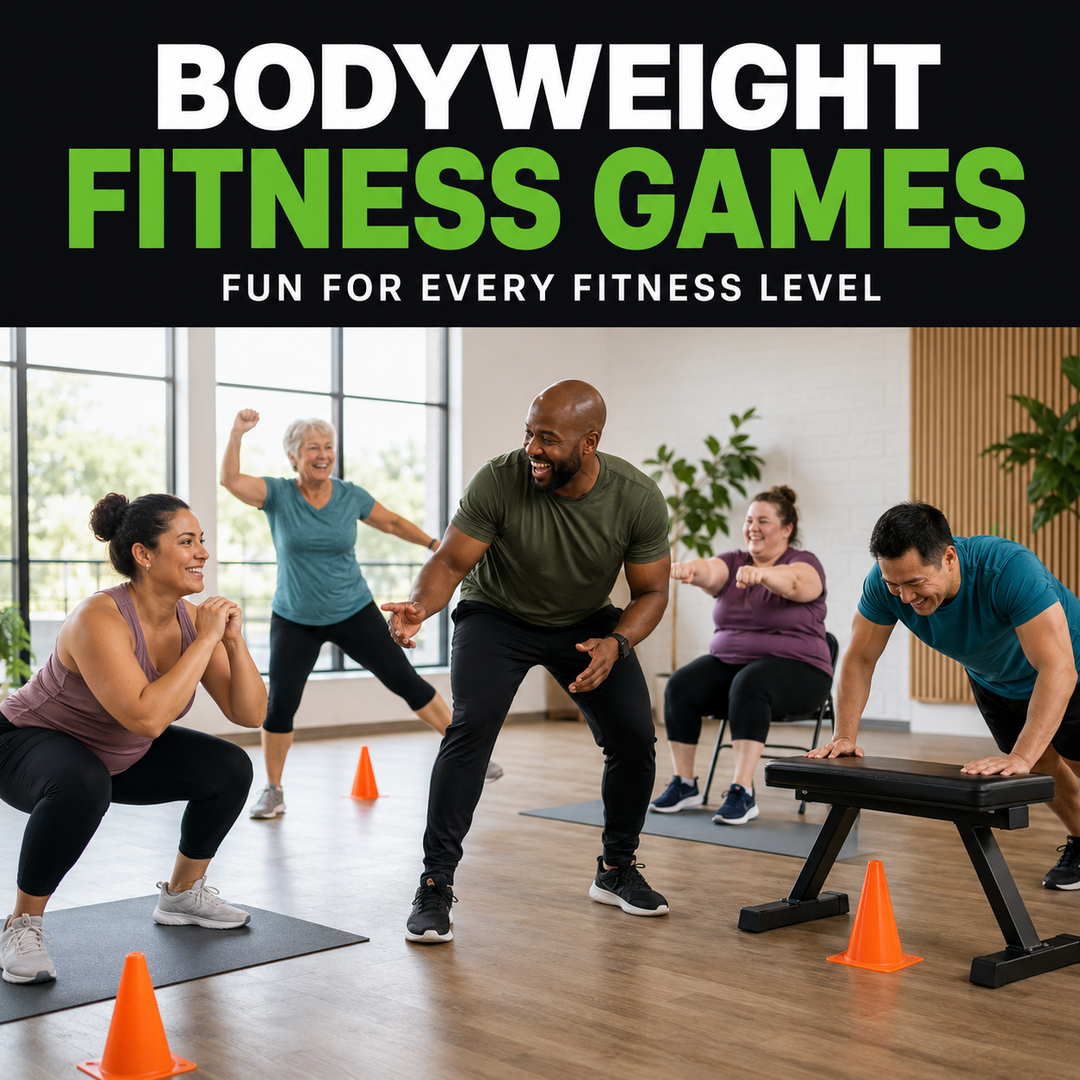
Bodyweight group fitness games turn familiar exercises into social, energizing challenges—without requiring a room full of equipment. The best games also let beginners, regular exercisers, and advanced participants train together without anyone feeling left behind.
This guide gives fitness instructors, bootcamp coaches, PE teachers, and group leaders 10 ready-to-run games. Each one includes simple rules, timing, coaching tips, and lower-impact or advanced options. Participants should choose movements that suit their ability, maintain good form, and stop if they feel pain, dizziness, or unusual shortness of breath.
Quick answer: What are the best bodyweight group fitness games?
Great options include Fitness Bingo, Four Corners, team AMRAPs, partner rep challenges, relays, movement scavenger hunts, beat-the-clock workouts, and BoardGains. Choose a game that matches your space and goal, demonstrate every movement, and offer a standing, seated or lower-impact option before the timer starts.
Table of contents
- Why bodyweight fitness games work
- Choose the right game
- How to coach mixed fitness levels
- 10 bodyweight group fitness games
- Bodyweight exercise modifications
- Ready-to-use 45-minute class plan
- Inclusion and safety tips
- Frequently asked questions
Why bodyweight fitness games work
A game gives a workout a clear objective, immediate feedback, and a reason to interact. Instead of silently counting repetitions, participants solve a challenge, collect points, support a partner, or work toward a team goal. That change can make a familiar circuit feel fresh.
Bodyweight games are especially practical because they can be used in a studio, gym, classroom, park, or workplace. You can scale the same game by changing the exercise, range of motion, work interval, or recovery—not by sorting people into “fit” and “unfit” groups.
- Low setup: many games need only a timer, cards, dice, cones, or paper.
- Flexible intensity: participants can choose a movement level while sharing the same goal.
- More connection: partner and team formats encourage communication and encouragement.
- Easy variety: changing the rules can refresh squats, presses, lunges, planks, and cardio drills.
- Broad skill development: instructors can emphasize strength, balance, mobility, coordination, or endurance.
Choose the right game for your class
| Game | Time | Group size | Equipment | Best for |
|---|---|---|---|---|
| 1. BoardGains | 15–45 min | 4+ | Game set | Complete class or main workout |
| 2. Fitness Bingo | 12–20 min | Any | Bingo cards | Choice and variety |
| 3. Roll-the-Dice | 10–18 min | 4–30 | Dice | Simple, unpredictable intervals |
| 4. Team AMRAP | 10–16 min | 6+ | Timer | Team endurance |
| 5. Partner Rep Challenge | 8–15 min | Pairs | None | Strength and cooperation |
| 6. Fitness Four Corners | 10–15 min | 8+ | 4 signs | Large groups |
| 7. Bodyweight Relay | 12–20 min | 8+ | Cones | Energy and teamwork |
| 8. Beat the Clock | 10–15 min | Any | Timer | Whole-group cooperation |
| 9. Movement Scavenger Hunt | 15–25 min | 6+ | Movement cards | Exploration and stations |
| 10. Rock-Paper-Scissors Fitness | 8–12 min | Pairs | None | Warm-up or finisher |
How to coach a mixed-level group
The fairest group workout is not the one in which everyone performs identical repetitions. It is the one in which everyone receives an appropriate challenge and can contribute. Use these rules before any game begins:
- Teach three options. Demonstrate a lower-impact or supported version, a standard version, and an advanced progression.
- Score effort or completion—not difficulty. A seated jack and a jumping jack should earn the same point when both match the participant’s selected level.
- Use time more often than fixed reps. A 30-second station lets participants work at their own sustainable pace.
- Keep teams small. Teams of three to five reduce waiting and give everyone a role.
- Remove penalties. Avoid punishment exercises, public rankings, and elimination. Use bonus choices, team targets, or personal bests instead.
- Normalize switching levels. Participants may change an exercise or take recovery at any point.
10 bodyweight group fitness games for every fitness level
1. BoardGains Fitness Game
Best for: a structured main workout, bootcamps, PE, team building, and classes that need variety
Equipment: a BoardGains game set
Time: 15–45 minutes
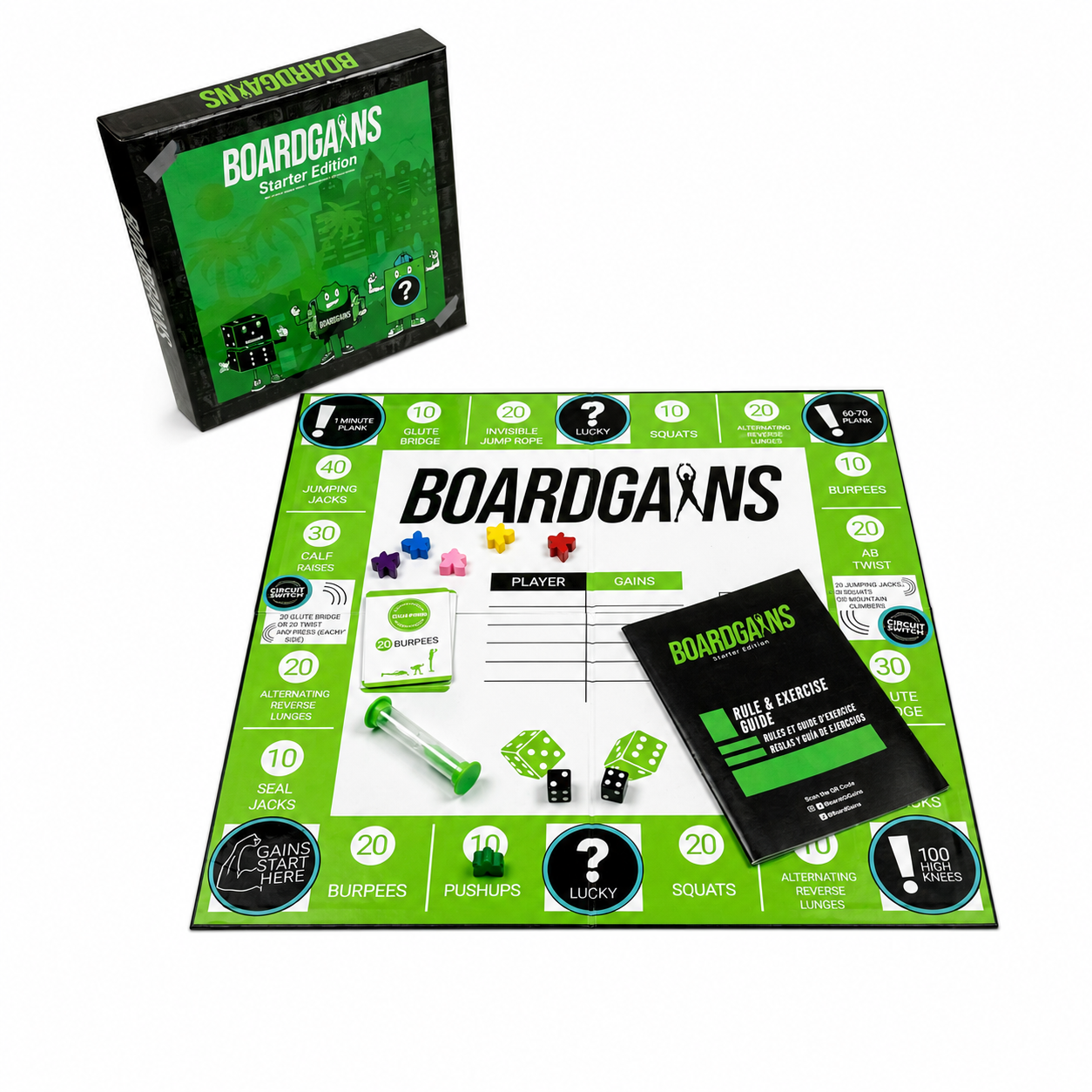
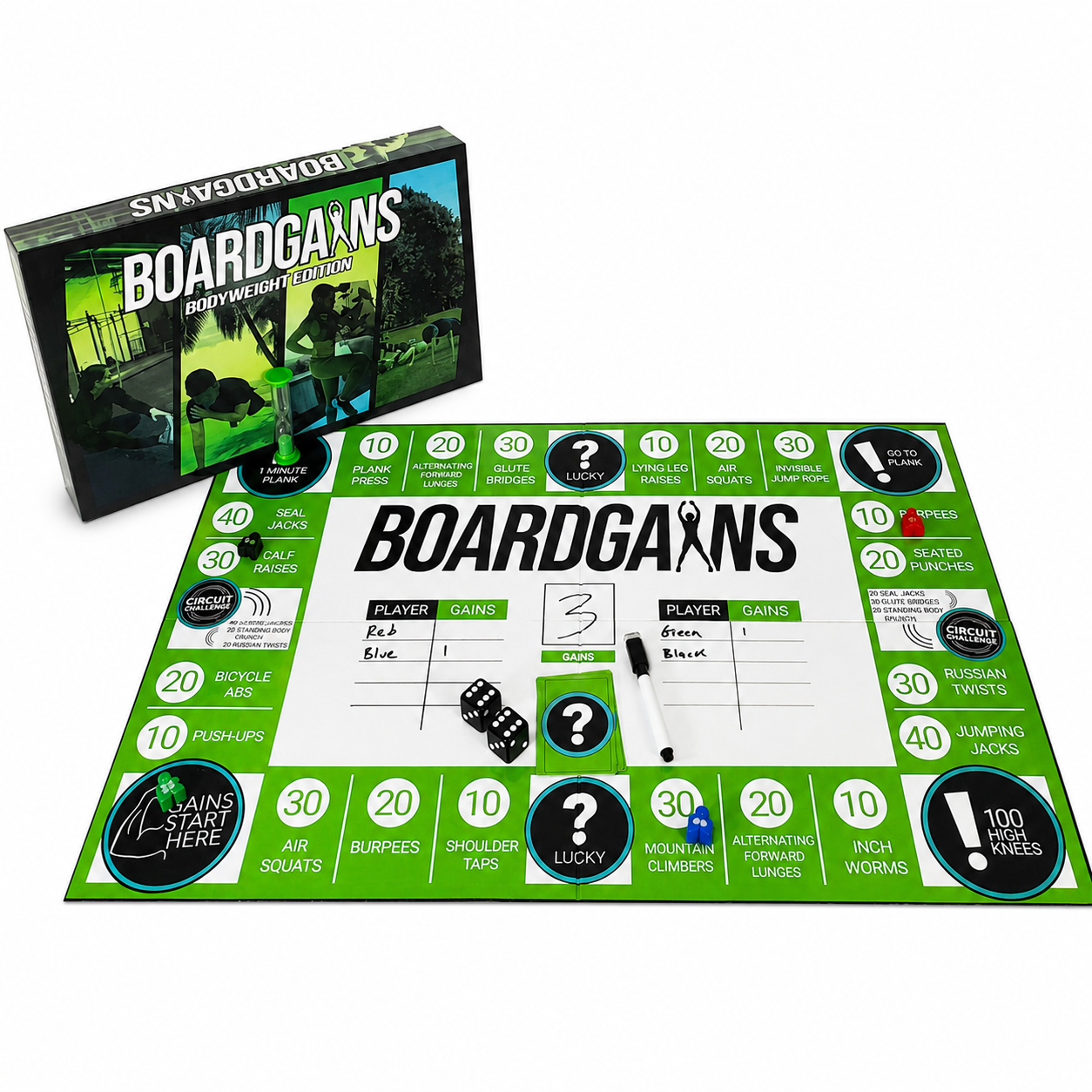
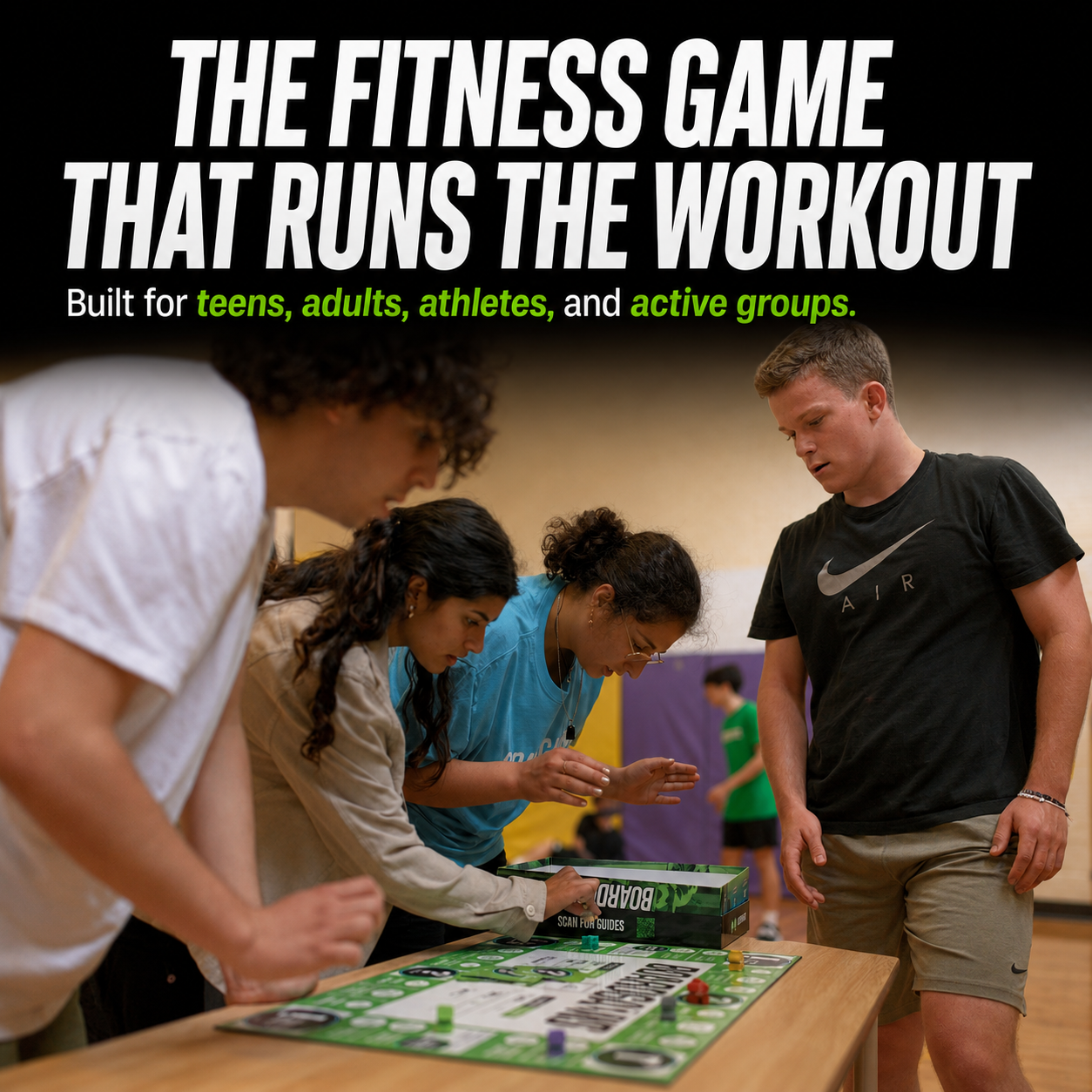
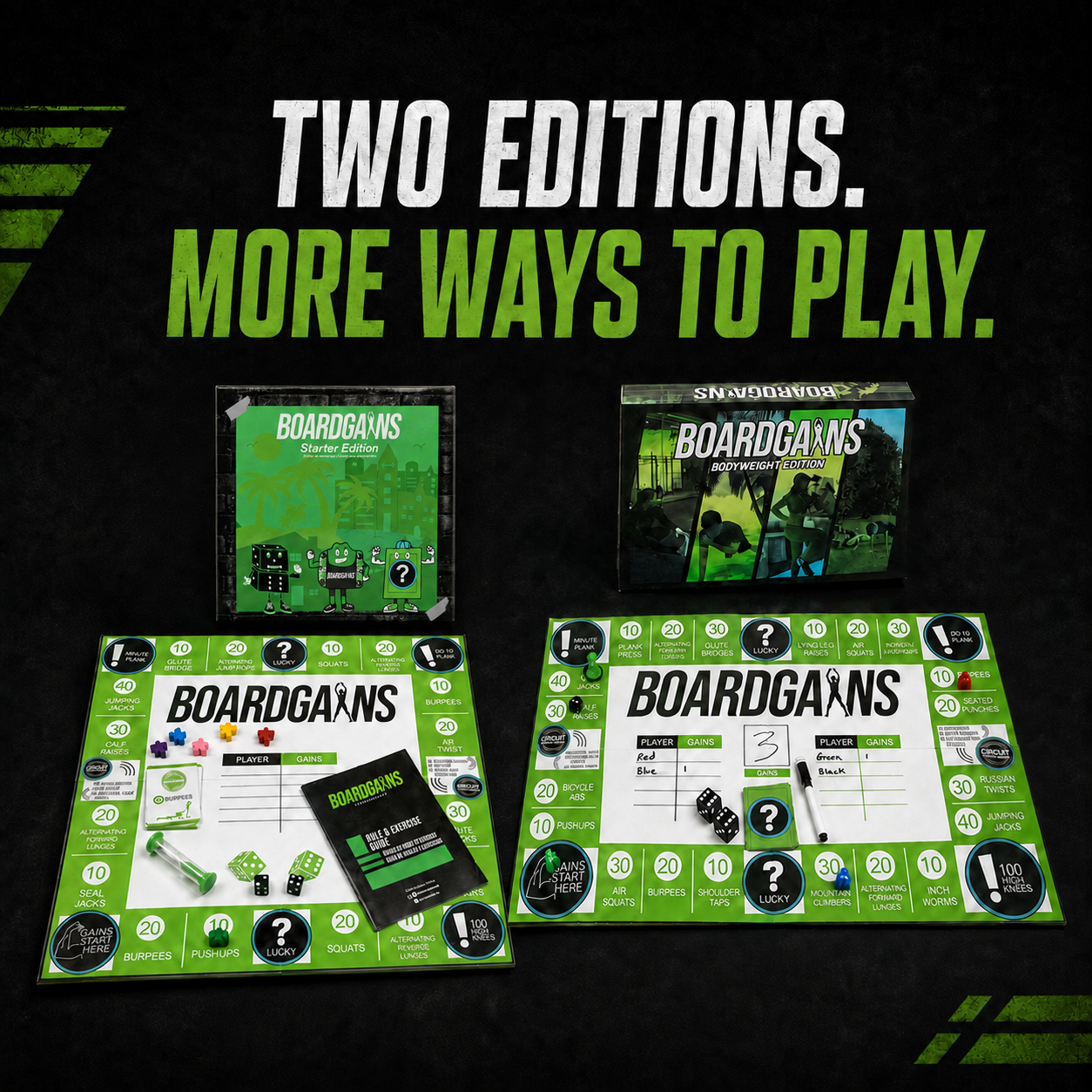
How to play: Divide the group into teams and place each team at the game board. Teams roll, move, and complete the bodyweight exercise shown. Every completed lap earns one Gain. Set a time limit and encourage teams to collect as many Gains as they can with controlled form.
Make it mixed-level: Before play, assign an accessible option to each exercise. For example, push-ups can be performed against a wall, on a bench, from the knees, or from the toes. Every valid version counts equally. The BoardGains group fitness format makes it easy to run the game as stations or team play.
Instructor tip: Use the first round as practice. Prioritize clean movement and communication before increasing pace. See the how-to-play guide for setup and rules.
2. Fitness Bingo
Best for: giving participants choice
Equipment: printed or handwritten bingo cards
Time: 12–20 minutes
How to play: Fill each square with a movement or short task: 30 seconds of squats, 20 marching knee drives, 10 wall push-ups, a balance hold, or a mobility drill. Participants complete squares in any order. The first goal can be one line; the class goal can be to complete the entire card together.
Make it mixed-level: Write the task in time rather than repetitions, or show two options in each square. Seated participants can use seated punches, knee extensions, heel taps, and overhead reaches.
Instructor tip: Ask participants to initial a partner’s square after completing a task together. This keeps the game social without making speed the only path to success.
3. Roll-the-Dice Workout
Best for: an easy-to-explain circuit
Equipment: one large die per group, or a digital die
Time: 10–18 minutes
How to play: Assign a movement to each number: 1 = squat, 2 = push-up, 3 = alternating reverse lunge, 4 = plank variation, 5 = step jack, and 6 = participant choice. One person rolls, then the group performs the movement for 30 seconds followed by 15 seconds of recovery. Rotate the roller every round.
Make it mixed-level: Display all exercise levels on a whiteboard. Participants choose their version after the roll, so the game stays shared while intensity remains individual.
Instructor tip: Dice should determine the movement, not an excessive rep count. Timed work is easier to scale and keeps the class together.
4. Team AMRAP
Best for: muscular endurance and team strategy
Equipment: timer and score sheet
Time: 10–16 minutes
How to play: Create teams of three or four. Give each team a simple round: 20 total squats, 20 total standing or seated punches per side, 12 total push-ups, and 20 total alternating knee drives. During a 10-minute AMRAP (as many quality rounds as possible), teammates divide the work however they choose.
Make it mixed-level: Count every approved variation equally and let teammates rotate whenever needed. One participant may contribute fewer repetitions in one movement and more in another.
Instructor tip: Score complete rounds plus extra repetitions, but celebrate communication, consistent form, and smart pacing as well as the total.
5. Partner Rep Challenge
Best for: cooperation and strength intervals
Equipment: none
Time: 8–15 minutes
How to play: Partners work toward a shared total, such as 40 squats, 30 push-up variations, and 40 alternating reverse lunges. Partner A works while Partner B counts and coaches, then they switch as often as they want.
Make it mixed-level: Partners do not need matching abilities. Each person selects an appropriate version and contributes manageable sets. If floor transitions are unsuitable, keep the entire round standing or seated.
Instructor tip: Pair by preferred pace or comfort—not appearance. Give participants the option to choose a partner or work solo toward half the team total.
6. Fitness Four Corners
Best for: large groups and limited equipment
Equipment: four exercise signs
Time: 10–15 minutes
How to play: Label the corners Strength, Cardio, Core, and Mobility. Participants travel safely to any corner and complete its movement for 40 seconds. Call “switch,” allow 20 seconds to move, and reveal a new exercise every two rounds.
Make it mixed-level: Give two choices at each corner. A Cardio corner might offer jumping jacks, step jacks, or seated jacks. Core might offer wall plank, incline plank, or floor plank.
Instructor tip: This does not need elimination. Award one class point when every participant visits all four corners, then try to earn three or four class points.
7. Bodyweight Relay
Best for: teamwork, agility, and high-energy classes
Equipment: cones or floor markers
Time: 12–20 minutes
How to play: Set up short lanes. One person from each team completes 20 seconds of a bodyweight movement, travels to a cone, returns, and tags the next teammate. Walking, rolling, or another safe travel method can replace running. Rotate through squats, step jacks, shadow boxing, and balance reaches.
Make it mixed-level: Use equal work intervals rather than equal distances. If space or mobility makes travel difficult, create an in-place relay in which the active participant performs the exercise while teammates recover.
Instructor tip: Run lanes in one direction, leave generous space, and make the goal a team completion rather than a high-speed race.
8. Beat-the-Clock Class Challenge
Best for: whole-group cooperation
Equipment: timer and whiteboard
Time: 10–15 minutes
How to play: Give the entire group a shared target, such as 300 total controlled repetitions across four exercises. Participants choose one exercise, complete a small set, report the number, and switch when desired. Stop the clock when the class reaches its target.
Make it mixed-level: Include standing, supported, floor, and seated choices. Smaller ranges of motion and low-impact variations count exactly the same. Adjust the class target after a practice round so it is challenging but realistic.
Instructor tip: Repeat the game later in the month and aim for smoother transitions or better form—not simply a faster time.
9. Movement Card Scavenger Hunt
Best for: stations, parks, gyms, and participants who enjoy exploration
Equipment: movement cards and optional cones
Time: 15–25 minutes
How to play: Place cards around the activity area. Teams find one card at a time, complete the exercise for 30–45 seconds, and record its symbol or color before locating another. Add a few recovery cards with breathing or mobility tasks.
Make it mixed-level: Put three movement options on every card. For example: chair squat, bodyweight squat, or squat with a three-second lowering phase. Participants choose independently.
Instructor tip: Do not hide cards in unsafe or inaccessible places. Keep travel routes visible, remove sprinting, and ensure every card can be reached by every participant.
10. Rock-Paper-Scissors Fitness
Best for: a lively warm-up or finisher
Equipment: none
Time: 8–12 minutes
How to play: Partners play rock-paper-scissors. Each result leads to a short movement: rock = 20 seconds of squats, paper = 20 seconds of step jacks, and scissors = 20 seconds of alternating knee drives. Both partners perform the movement, then find a new partner.
Make it mixed-level: Display standing and seated versions for all three outcomes. The result chooses the movement family; each participant chooses the variation.
Instructor tip: Nobody “loses” and nobody is eliminated. Both players move, reconnect, and begin the next round together.
Bodyweight exercise modification guide
Use this chart as a starting point. A modification is not an easier “punishment” version—it is a way to match the movement to the person and the purpose of the class.
| Movement | Supported or lower impact | Standard | Progression |
|---|---|---|---|
| Jumping jack | Seated jack or alternating step jack | Jumping jack | Faster controlled jack or seal jack |
| Push-up | Wall or high-bench push-up | Knee or toe push-up | Slow lowering or pause push-up |
| High knees | Seated knee lift or standing march | Quick high-knee march | High-knee run |
| Plank | Wall or bench plank | Knee or toe plank | Plank shoulder tap |
| Squat | Chair sit-to-stand or shallow squat | Bodyweight squat | Tempo, pause, or pulse squat |
| Lunge | Supported split stance or alternating toe tap | Reverse lunge | Knee-drive reverse lunge |
Ready-to-use 45-minute bodyweight game class
- 0–5 minutes: Welcome and readiness check. Explain the session, identify available supports, and remind participants that changing levels is encouraged.
- 5–11 minutes: Dynamic warm-up. March, step-touch, shoulder circles, hip hinges, shallow squats, and balance reaches.
- 11–19 minutes: Rock-Paper-Scissors Fitness. Use moderate-intensity options so participants learn the movement menu.
- 19–35 minutes: Main game. Play BoardGains, Team AMRAP, Fitness Bingo, or Four Corners. Use 30–40 seconds of work with clear transition time.
- 35–40 minutes: Beat-the-Clock finisher. Set a cooperative class target with one upper-body, one lower-body, one cardio, and one core option.
- 40–45 minutes: Cool-down. Gradually lower the pace, breathe comfortably, and use gentle mobility for the major areas trained.
For a 30-minute class, use a five-minute warm-up, one 16-minute main game, a four-minute cooperative finisher, and a five-minute cool-down.
Inclusion and safety tips for instructors
- Ask about relevant injuries, health concerns, and movement needs before class. Encourage participants to seek qualified medical advice when appropriate.
- Inspect the floor, benches, chairs, walls, and travel paths. Secure anything used for support.
- Demonstrate the purpose and key form cues for each movement before adding speed or competition.
- Build recovery into the rules. Water breaks and rest should never reduce a team’s score.
- Avoid long maximal holds, excessive high-impact repetitions, punishment exercises, and games that reward poor form.
- Use music and signals that allow everyone to hear instructions. Offer visual demonstrations as well as verbal cues.
- Keep the emphasis on personal effort, quality movement, teamwork, and enjoyment.
Frequently asked questions
What are bodyweight group fitness games?
They are structured activities that combine exercises such as squats, pushes, lunges, marches, and core work with game elements like teams, points, cards, dice, or shared challenges.
Do bodyweight fitness games require equipment?
Many require no exercise equipment. A timer, cones, paper cards, dice, or a purpose-built fitness game can improve organization and variety, but resistance machines and weights are not necessary.
How do I make one game work for beginners and advanced participants?
Give every movement a supported or low-impact option, a standard version, and a progression. Score all approved versions equally, and use timed intervals so each person can choose an appropriate pace.
How long should a group fitness game last?
A warm-up game may last 5–10 minutes, a main game 15–30 minutes, and a finisher 4–8 minutes. Explain and demonstrate the rules before starting the clock.
How many people can play?
Most games work with four participants to a full class. For groups larger than 20, create small teams or duplicate stations to reduce waiting and congestion.
What are good low-impact bodyweight game exercises?
Try step jacks, marching, chair sit-to-stands, wall push-ups, standing punches, heel raises, supported split stances, seated knee lifts, and wall planks.
How can I keep fitness games from becoming too competitive?
Use shared class targets, personal bests, random chance, and teamwork. Avoid elimination and punishment. Recognize communication, control, creativity, and encouragement—not only speed or total repetitions.
Can these games be used in PE or youth programs?
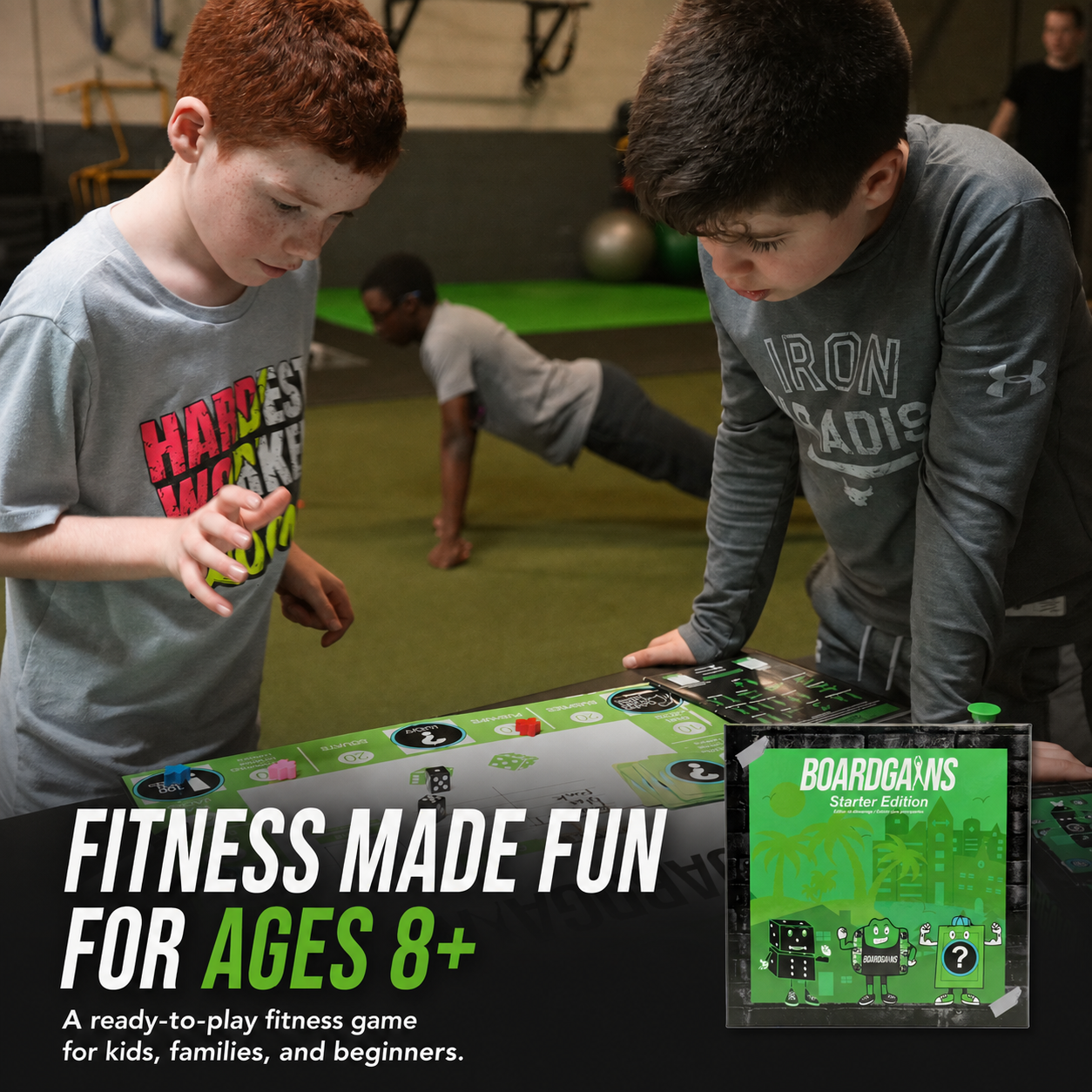
Yes, when movements, instructions, space, supervision, and session length are appropriate for the participants. Keep rules simple, use inclusive scoring, and emphasize skill development and enjoyment.
Make your next group workout easier to run
A strong fitness game has simple rules, flexible movements, short transitions, and a goal that keeps everyone involved. Start with one game, teach the movement options clearly, and adjust the next round based on what you observe.
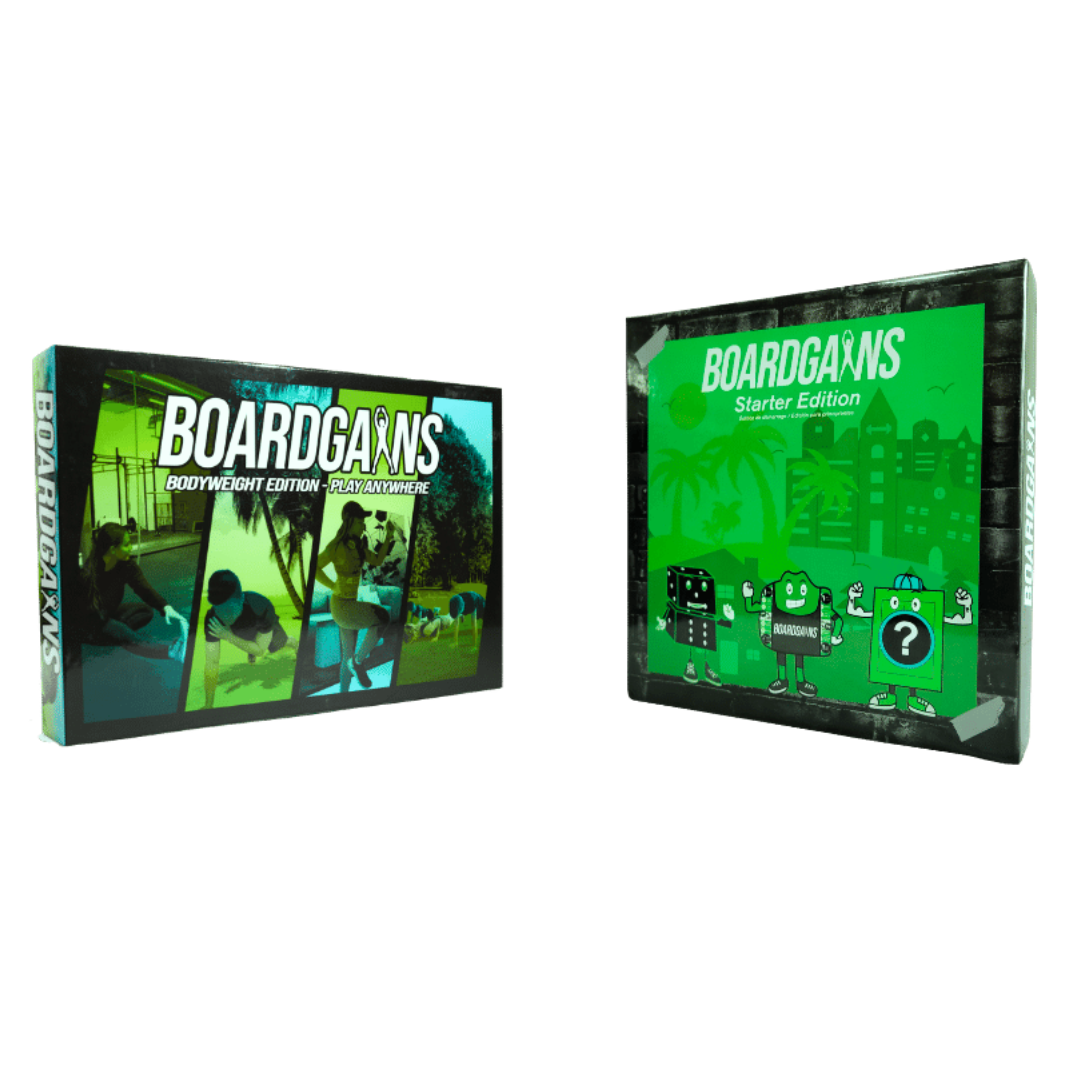
If you want a ready-to-play format instead of creating cards and rules from scratch, explore BoardGains for group fitness and bootcamps. The game combines bodyweight exercise, team strategy, and simple roll-and-move play so participants can move, connect, and collect Gains together.
About the author: Eric Mathura is the creator of BoardGains. He holds a BSc in Kinesiology and has more than 10 years of experience as a personal trainer and group fitness instructor. He created BoardGains to make movement more social, accessible, and fun.

Leave a comment
This site is protected by hCaptcha and the hCaptcha Privacy Policy and Terms of Service apply.