
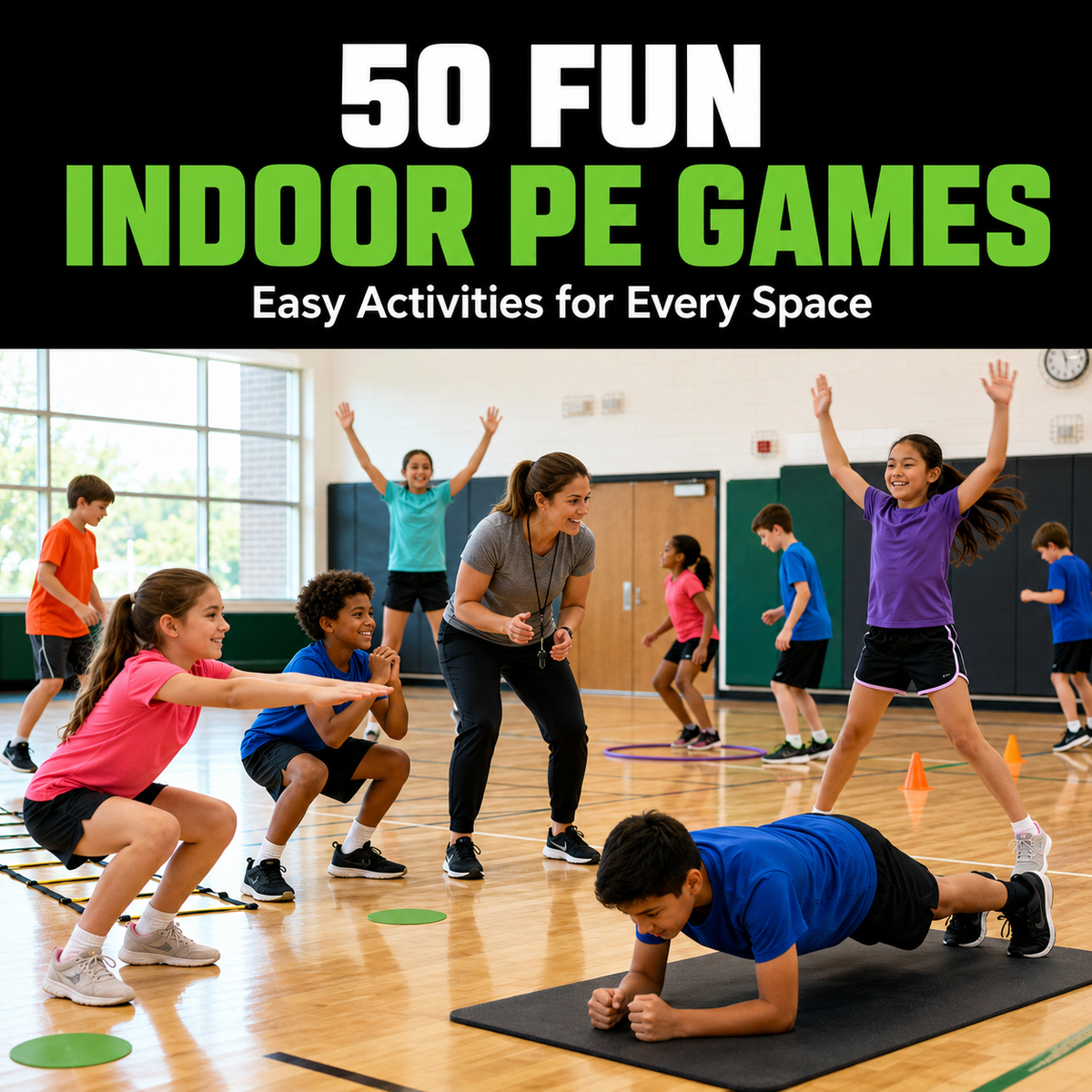
Rain, snow, extreme heat, or limited gym space can quickly change your PE plans. The good news? Students can still enjoy an active, exciting class indoors.
This guide includes 50 fun indoor PE games for elementary and middle school students. You’ll find no-equipment activities, small-space games, team challenges, fitness games, and low-prep ideas.
Each activity includes simple instructions, equipment needs, safety notes, easy adjustments, and inclusive options. Whether you have a full gym, a small classroom, or only 20 minutes, you can find a game that gets everyone moving.
Want a ready-to-use plan for introducing BoardGains in PE?
Get exercise teaching cues, team setup ideas, lesson plans, modifications, reflection prompts, and assessment tools in the free BoardGains PE Implementation Guide.
Choose an Indoor PE Game
| What You Need | Games to Try |
|---|---|
| No equipment | Freeze Dance, Animal Walks, Simon Says Fitness, Mirror Movement |
| Small space | Fitness Dice, Fitness Bingo, Card Deck Fitness, Fitness Trivia |
| Large classes | BoardGains, Relay Stations, Capture the Cones, Parachute Games |
| Teamwork | Hula Hoop Pass, Tunnel Ball, Passing Frenzy, Tic-Tac-Toe Relay |
| Elementary students | Four Corners, Balloon Volleyball, Hot Lava, Red Light, Green Light |
| Middle school students | Shuttle Run Challenge, Crab Soccer, Fitness Dice Tag, High Five Circuit |
| Low-impact options | Yoga Flow, Mirror Movement, Target Toss, Balloon Balance Race |
50 Indoor PE Games
- Games 1–10: Easy Indoor PE Games
- Games 11–20: Relay and Movement Games
- Games 21–30: Small-Space and Team Games
- Games 31–40: Fitness and Skill Challenges
- Games 41–50: Low-Prep Indoor PE Activities
Teacher note: Check your space, equipment, school rules, and student needs before starting. Demonstrate unfamiliar movements and offer different challenge levels so everyone can participate safely.
Games 1–10: Easy Indoor PE Games
1. Four Corners
Best for: Grades 2–6 | Equipment: Four signs or cones | Space: Classroom or gym
How to play: Label each corner with a number or colour. One student stands in the middle with their eyes closed while everyone quietly moves to a corner. The middle player calls a corner. Students there complete a quick movement challenge before the next round. Nobody has to sit out.
Adjust it: Use walking, side steps, or animal movements. Show colour cards for students who benefit from visual instructions. Keep pathways clear and require controlled movement.
2. Fitness Dice
Best for: Grades 2–8 | Equipment: Foam dice | Space: Small or large
How to play: Assign an exercise to each number on one die. Roll a second die for repetitions or time. Everyone completes the result together before the next roll.
Adjust it: Offer two movement choices, such as squats or sit-to-stands. Use fewer repetitions for beginners and let students take turns rolling. Review each exercise first.
3. Snowball Relay
Best for: Grades K–5 | Equipment: Paper balls and spoons | Space: Gym
How to play: Teams carry a crumpled-paper “snowball” on a spoon to a marker and back. If it falls, the player picks it up and continues from that spot before handing it to the next teammate.
Adjust it: Walk instead of run, add a zigzag path for older students, or carry the snowball by hand. Create several short lanes to reduce waiting.
4. Freeze Dance
Best for: Grades K–6 | Equipment: Music | Space: Any clear area
How to play: Students dance while the music plays and freeze when it stops. Instead of eliminating anyone who moves, call a quick balance pose or movement before restarting the music.
Adjust it: Use themes such as robot, athlete, or animal movements. Include seated dance choices and remind students to stay in their personal space.
5. Indoor Obstacle Course
Best for: Grades K–8 | Equipment: Cones, hoops, tape, or mats | Space: Gym
How to play: Build a course with safe actions such as stepping over tape lines, weaving around cones, balancing, crawling, and target tossing. Students begin at spaced intervals.
Adjust it: Create easy and advanced routes. Allow students to roll, walk, or use a partner for support. Secure equipment and demonstrate every station before starting.
6. Animal Walks
Best for: Grades K–5 | Equipment: None | Space: Classroom or gym
How to play: Call an animal and have students copy its movement. Try a bear crawl, crab walk, frog step, penguin walk, or bird flap.
Adjust it: Use short distances and slow, controlled movements. Students can perform seated animal actions with their arms and upper body. Avoid any movement that causes wrist, shoulder, or knee discomfort.
7. Indoor Bowling
Best for: Grades K–8 | Equipment: Foam balls and pins or bottles | Space: Small or large
How to play: Students roll a soft ball toward pins. Award points for each pin knocked down, then reset and rotate.
Adjust it: Change the rolling distance, ball size, or number of pins. Students may roll from a seated position. Use separate lanes and only retrieve balls when the teacher gives the signal.
8. Balloon Volleyball
Best for: Grades K–6 | Equipment: Balloon or beach ball and a rope | Space: Classroom or gym
How to play: Teams tap a balloon over a low rope and try to keep it off the floor. Allow multiple touches so more students can join each rally.
Adjust it: Use a beach ball where balloons are not permitted, allow a catch before passing, or play seated. Check for latex restrictions and keep the area clear of sharp objects.
9. Hula Hoop Pass
Best for: Grades 2–8 | Equipment: Hula hoops | Space: Gym
How to play: Students form a circle and hold hands. They move a hoop around the circle by stepping and ducking through it without breaking the chain.
Adjust it: Add a second hoop, challenge the group to improve its time, or let students use verbal directions and pass the hoop hand-to-hand when needed. Remind everyone not to pull on each other.
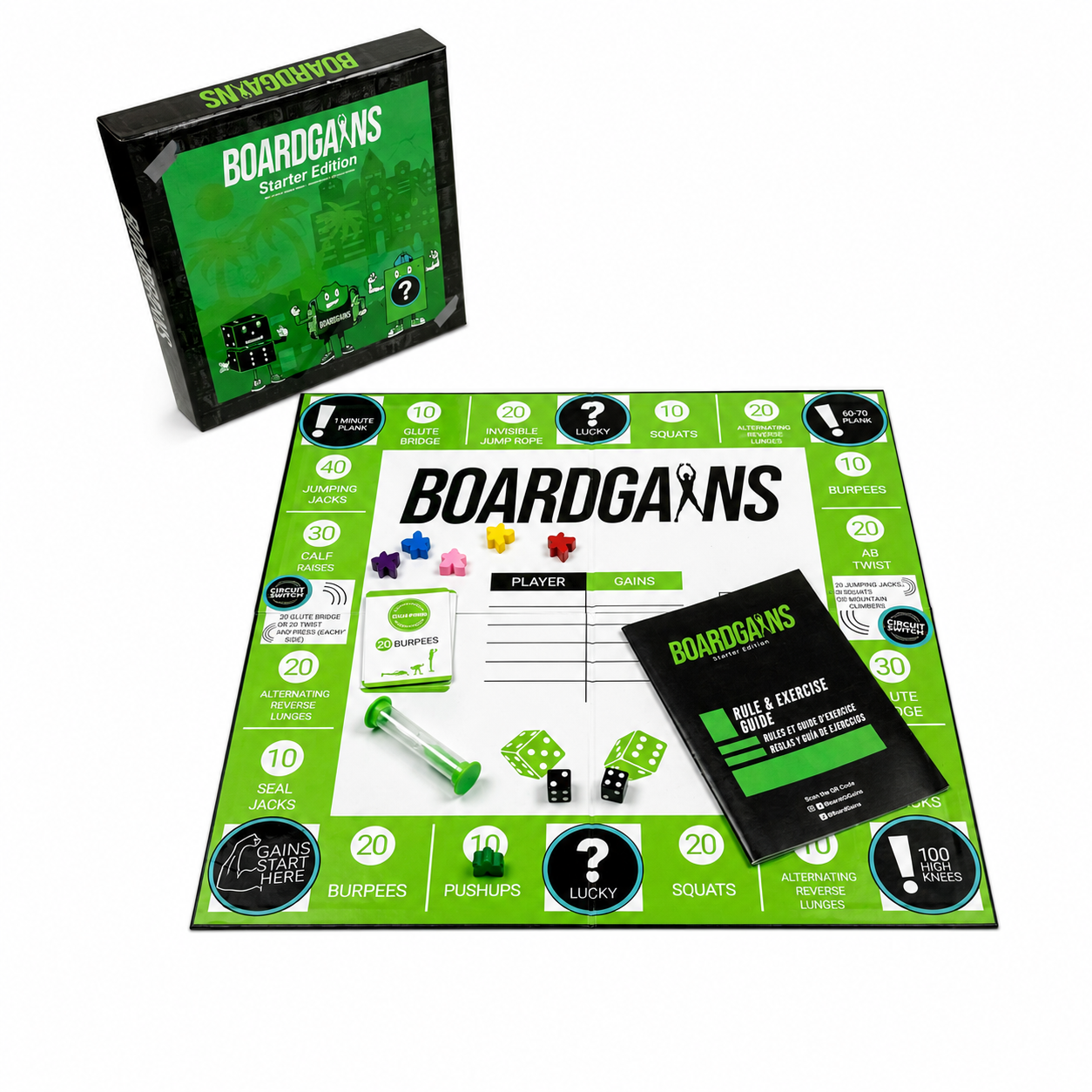
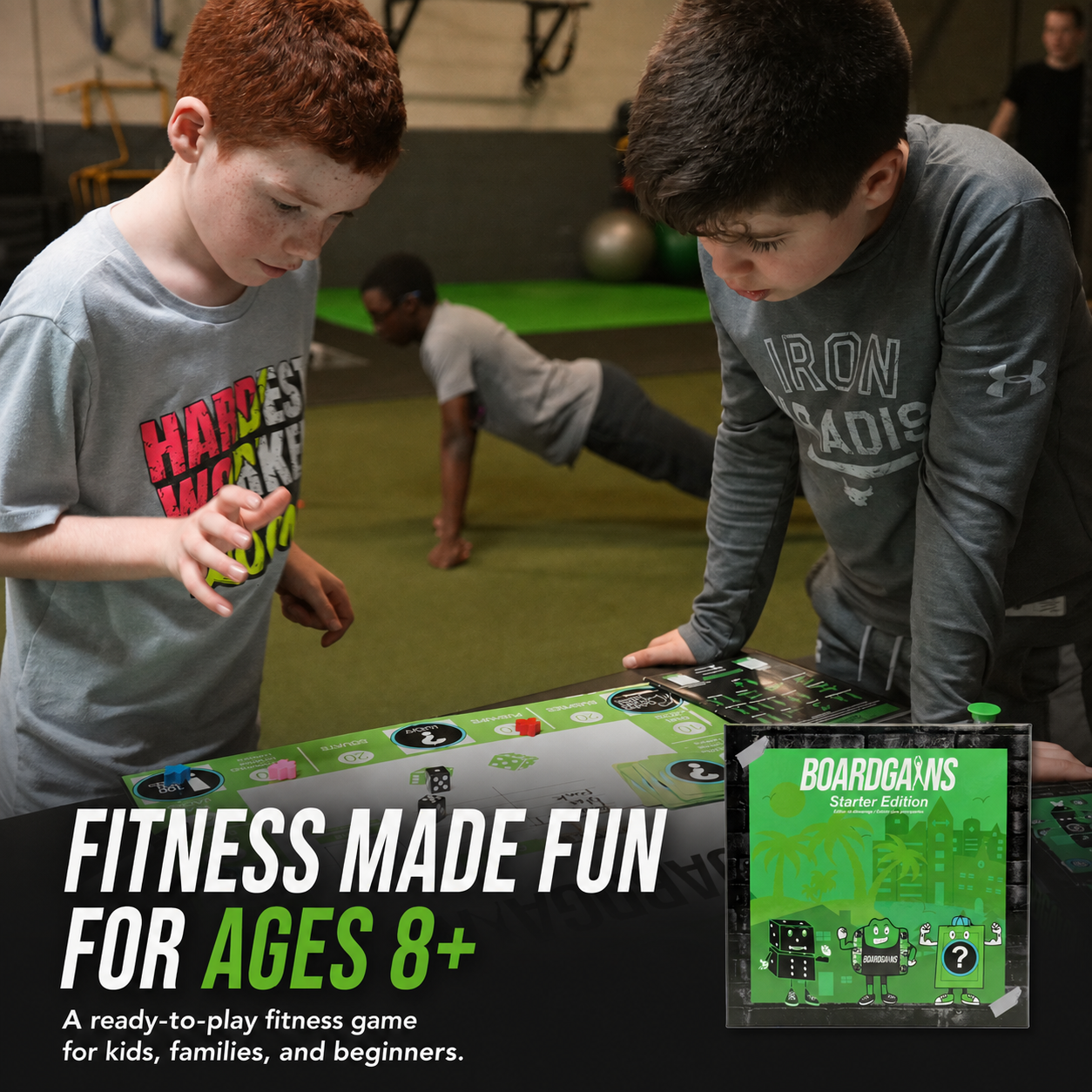
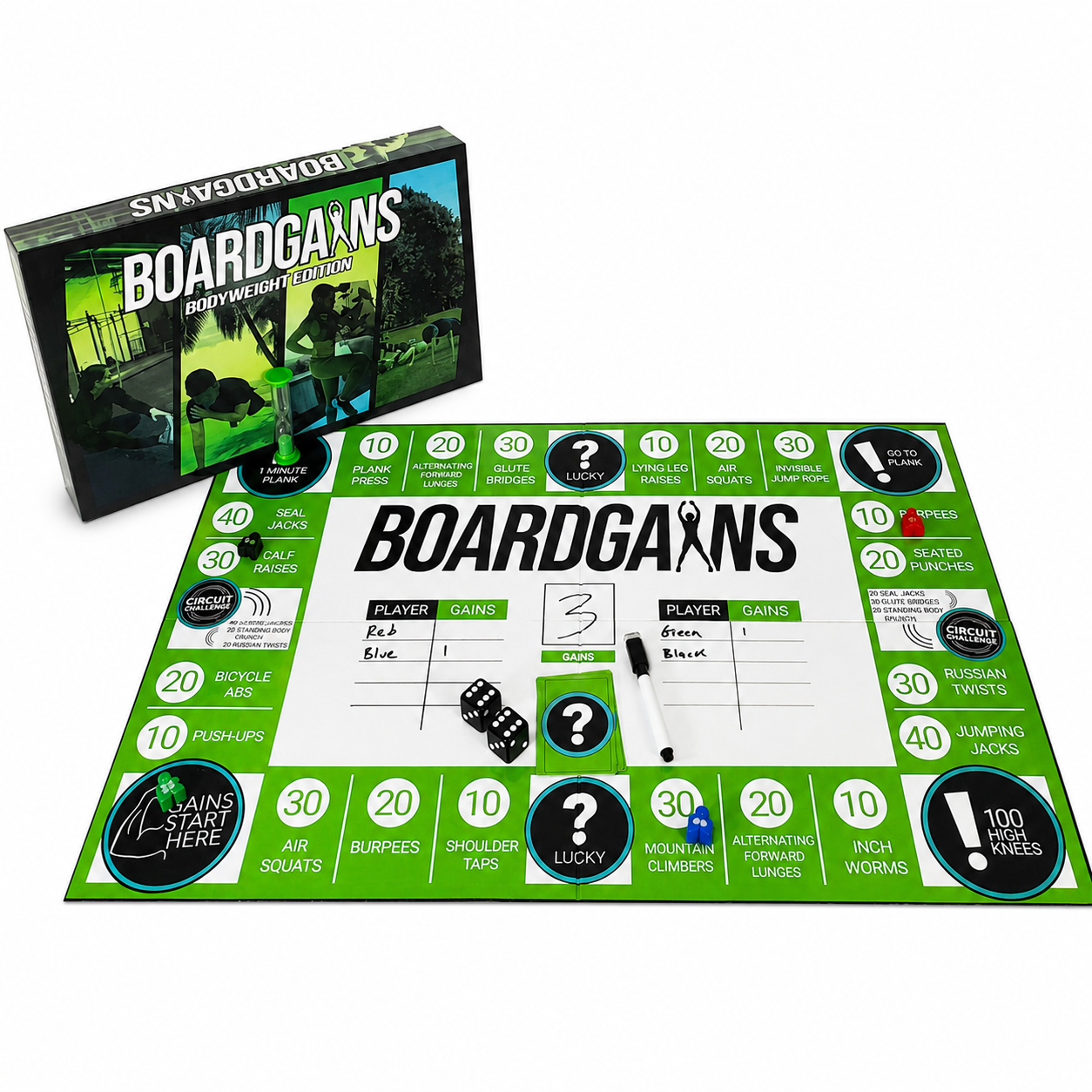
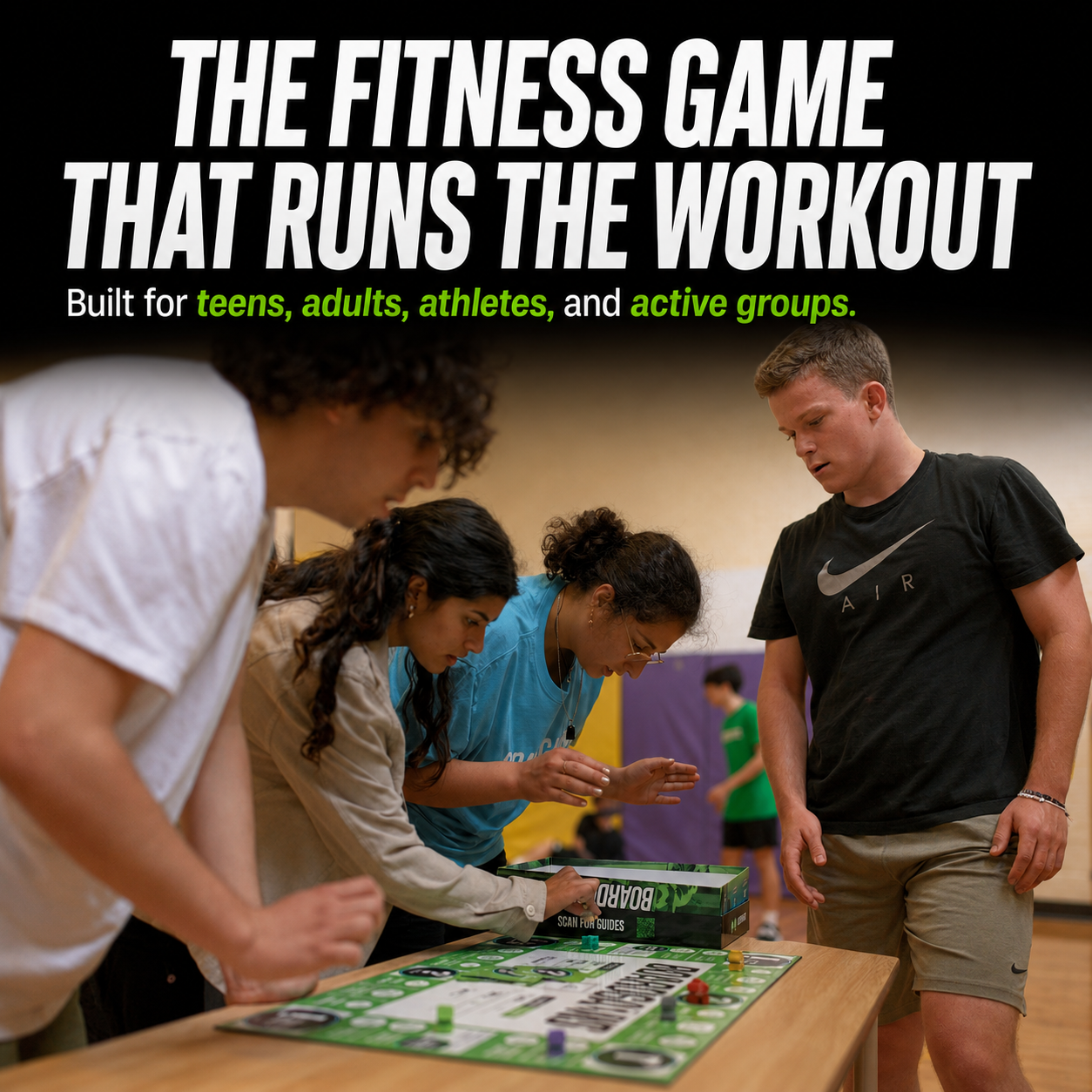
10. BoardGains Fitness Board Game
Best for: Grades 3–12, teams, and large groups | Equipment: BoardGains game set | Space: Classroom, gym, fitness room, or multipurpose space
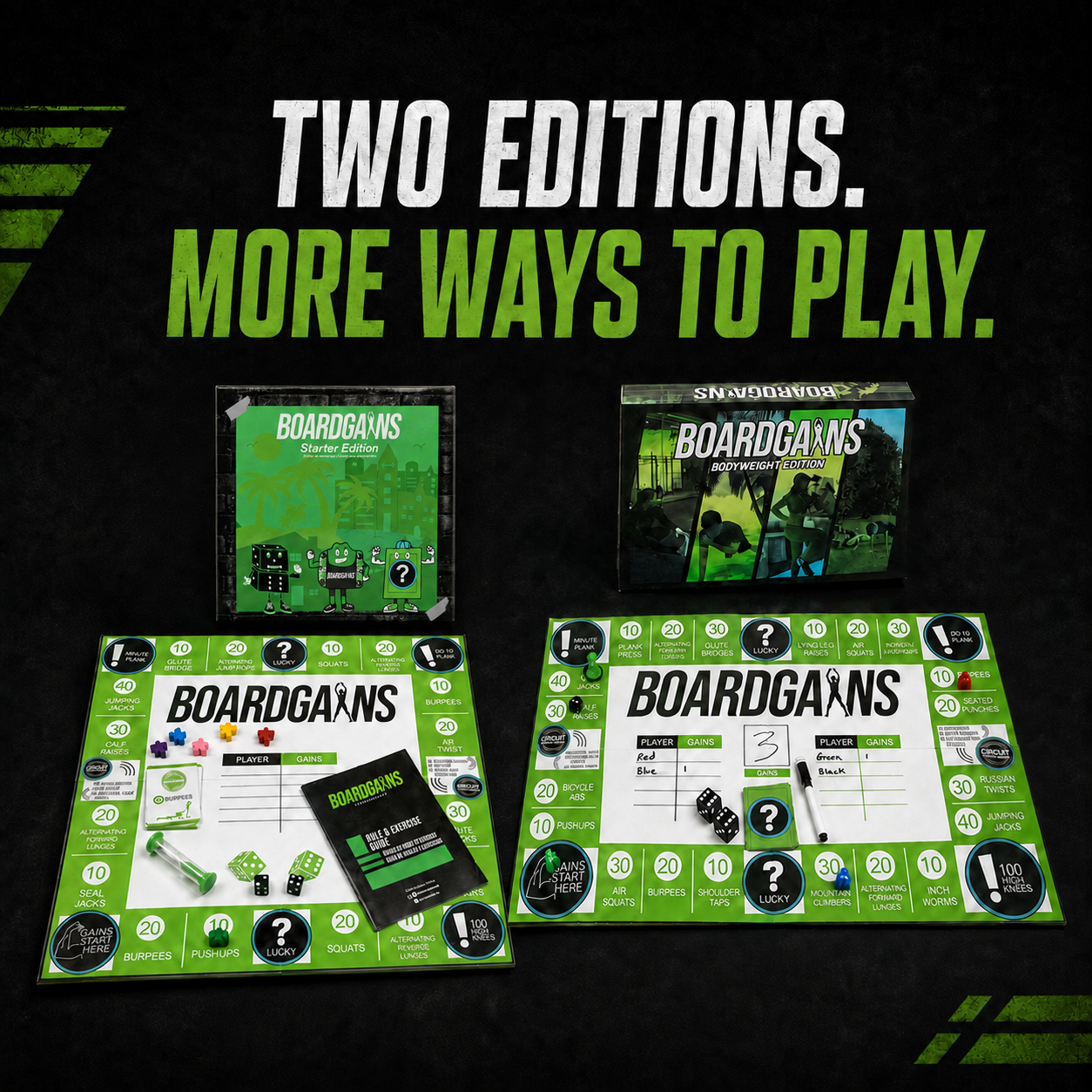
How to play: Set a Gains Goal based on the available class time. Each lap around the board equals one Gain. Players or teams roll the dice, move their game piece, and complete the bodyweight exercise they land on. Everyone plays at the same time. The first player or team to reach the Gains Goal wins.
Why it works for indoor PE: The board guides the workout while the teacher coaches the class. Students stay active without waiting for individual turns, and every exercise uses bodyweight only.
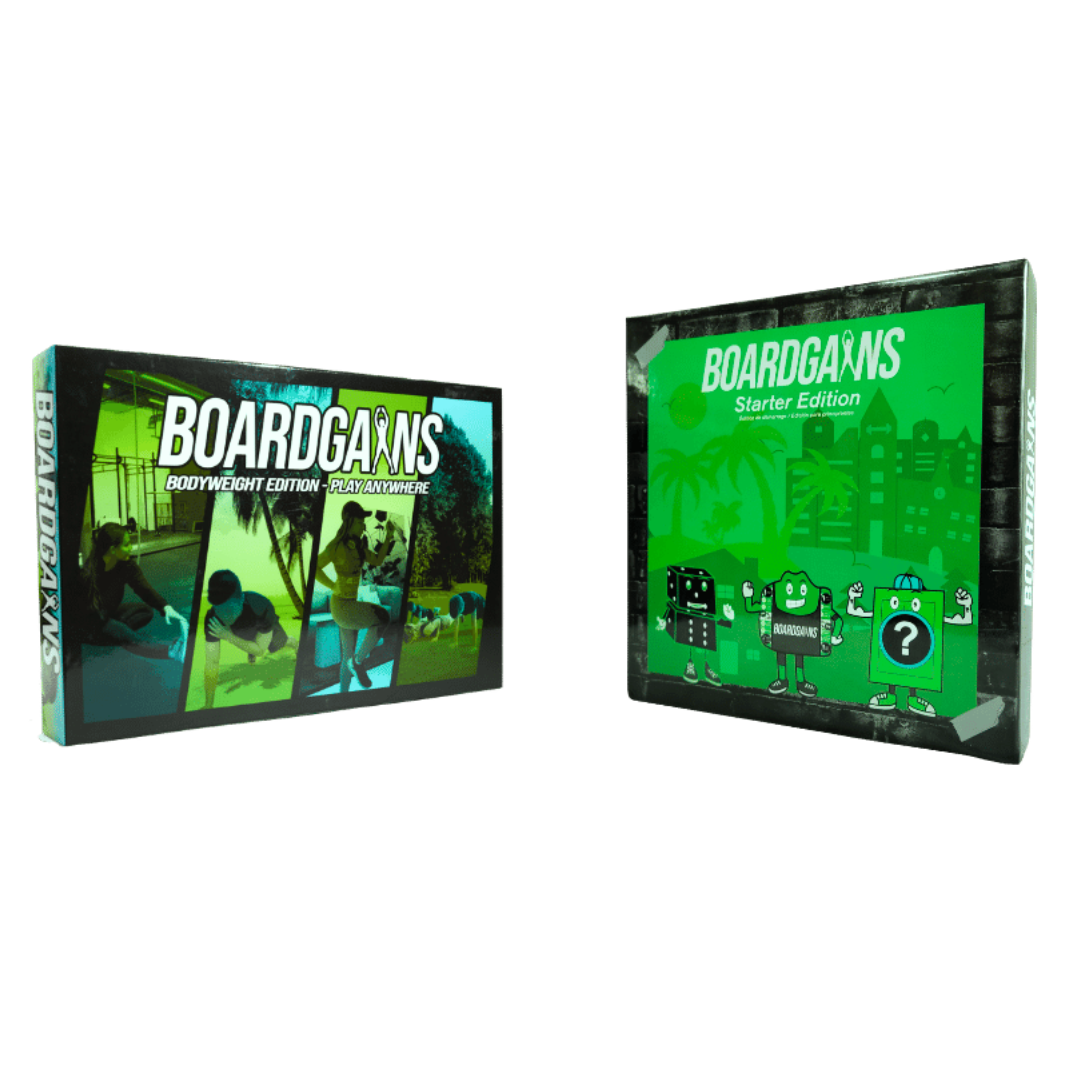
- Use the Starter Edition for younger students and beginners.
- Use the Pro Edition for older students and more exercise variety.
- Adjust repetitions, exercise options, or the Gains Goal.
- Place students into teams when working with a large class.
- Review exercises first and provide lower-impact, seated, or reduced-range options when needed.
Skills developed: Cardiovascular fitness, muscular endurance, teamwork, decision-making, and social interaction.
See How BoardGains Works → | View Starter → | View Pro →
Games 11–20: Relay and Movement Games
11. Cone Flip Relay
Best for: Grades 2–8 | Equipment: Cones | Space: Gym
How to play: Place cones at the far end of several lanes. One player from each team travels to a cone, flips it, returns, and tags the next teammate.
Adjust it: Change the travel skill to walking, skipping, or side stepping. Use more lanes or have several teammates moving at once to reduce waiting. Keep cones and lanes well spaced.
12. Shuttle Run Challenge
Best for: Grades 4–12 | Equipment: Cones | Space: Gym
How to play: Set markers at each end of a lane. Students travel back and forth, touching each line as many times as possible during a short interval.
Adjust it: Use walking, jogging, skipping, or wheelchair propulsion. Focus on personal improvement instead of ranking students. Leave enough room for safe turns.
13. Tunnel Ball
Best for: Grades 2–8 | Equipment: Soft balls | Space: Gym
How to play: Teams form lines with space between players. The first person rolls a ball through the “tunnel” created by everyone’s legs. The last person collects it, moves to the front, and repeats.
Adjust it: Pass overhead or along one side instead. Seated teams can pass or roll the ball along their line. Use several small teams to increase participation.
14. Musical Spots Fitness
Best for: Grades K–6 | Equipment: Music and floor markers | Space: Classroom or gym
How to play: Place enough spots for everyone. Students move while music plays and find a spot when it stops. Call a movement for everyone to complete before the next round.
Adjust it: Share spots in pairs, use different travel skills, or perform seated actions. Keep every student in the game instead of removing spots or players.
15. Balloon Tap Fitness
Best for: Grades K–6 | Equipment: Balloons or beach balls | Space: Small or large
How to play: Students keep a balloon in the air while completing teacher-called movements between taps. The goal is to work together and build the longest streak.
Adjust it: Use two hands, allow a bounce, pair students, or play seated. Use beach balls if balloons are restricted or latex sensitivities are present.
16. Target Toss
Best for: Grades K–8 | Equipment: Beanbags, hoops, or buckets | Space: Any
How to play: Set targets at different distances and give each one a point value. Students throw soft objects from behind a marked line and add their scores.
Adjust it: Move targets closer, change their size, or use underhand and overhand rounds. Students may toss from seated or standing positions. Retrieve objects only on the signal.
17. Simon Says Fitness
Best for: Grades K–6 | Equipment: None | Space: Any
How to play: The leader calls movement instructions. Students follow only when the command starts with “Simon says.” Keep everyone playing even after a mistake.
Adjust it: Use picture cards, let students lead, or offer standing and seated versions. Choose simple movements that fit the available space.
18. Frog Leap Relay
Best for: Grades 2–6 | Equipment: Cones or floor markers | Space: Gym
How to play: Teams move between two lines using controlled frog jumps or low frog steps, then tag the next teammate.
Adjust it: Replace jumping with squat-and-reach movements or short steps. Use soft landings, short distances, and enough recovery time to protect knees and maintain good form.
19. Mirror Movement
Best for: Grades K–12 | Equipment: None | Space: Classroom or gym
How to play: Partners face each other. One leads slow movements while the other copies like a mirror. Switch leaders after 30–60 seconds.
Adjust it: Add short movement sequences, change levels, or use seated upper-body actions. Keep movements slow and give each pair a clear personal space.
20. Jump Rope Challenge
Best for: Grades 2–12 | Equipment: Jump ropes | Space: Gym
How to play: Students practise basic jumps, alternating feet, or timed personal challenges. Encourage them to improve their own score.
Adjust it: Use an invisible rope, step over a rope on the floor, or turn a rope with a partner. Give every jumper enough space and use a non-slip surface.
Games 21–30: Small-Space and Team Games
21. Speed Stack Challenge
Best for: Grades 2–12 | Equipment: Stacking cups | Space: Classroom or gym
How to play: Students build and take down cup formations as quickly and accurately as possible. Use individual stations or partner relays.
Adjust it: Start with smaller stacks, add a movement between rounds, or challenge students to beat their own time. This activity works well seated.
22. Shadow Tag
Best for: Grades 2–6 | Equipment: Strong indoor lighting | Space: Open gym
How to play: One student tries to gently step on another player’s shadow rather than touching their body. Switch taggers often.
Adjust it: Use walking only, create small groups, or replace shadows with floor spots when lighting is limited. Keep the area clear and avoid crowded play.
23. Indoor Scavenger Hunt
Best for: Grades K–8 | Equipment: Clue or movement cards | Space: Classroom or gym
How to play: Hide cards around the room. Students find a card, complete its movement or solve its clue, and continue to the next location.
Adjust it: Play in teams, use picture clues, or let one student search while a partner completes the movement. Hide cards only in safe, visible, accessible places.
24. Parachute Games
Best for: Grades K–6 | Equipment: Activity parachute and soft balls | Space: Gym
How to play: Students hold the parachute edge and work together to create waves, lift and lower it, or keep soft balls moving on top.
Adjust it: Add colour-based position changes or teamwork challenges. Students can participate standing or seated. Use secure grips and controlled motions rather than hard pulling.
25. Hoop Hop Showdown
Best for: Grades 3–8 | Equipment: Hula hoops | Space: Gym
How to play: Lay hoops in a path. One player from each team travels from opposite ends. When they meet, they play rock-paper-scissors; the winner continues and the other team sends a new player.
Adjust it: Step instead of hop, use floor spots, or make a wider path. Stress soft landings, patience, and safe spacing.
Turn These Ideas Into Complete PE Lessons
The free PE Implementation Guide shows you how to teach exercises, organize teams and workout zones, introduce BoardGains, and build lessons for different ages and abilities.
26. Silent Speed Ball
Best for: Grades 3–12 | Equipment: Soft foam ball | Space: Classroom or gym
How to play: Players form a circle and pass a ball without speaking. Set a goal for completed passes or challenge the group to improve its best time.
Adjust it: Add a second ball, allow one bounce, or use seated passing. If a pass is dropped, simply restart the count so nobody sits out.
27. Fitness Bingo
Best for: Grades 2–12 | Equipment: Fitness bingo cards | Space: Any
How to play: Students complete the movement in a square and mark it. The goal may be one line, four corners, or the full card.
Adjust it: Use pairs, picture-based cards, or choice squares with two movement levels. Demonstrate all exercises and focus on quality rather than rushing.
28. Hot Lava Game
Best for: Grades K–5 | Equipment: Non-slip mats, hoops, or floor spots | Space: Gym
How to play: Create “islands” that students travel between without touching the surrounding “lava.” Call different travel skills or team challenges.
Adjust it: Place islands closer, allow partner support, or use a rolling pathway for mobility devices. Secure every surface and do not encourage long or unsafe jumps.
29. Tug of War
Best for: Grades 5–12 | Equipment: Tug-of-war rope and floor markers | Space: Large gym
How to play: Balanced teams hold opposite sides of a rope and pull steadily to move the centre marker across a line.
Adjust it: Use smaller teams or short rounds. Check school rules first, inspect the rope, use a non-slip floor, keep the rope away from necks and waists, and teach students never to wrap it around their hands.
30. Red Light, Green Light Fitness
Best for: Grades K–6 | Equipment: None | Space: Classroom or gym
How to play: Students move on “green light” and freeze on “red light.” Add “yellow light” for slow motion and other colours for teacher-selected movements.
Adjust it: Use walking, rolling, marching, or seated movements. If someone moves on red, have them freeze and continue rather than returning to the start.
Games 31–40: Fitness and Skill Challenges
31. Wall Ball Challenge
Best for: Grades 4–12 | Equipment: Soft balls | Space: Gym wall
How to play: Students toss a soft ball against a wall and catch it. Add a clap, switch hands, or complete a movement before the catch.
Adjust it: Move closer, allow a bounce, or use partner wall passes. Mark separate stations and confirm that the wall area is approved for throwing.
32. Plank High-Five Challenge
Best for: Grades 5–12 | Equipment: Mats | Space: Small or large
How to play: Partners face each other in a plank and alternate gentle high-fives for a short interval while maintaining control.
Adjust it: Use knees-down planks, elevated planks against a bench, or seated cross-body reaches. Keep rounds short and stop if wrists, shoulders, or the lower back feel uncomfortable.
33. Balloon Keep-Up
Best for: Grades K–8 | Equipment: Balloons or beach balls | Space: Any
How to play: Students keep a balloon in the air using teacher-called body parts, such as hands, elbows, or knees.
Adjust it: Work individually or in teams, allow a bounce, or play seated. Use beach balls if balloons are not allowed and create safe personal spaces.
34. Crab Soccer
Best for: Grades 4–8 | Equipment: Beach ball and cones | Space: Gym
How to play: Small teams move in a crab position and guide a beach ball toward a cone goal using their feet.
Adjust it: Use short rounds, larger goals, or seated ball passing. Offer another movement for students with wrist or shoulder discomfort and keep players spaced around the ball.
35. Passing Frenzy
Best for: Grades 3–12 | Equipment: Soft balls | Space: Classroom or gym
How to play: Teams pass a ball around a circle and count successful passes during a set time. Try to improve the team score each round.
Adjust it: Add a second ball, require bounce passes, or change direction. Use seated passing and select a ball that everyone can control safely.
36. Bear Crawl Tag
Best for: Grades 3–8 | Equipment: Cones | Space: Open gym
How to play: In a small marked area, one player bear-crawls and tries to tag others who are also moving slowly in a bear crawl. Rotate the tagger every 30 seconds.
Adjust it: Use a hands-and-knees crawl, walking tag, or seated foam-ball tag. Keep rounds short and avoid fast movements that strain wrists or cause collisions.
37. Relay Stations
Best for: Grades 3–12 | Equipment: Cones, signs, and optional mats | Space: Gym
How to play: Create stations with movements such as squats, marching, balance holds, wall push-ups, and shuttle walks. Teams rotate when the timer sounds.
Adjust it: Place an easy and advanced choice at each station. Keep teams small, demonstrate each movement, and build in rest or water breaks.
38. Tic-Tac-Toe Relay
Best for: Grades 3–12 | Equipment: Tape grid and two colours of beanbags | Space: Gym
How to play: Teams take turns travelling to a large tic-tac-toe grid and placing one marker. After all markers are used, players may move one on each turn until a team makes three in a row.
Adjust it: Walk instead of run, roll markers from a line, or use a larger grid. Keep students away from the grid until the current player returns.
39. Line Dancing Workout
Best for: Grades 3–12 | Equipment: Music | Space: Classroom or gym
How to play: Teach a short routine using simple steps such as step-touch, grapevine, knee lifts, and claps. Practise slowly before adding music.
Adjust it: Use upper-body movements, reduce travel, or let groups create an eight-count sequence. Leave enough space for every dancer.
40. Yoga Flow Challenge
Best for: Grades K–12 | Equipment: Optional mats | Space: Any quiet area
How to play: Lead students through simple poses and transitions, then challenge them to build a short flow or hold a comfortable balance.
Adjust it: Use chair-based poses, wall support, or shorter holds. Encourage students to work within a pain-free range and never force a stretch.
Games 41–50: Low-Prep Indoor PE Activities
41. Card Deck Fitness
Best for: Grades 4–12 | Equipment: Deck of cards | Space: Any
How to play: Assign one movement to each suit. Flip a card to choose the movement and use the card value for repetitions or seconds.
Adjust it: Cap high card values, let students select between two movements, or play in small teams. Face cards can become short teamwork or recovery challenges.
42. Balloon Balance Race
Best for: Grades K–6 | Equipment: Balloons or light balls and paddles | Space: Gym
How to play: Students walk to a marker while balancing a balloon on a paddle or paper plate, then return to their team.
Adjust it: Use hands, shorten the route, or add a gentle zigzag. Allow seated balancing or partner support. Walking only keeps the activity controlled.
43. Floor Curling
Best for: Grades 3–12 | Equipment: Floor spots and beanbags or sliders | Space: Gym
How to play: Create a target with tape or hoops. Students slide a beanbag or floor-safe disc toward the centre and score based on where it stops.
Adjust it: Change the distance or target size and play individually or in teams. This game works standing or seated. Make sure nobody crosses the throwing line during a turn.
44. Fitness Trivia
Best for: Grades 4–12 | Equipment: Trivia questions | Space: Classroom or gym
How to play: Ask teams questions about movement, muscles, health, or sports. After each answer, the whole class completes a short movement related to the question.
Adjust it: Use multiple-choice cards, let students write questions, or offer two movement options. Do not use exercise as punishment for wrong answers.
45. Fitness Dice Tag
Best for: Grades 3–8 | Equipment: Foam fitness dice | Space: Open gym
How to play: When tagged, a student moves to a safe side zone, rolls the die, completes the movement, and returns to play. Rotate taggers often.
Adjust it: Use walking tag, multiple small games, or foam-noodle reach tags. Offer standing and seated movement choices and clearly mark boundaries.
46. High-Five Circuit
Best for: Grades 3–12 | Equipment: Station signs and cones | Space: Gym
How to play: Students complete a movement at each station, then give the next person an air high-five or regular high-five before rotating.
Adjust it: Add timers, partner stations, or two challenge levels. Space stations well and use air high-fives if contact is not appropriate.
47. Capture the Cones
Best for: Grades 4–12 | Equipment: Cones and pinnies | Space: Large gym
How to play: Teams collect cones from the centre or the other side and return them to their home zone. Tagged players complete a brief reset action before rejoining.
Adjust it: Use walking, add safe zones, or assign roles such as collector, defender, and coach. Teach light tagging and set clear boundaries.
48. Balance Beam Relay
Best for: Grades K–8 | Equipment: Floor tape, low beam, and beanbags | Space: Any
How to play: Students travel along a taped line or low beam while carrying a beanbag, then return and tag the next teammate.
Adjust it: Make the path wider, allow arms out for support, or use seated balance tasks. Floor tape is the safest choice when a trained spotter is not available.
49. Fitness Memory Game
Best for: Grades K–8 | Equipment: Matching movement cards | Space: Classroom or gym
How to play: Place cards face down. Students turn over two cards. When they find a matching pair, the group completes that movement together.
Adjust it: Use picture cards, fewer pairs, or team play. Add standing and seated versions to every movement card.
50. Hula Hoop Showdown
Best for: Grades 2–12 | Equipment: Hula hoops | Space: Gym
How to play: Students practise hooping and work toward personal goals such as longest time, most controlled turns, or a creative hoop skill.
Adjust it: Hoop around an arm, roll the hoop, step through it, or create a partner routine. Provide enough room and focus on personal improvement rather than elimination.
Indoor PE Games: Frequently Asked Questions
What are the best indoor PE games with no equipment?
Freeze Dance, Animal Walks, Simon Says Fitness, Mirror Movement, and Red Light, Green Light are easy choices. They require little preparation and can be adjusted for different ages, abilities, and spaces.
What indoor PE games work in a classroom?
Fitness Dice, Fitness Bingo, Card Deck Fitness, Yoga Flow, Fitness Trivia, Mirror Movement, and Fitness Memory work well when running space is limited. Choose low-impact movements and give every student a personal activity space.
How do you keep a large PE class active indoors?
Create small teams, give each team a defined workout space, explain the rules before starting, and choose games in which everyone moves at the same time. BoardGains, circuit stations, relay stations, and parachute games can all be adapted for large classes.
What indoor PE games work for middle school students?
Middle school students often enjoy games that combine fitness, teamwork, and strategy. Try Tic-Tac-Toe Relay, Capture the Cones, Fitness Dice Tag, Crab Soccer, BoardGains, Floor Curling, or High-Five Circuit.
How can indoor PE games be made inclusive?
Offer seated, low-impact, and reduced-range movement choices. Avoid elimination whenever possible, provide different challenge levels, use visual and verbal instructions, and let students participate as players, leaders, scorers, or coaches.
Ready for Your Next Indoor PE Class?
Indoor PE does not have to feel like a backup plan. With the right game, students can build fitness, teamwork, movement skills, and confidence while having fun.
Save this list for your next rainy day, limited-space class, or last-minute schedule change.
Turn Your PE Class Into a Game
BoardGains is a fitness board game that runs the workout. Students roll, move, exercise, and work toward their Gains Goal while everyone stays active.
Explore BoardGains for Schools
Want a complete plan for introducing BoardGains to your students?
About the Author
Eric Mathura is a CSEP-Certified Personal Trainer with a B.Sc. in Kinesiology and more than 10 years of experience leading personal training, bootcamp, and group fitness sessions. He created BoardGains to make fitness more active, social, and fun for schools, gyms, teams, and families.
Updated September 2026.

1 comment
anas
balance been, capture the cones, target practice, line dancing workout, bear crawl tag, sock slide race, red light green light fitnees, tug of work.
Leave a comment
This site is protected by hCaptcha and the hCaptcha Privacy Policy and Terms of Service apply.