
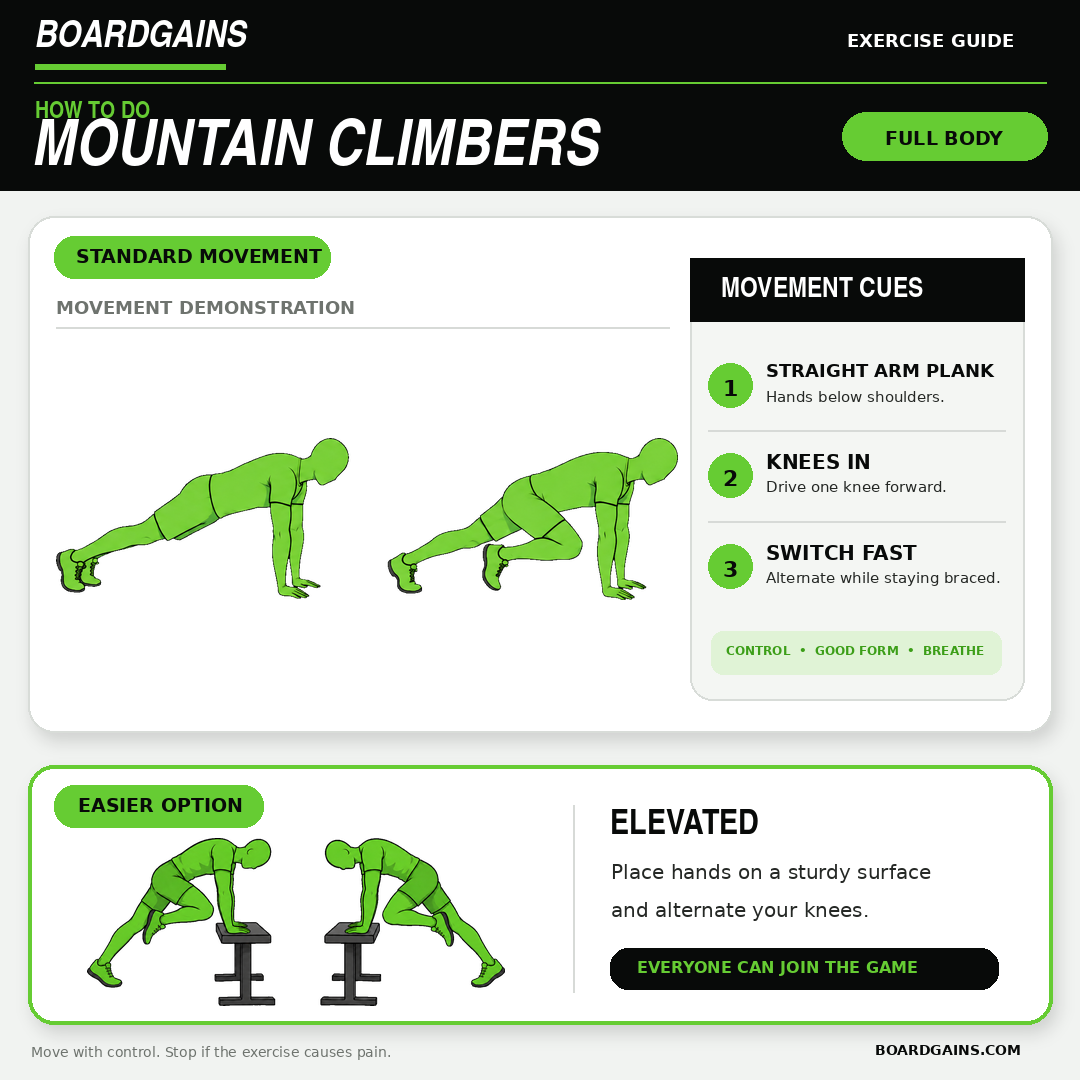
Mountain climbers combine a high plank with alternating knee drives. Your upper body supports the plank while your core controls your torso and your legs move forward and back.
The exercise can be slow and deliberate or fast and running-like. Slow mountain climbers place more focus on control. Faster repetitions can raise your heart rate and create a greater conditioning challenge.
Speed should come after position. If your hips bounce, your lower back sags or your shoulders move far behind your hands, slow down or switch to an incline.
This guide explains how to do mountain climbers with proper form, count each knee drive and adjust the movement for different fitness levels.
Written by Eric Mathura, B.Sc. Kinesiology and CSEP-CPT, with more than 10 years of experience as a personal trainer and group fitness instructor. Updated August 19, 2026.
Quick answer:
Start in a high plank with your shoulders over your wrists. Brace your core, drive one knee toward your chest and return that foot to the plank. Switch legs and continue at a pace you can control. Each knee drive counts as one repetition.
Quick exercise overview
- Exercise: Mountain climbers
- Level: Beginner to advanced
- Equipment: None; a stable elevated surface is optional
- Main muscles: Abdominals, hip flexors and shoulders
- Also works: Quadriceps, chest, triceps and glutes
- Movement type: Core control and conditioning
- Rep count: Each knee drive counts as one rep
Watch: How to Do Mountain Climbers
Table of Contents
- What Are Mountain Climbers?
- How to Do Mountain Climbers
- How to Count Repetitions
- Plank Setup, Hip Position and Knee Drive
- Muscles Worked
- Benefits
- Beginner and Low-Impact Modifications
- Variations
- Common Mistakes
- Group Coaching Tips
- Mountain Climbers in BoardGains
- Frequently Asked Questions
What Are Mountain Climbers?
Mountain climbers are performed from the top of a push-up position. While supporting your upper body with both hands, you bring one knee toward your chest, return that leg and switch sides.
Slow repetitions are controlled step-ins from the plank. Fast repetitions use quick foot switches and look more like running while facing the floor.
The exercise gets its name because the alternating leg action resembles climbing. Unlike actual climbing, however, your hands remain planted while the legs do most of the visible movement.
How to Do Mountain Climbers With Proper Form
- Begin on your hands and knees.
- Place your hands approximately shoulder-width apart.
- Stack your shoulders over your wrists and spread your fingers.
- Step both feet back into a high plank.
- Create a long line from your head through your hips to your heels.
- Brace your core and lightly squeeze your glutes.
- Press your hands into the floor and keep your neck neutral.
- Drive your right knee toward your chest.
- Return your right foot to the starting plank position.
- Drive your left knee toward your chest.
- Continue alternating legs at a pace you can control.
Bring each knee only as far forward as your mobility and plank position allow. The knee does not have to touch your chest.
Movement cue: Shoulders over hands. Brace your core. Knee forward. Return and switch.
How to Count Mountain-Climber Repetitions
Each knee drive counts as one repetition.
- Right knee forward = 1 rep
- Left knee forward = 2 reps
- Right knee forward = 3 reps
- Left knee forward = 4 reps
One right and one left knee drive equal two total reps—not one.
Count a rep after the knee drives forward and the foot returns to the plank. During BoardGains, alternate until you complete the total number shown on the board.
Mountain-Climber Form Tips
Where Should Your Hands and Shoulders Be?
Place your hands roughly shoulder-width apart with your shoulders stacked above your wrists. Spread your fingers and press through the whole hand.
Your shoulders may shift slightly as your legs move, but avoid rocking far forward and backward. An incline can reduce the upper-body load when the supporting position is difficult to maintain.
Where Should Your Hips Be?
Keep your hips around the same height as your shoulders and heels so your body forms a long plank line.
Your hips do not need to be perfectly still, especially during fast repetitions. However, they should not bounce dramatically, lift high toward the ceiling or drop toward the floor.
If your hips begin to sag, slow down, shorten the set, rest or elevate your hands.
How Far Should the Knee Drive?
Bring the knee forward through the largest range you can control without rounding your upper back, lifting your hips or losing hand position.
A shorter knee drive is still useful as a modification. Do not force your knee to touch your chest.
Should the Foot Touch the Floor?
During a slow mountain climber, the toes may briefly touch down near the hands before the leg returns. During faster repetitions, the feet switch quickly and spend less time supported at the front.
Keep your steps quiet and controlled. Slamming your toes down often signals that the pace is too fast.
Where Should You Look?
Look at the floor slightly ahead of your hands. Keep your head in line with your spine instead of dropping your chin or lifting your face forward.
How Should You Breathe?
Use a steady breathing rhythm. You can exhale with each knee drive during slow repetitions. At a faster pace, breathe continuously rather than trying to match every step.
What Muscles Do Mountain Climbers Work?
Abdominal Muscles
Your abdominal muscles brace your trunk and help prevent your lower back from dropping as your legs move.
Hip Flexors
The hip flexors bring each thigh forward toward your torso.
Shoulders
Your shoulders support your upper body and help maintain the high-plank position.
Quadriceps
The quadriceps help extend the legs and support the alternating step or running motion.
Chest and Triceps
Your chest and triceps help keep your arms extended while you press into the floor.
Glutes
The glutes contribute to hip and pelvic control and help support the plank position as each leg returns.
Mountain climbers use several muscle groups, but the training focus changes with speed. Slow reps emphasize position and control; fast reps create a stronger conditioning demand.
Benefits of Mountain Climbers
Challenges Core Control
Your core works to limit unwanted motion through the pelvis and lower back as your knees alternate.
Can Raise Your Heart Rate
Quick, continuous mountain climbers can increase breathing and heart rate. The effect depends on your speed, range, duration and current fitness level.
Trains Coordination
Your upper body holds the plank while your legs alternate in a repeated rhythm.
Uses Several Muscle Groups
Your shoulders, chest and arms support the plank while your core braces and your hips and legs move.
Requires No Equipment
The standard version needs only enough floor space for a plank. A bench, box or sturdy table can be used for an incline modification.
Easy to Adjust
You can change your hand height, knee range, step speed or interval length. That makes the exercise practical for mixed-level fitness groups.
Mountain climbers can add activity and intensity to a complete workout, but one exercise alone cannot guarantee weight loss, visible abs or protection from injury.
Mountain-Climber Modifications
Modification 1: Incline Mountain Climbers
Placing your hands on a higher surface reduces the amount of body weight supported by your upper body and changes the plank angle.
- Use a stable wall, bench, box or sturdy table that will not slide.
- Place your hands approximately shoulder-width apart.
- Walk your feet back into an incline plank.
- Brace your core and keep a long line through your body.
- Drive one knee forward.
- Return the foot fully and switch legs.
A higher surface is generally easier. Lower the incline gradually as your control improves.
Modification 2: Slow Step-In Mountain Climbers
Move one leg at a time without jumping or switching in the air. Bring one knee forward, return that foot completely and then change sides.
Modification 3: Short-Range Mountain Climbers
Bring each knee partway toward your chest. Use the range that lets your hips and lower back stay controlled.
Modification 4: High-Plank Hold
If the knee drives are too challenging, practise holding the starting high plank for 10 to 20 seconds. Build control in the base position before adding leg movement.
Modification cue:
Raise your hands, slow your steps or shorten the knee drive. Control the plank before adding speed.
Mountain-Climber Variations
Cross-Body Mountain Climbers
Drive your right knee toward your left elbow, return to plank and switch sides. This variation adds more rotational movement than the standard version.
Spiderman Mountain Climbers
Bring your right knee toward your right elbow, allowing the knee to travel outside your torso. Return to plank and alternate sides.
Slider Mountain Climbers
Place exercise sliders—or towels on a suitable smooth surface—under your feet. Slide one knee forward at a time while keeping both feet in contact with the floor. Check that the surface is safe and clear.
Fast Mountain Climbers
Quickly switch your legs in a running-style motion. Add speed only after you can maintain a controlled plank during slower repetitions.
Mountain Climbers With a Push-Up
Complete a set number of knee drives, perform one push-up and repeat. Use an incline or knee-supported push-up when needed.
Slow Versus Fast Mountain Climbers
Both speeds can be useful, but they create different priorities.
- Slow reps: Plank position, core control, shoulder endurance and learning the movement.
- Fast reps: Conditioning, quick coordination, leg speed and muscular endurance.
Beginners should learn the slow version first. Faster does not mean better when the plank position disappears.
Common Mountain-Climber Mistakes
1. Moving Too Fast
The problem: Speed causes your hips to bounce, your back to sag or your shoulders to leave their position.
The fix: Perform slow step-ins until you can maintain a steady plank.
2. Lifting the Hips Too High
The problem: Your body shifts into a pike and reduces the trunk-control challenge.
The fix: Aim for one long line from your shoulders through your hips to your heels.
3. Letting the Lower Back Sag
The problem: Your pelvis drops as the core becomes tired.
The fix: Brace, squeeze your glutes and stop or modify before you lose your plank.
4. Rocking Forward and Backward
The problem: Your shoulders travel far ahead of and behind your hands during each rep.
The fix: Press firmly into the floor and keep your shoulders close to stacked above your wrists.
5. Forcing the Knee Too Far Forward
The problem: You lift your hips or round your back to make the knee touch your chest.
The fix: Use the largest knee drive that preserves your plank. A shorter range still counts.
6. Letting the Feet Slam Down
The problem: Your toes land loudly and the movement becomes difficult to control.
The fix: Slow down and use quieter, deliberate foot contacts.
7. Looking Too Far Forward
The problem: Your head lifts and your neck leaves its neutral position.
The fix: Look at the floor slightly ahead of your hands.
8. Holding Your Breath
The problem: Breathing stops as the pace increases.
The fix: Reduce the speed and maintain a steady breathing rhythm.
9. Continuing After Form Breaks
The problem: A long set continues after your hips, shoulders and back lose position.
The fix: Stop, rest or finish the remaining reps on an incline.
How Many Mountain Climbers Should You Do?
The right amount depends on your experience, pace and training goal.
- Learning the movement: 2 sets of 12 to 20 total slow reps
- General fitness: 2 to 3 sets of 20 to 40 total reps
- Timed circuit: 15 to 40 seconds
- Warm-up: 10 controlled reps per side
- BoardGains: Complete the total number shown on the board
A set of 20 total mountain climbers provides approximately 10 knee drives per side when you alternate evenly.
Stop when you can no longer keep your hips, shoulders and lower back controlled. Short, high-quality sets are better than long sets with lost position.
How to Teach Mountain Climbers in a Group
- Give every participant enough room to hold a high plank.
- Check that the floor, mats and any elevated surfaces will not slide.
- Demonstrate the starting plank before adding knee drives.
- Show the movement slowly before demonstrating speed.
- Explain that each knee drive counts as one rep.
- Demonstrate the incline and slow step-in modifications.
- Watch for sagging hips, raised hips and hands placed too far forward.
- Let every participant choose a pace they can control.
Coach it in four cues:
Shoulders over hands. Push the floor away. Knee forward. Switch under control.
Mountain Climbers in BoardGains
Mountain climbers are one of the 20 bodyweight exercises included in the BoardGains Pro game. They add a full-body plank and conditioning challenge without requiring equipment.
When a player lands on mountain climbers, each knee drive counts toward the number shown on the board. A right knee drive is one rep and a left knee drive is the next rep.
Before the game begins, show everyone the incline or slow step-in option. Players can adjust the hand height, range and speed while still completing the same movement pattern.
Turn Your Workout Into a Game
BoardGains combines bodyweight exercises, teamwork and friendly competition for trainers, PE teachers, families and fitness groups.
Mountain-Climber FAQs
Are mountain climbers good for beginners?
They can be, but the full fast version may be difficult. Beginners can elevate their hands, use slow step-ins, shorten the knee drive or practise the high-plank position first.
Are mountain climbers a core or cardio exercise?
They can be both. Slow mountain climbers emphasize plank and core control. Faster continuous repetitions create a greater conditioning demand.
Do mountain climbers work your abs?
Your abdominal muscles work to stabilize your torso and control your hips while your legs move. The exercise does not isolate the abs or remove fat from the stomach.
Why do my hips rise?
Your hips may rise because of fatigue, limited plank control, a restricted knee drive or excessive speed. Slow down, shorten the set or use an incline.
Why does my lower back sag?
Your plank may be breaking down as you fatigue. Brace your core, squeeze your glutes and reduce your speed. Stop or modify before the position becomes uncomfortable.
Why do my wrists hurt?
Mountain climbers place body weight through the hands and wrists. Keep your shoulders over your wrists, spread your fingers and press through the whole hand. An incline may reduce the load. Stop if pain continues and seek individual guidance when needed.
Do my feet touch the floor?
Yes. During slow mountain climbers, the toes can touch down near the front before the leg returns. During fast repetitions, the feet switch quickly and contact the floor behind you.
How many mountain climbers equal one rep?
Each knee drive counts as one repetition. A right knee drive followed by a left knee drive equals two total reps.
Should the knee touch the chest?
No. Drive the knee as far forward as you can without lifting your hips, rounding your back or losing hand position.
Can mountain climbers help with weight loss?
They can increase the activity and intensity of a workout, but no single exercise causes weight loss. Total activity, nutrition, sleep and consistency also matter.
Are mountain climbers low impact?
Slow step-in mountain climbers avoid jumping and reduce impact. Fast switching adds more landing demand through the feet, even though the hands remain supported.
Can I do mountain climbers every day?
Daily practice is not required. Frequency should reflect the effort, your total training plan and how your wrists, shoulders, core and hips recover.
Final Form Checklist
- Hands approximately shoulder-width apart
- Shoulders stacked above wrists
- Long line from head to heels
- Core braced and glutes lightly active
- One knee driven forward at a time
- Foot returned fully before switching during slow reps
- Hips controlled without large bouncing
- Steady breathing maintained
- Each knee drive counted as one rep
Control the plank before adding speed. Keep your shoulders over your hands, press the floor away and move only as quickly as you can maintain your body position.







Leave a comment
This site is protected by hCaptcha and the hCaptcha Privacy Policy and Terms of Service apply.