
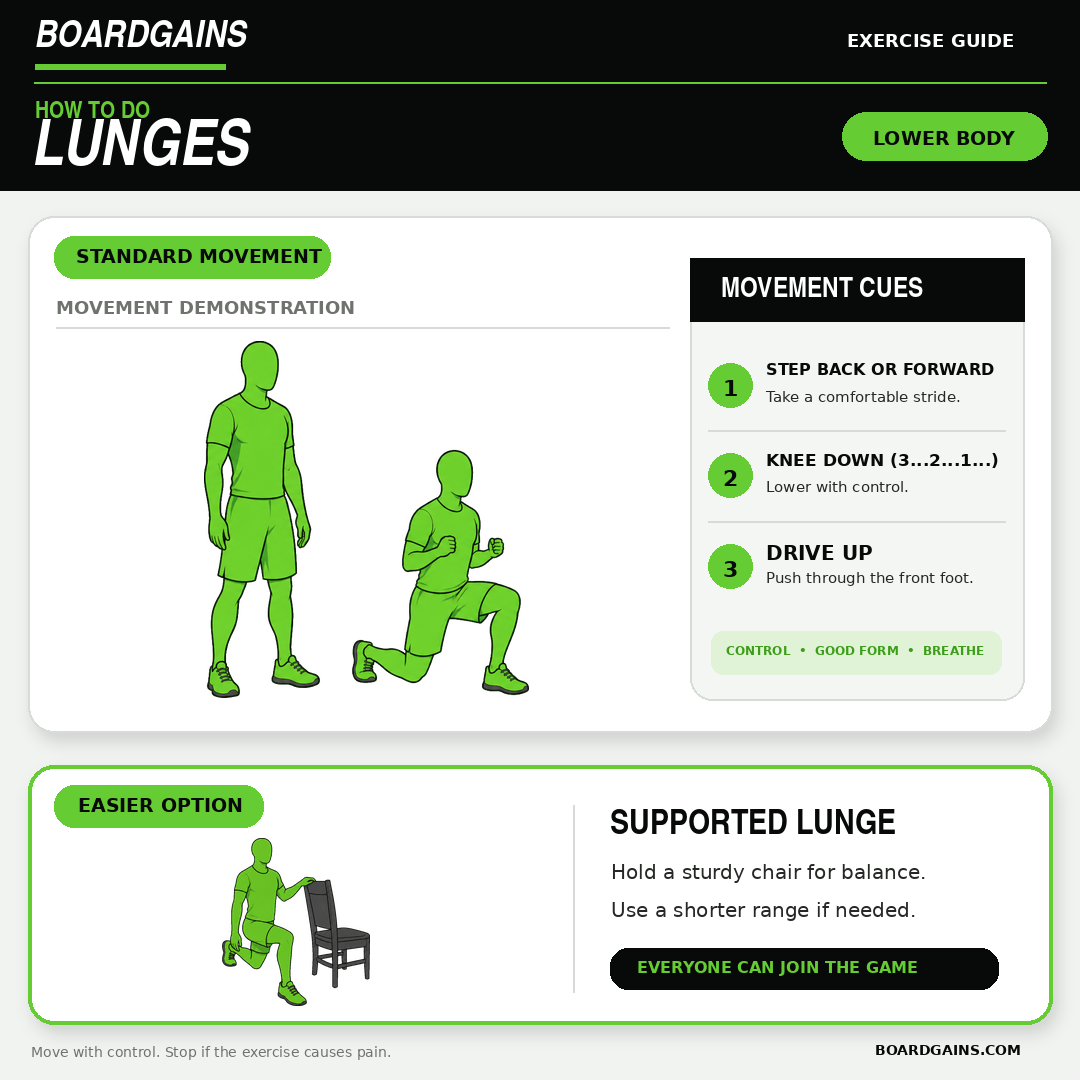
Alternating lunges are a bodyweight exercise that trains your legs one side at a time while challenging balance and coordination. You complete a lunge with one leg, return to standing and then switch sides.
BoardGains uses the alternating reverse lunge. You step one foot backward, lower under control and push through the front foot to stand. This version works well in one workout space and can be adjusted for different fitness levels.
Written by Eric Mathura, B.Sc. Kinesiology and CSEP-CPT, with more than 10 years of experience as a personal trainer and group fitness instructor. Updated August 19, 2026.
Quick answer: Stand with your feet hip-width apart. Step one foot backward as if your feet are moving on two separate tracks. Bend both knees and lower through a range you can control. Keep the front foot planted and the front knee following the toes. Push through the front foot to stand, then repeat on the other side.
Alternating Lunge Overview
- BoardGains version: Alternating reverse lunge
- Level: Beginner to advanced
- Equipment: None
- Main muscles: Quadriceps, glutes and hamstrings
- Supporting muscles: Calves, hips and core
- Movement type: Lower-body, single-leg exercise
- One rep: One completed lunge on one side
What Is an Alternating Lunge?
An alternating lunge is a lunge where you switch legs after each repetition. In an alternating reverse lunge, you step one foot backward, lower your body, return to standing and repeat with the other leg.
Because each side takes a turn as the front leg, the exercise challenges lower-body strength and control on both sides. The moving step also requires more balance than a squat, where both feet stay beside each other.
Alternating lunges can also be performed by stepping forward. However, this guide focuses on the reverse version used in BoardGains. Many beginners find it easier to control because the working front foot remains planted as the other foot steps back.
How to Do Alternating Reverse Lunges
- Set your stance. Stand tall with your feet about hip-width apart. Keep your arms at your sides, on your hips or extended for balance.
- Brace your core. Keep your ribs controlled over your pelvis and look straight ahead.
- Step back. Move your right foot backward and land on the ball of that foot. Keep space between your left and right feet as if they are on two separate tracks.
- Lower under control. Bend both knees and allow your back knee to move toward the floor.
- Keep the front foot planted. Maintain contact through the front heel, base of the big toe and base of the little toe.
- Track the front knee. Let it move in the same general direction as the toes instead of collapsing inward.
- Choose your depth. Lower only as far as you can keep your balance and body position. The back knee does not need to touch the floor.
- Return to standing. Push through the front foot and bring the back leg forward.
- Switch sides. Step the left foot back and repeat the same movement.
Inhale as you lower and exhale as you return to standing. A small forward torso lean can be natural. Keep your back controlled rather than forcing your chest perfectly upright.
Key Alternating Lunge Form Cues
Step on Two Separate Tracks
Imagine your feet moving along train tracks instead of a tightrope. Keeping the stance about hip-width from side to side creates a wider base and usually improves balance. If your feet cross behind each other or land on one narrow line, the lunge may feel unstable.
Use a Comfortable Step Length
A step that is too short can make the position crowded. A step that is too long can make it hard to stand again. Step back far enough that both knees can bend comfortably while your front foot stays planted.
Keep the Front Foot Connected
Maintain pressure through your front heel, base of the big toe and base of the little toe. This tripod foot helps you stay balanced. Avoid rolling onto the outside of the foot or letting the front heel lift.
Let the Front Knee Follow the Toes
Your front knee should move in the same general direction as your middle toes. Some forward knee movement is normal and depends on your step length, ankle mobility and body proportions. The knee does not have to remain behind the toes.
Lower Straight Down
After stepping back, think about lowering your body between your feet. Avoid reaching the back knee far behind you or shifting the whole body forward. The back knee moves toward the floor while both legs bend.
Use the Front Leg to Stand
The back foot helps with balance, but the front leg should perform most of the work. Press through the front foot and bring the back leg forward. Avoid launching yourself off the back toes.
Control Your Torso
Keep your core braced and your back in a comfortable position. A slight forward lean can help load the glutes and is not automatically a mistake. Avoid rounding the back, twisting or losing balance.
Short coaching cues: “Two train tracks.” “Front foot planted.” “Knee follows toes.” “Lower straight down.” “Push through the front foot.” “Control, then switch.”
How Do You Count Alternating Lunges?
The clearest method is to count each completed lunge as one repetition:
- Right leg lunge = rep 1
- Left leg lunge = rep 2
- Right leg lunge = rep 3
- Left leg lunge = rep 4
If a workout says “10 lunges per side,” complete 10 with the right leg forward and 10 with the left leg forward, for 20 total lunges. If it says “10 alternating lunges,” that usually means 10 total reps, or five per side.
BoardGains counting tip: Count every completed side as one rep unless the instructor says “per side.” Explain the counting method before the game so every player follows the same rule.
What Muscles Do Alternating Lunges Work?
- Quadriceps: The muscles at the front of the thighs help control the descent and straighten the front knee as you stand.
- Glutes: The glute muscles help extend the front hip and drive the body back to standing.
- Hamstrings: These muscles assist hip movement and help stabilize the legs.
- Adductors: The inner-thigh muscles help control the hip and support the staggered position.
- Calves: The calf muscles help stabilize the feet and ankles during the step, lower and return.
- Core: The abdominal and back muscles help keep the torso and pelvis steady while the legs move.
The front leg performs most of the work, but the back leg and core help control the position. Holding weights, slowing the descent or adding a pause can increase the muscular challenge.
Benefits of Alternating Lunges
Build Lower-Body Strength
Alternating lunges train the quadriceps, glutes and hamstrings without requiring equipment. They fit well beside two-leg exercises such as squats and glute bridges.
Train One Leg at a Time
Each leg must support and control the movement separately. This can reveal differences in balance or control between sides and gives both legs a turn in the front position.
Challenge Balance and Coordination
You must maintain your base while stepping backward, lowering and returning to standing. Alternating sides adds another layer of coordination.
Require Little Space
Reverse lunges can be performed in one workout spot. Participants do not need to travel across the room, which makes the exercise useful for PE classes, bootcamps and circuits.
Scale Across Fitness Levels
You can shorten the range, hold a stable support or use a stationary split squat. More advanced participants can add resistance, pauses, slower tempos or controlled knee drives.
Work Well in Group Training
Everyone can lunge at the same time without waiting for equipment. Instructors can teach one counting method and provide support or range options.
Alternating Lunge Modifications for Beginners
1. Supported Alternating Lunge
Hold a wall, stable chair, rail or dowel for balance while stepping backward. Use only as much help from the upper body as needed. Keep the support beside you so you still have room to step.
2. Short-Range Reverse Lunge
Take the step back but lower only partway before returning to standing. Use the same foot and knee positions as the full version. Increase the depth gradually as control improves.
3. Reverse Step and Tap
Step one foot backward and lightly tap the floor without lowering into a full lunge. Return to standing and switch sides. This helps beginners practise the step and balance before adding more knee bend.
4. Stationary Split Squat
Begin with one foot forward and one foot back on two separate tracks. Lower and rise without stepping between reps. Complete the set, then switch legs. Removing the repeated step makes it easier to focus on the lowering pattern.
5. Chair Target Lunge
Place a stable chair beside you for support or behind the front leg as a visual depth guide. Do not drop onto the chair. Use it to keep the range consistent and make the movement easier to judge.
Progression tip: Begin with a stable split stance or supported reverse lunge. Add depth only while the front foot stays planted and the knee remains aligned. Add speed or resistance last.
Lunge Variations and Progressions
- Forward lunge: Step forward, absorb your body weight and push back to standing. This often requires more control as the front foot lands.
- Stationary split squat: Keep both feet planted in a staggered stance while lowering and rising.
- Walking lunge: Step forward into each new rep and travel across the room. This version requires more space.
- Lateral lunge: Step to the side, bend one knee and push the hips back while the other leg stays straighter.
- Curtsy lunge: Step one foot diagonally behind the other. Use a small range and stop if the position feels uncomfortable at the knees or hips.
- Reverse lunge with knee drive: Stand from the lunge and bring the stepping knee forward and up before the next rep.
- Tempo or pause lunge: Lower for three seconds or pause near the bottom to increase control and time under tension.
- Weighted lunge: Hold dumbbells at your sides or a kettlebell at your chest.
- Jumping lunge: Switch legs in the air and land in the opposite stance. This advanced version requires strength and landing control.
Add only one progression at a time. More difficulty should not come at the cost of balance, foot pressure or knee control.
Common Alternating Lunge Mistakes and How to Fix Them
Mistake 1: Feet Land on One Narrow Line
What it looks like: The back foot steps directly behind the front foot, like standing on a tightrope.
Try this: Keep your feet about hip-width apart from side to side. Imagine stepping on two train tracks.
Mistake 2: Front Knee Collapses Inward
What it looks like: The knee turns toward the middle during the lower or standing phase.
Try this: Keep the knee moving in the same direction as your middle toes. Reduce the depth or use support if needed.
Mistake 3: Step Is Too Short
What it looks like: The stance feels crowded and the back knee cannot lower comfortably.
Try this: Step farther back while keeping your stance wide enough from side to side.
Mistake 4: Step Is Too Long
What it looks like: The legs spread so far apart that you cannot stand without losing balance.
Try this: Shorten the step until both knees can bend and you can push through the front foot.
Mistake 5: Front Heel Lifts
What it looks like: The front foot rolls toward the toes as you lower.
Try this: Reduce your depth, adjust your step and keep the heel, big toe and little toe planted.
Mistake 6: Pushing Too Much With the Back Leg
What it looks like: You bounce off the back toes instead of driving through the front leg.
Try this: Make the front foot heavy and use it to push the floor away. Let the back foot assist with balance.
Mistake 7: Dropping the Back Knee
What it looks like: The back knee hits the floor at the bottom.
Try this: Slow the lowering phase and stop before contact. The knee may move close to the floor but does not need to touch.
Mistake 8: Forcing Maximum Depth
What it looks like: Balance, front foot pressure or torso position disappears to reach lower.
Try this: Use a range you can control. Depth can increase over time.
Mistake 9: Moving Too Quickly
What it looks like: The feet rush between sides and each landing becomes unstable.
Try this: Pause in the standing position before switching legs. Count a steady two seconds down and one second up.
How Many Alternating Lunges Should You Do?
The right amount depends on your experience, workout and current balance. Stop the set when you cannot maintain foot pressure or knee control.
- Beginner: 2 sets of 6 to 8 reps per side
- General fitness: 2 to 3 sets of 8 to 12 reps per side
- Warm-up: 1 to 2 sets of 5 to 8 reps per side
- Timed circuit: 20 to 40 seconds at a controlled pace
- BoardGains game: Complete the number shown, counting each completed side as one rep
Simple Lower-Body Circuit
- 8 alternating reverse lunges per side
- 12 bodyweight squats
- 12 glute bridges
- 15 calf raises
- Rest for 60 to 90 seconds and repeat for 2 or 3 rounds
Change the repetitions and rest to match the group. Participants can use supported, short-range or stationary options during the same station.
How to Teach Alternating Lunges in PE or Group Fitness
- Demonstrate the reverse lunge from the front and side.
- Show the supported, short-range and stationary options before the set begins.
- Give each participant enough space behind them to step safely.
- Practise the step-and-tap pattern before adding depth.
- Explain the counting method clearly: every side or every pair.
- Use one or two cues, such as “two train tracks” and “front foot planted.”
- Watch for knees turning inward and feet landing on one line.
- Let each person choose a range and level of support they can control.
- Encourage steady repetitions instead of racing between sides.
The group does not need to lunge to the same depth or move at the same speed. Use a timer when participants need different rep speeds, or use a clear total when counting together.
Alternating Lunges in BoardGains
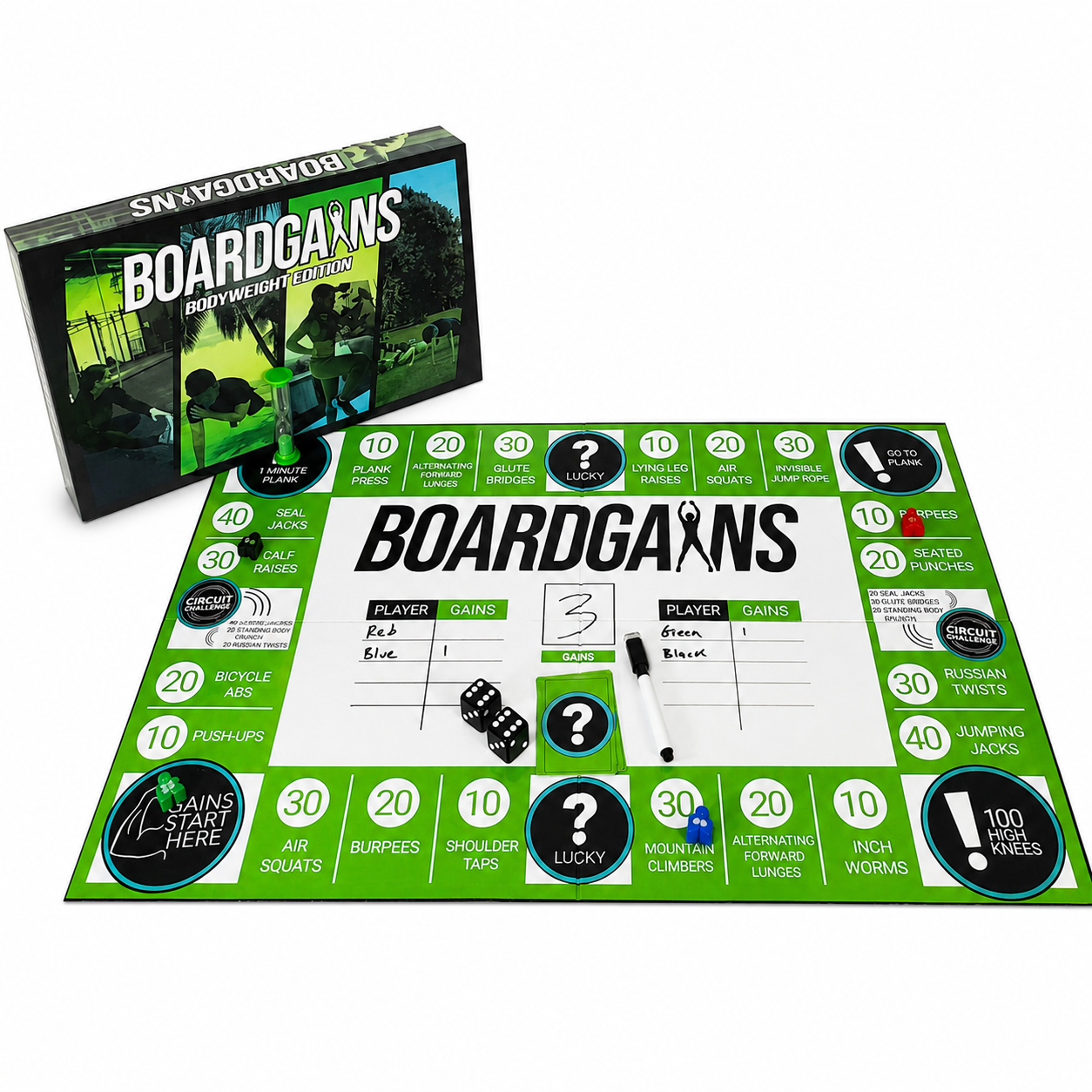
Alternating reverse lunges are one of the bodyweight movements used in the BoardGains fitness board game. Players roll the dice, move their game piece and complete the exercise they land on. Everyone plays and exercises at the same time, helping teachers, trainers and coaches keep the whole group moving.
When a player lands on lunges, each completed side counts as one rep unless the instructor has announced another method. A supported lunge, step-and-tap or stationary split squat can be used so players of different fitness levels stay involved.
Before play begins, show the two-train-track stance, front-knee direction and the modification area. During the game, remind players that control matters more than maximum depth.
Turn Lunges Into a Game
Bring movement, teamwork and friendly competition to your PE class, group workout, team practice or family fitness session.
Alternating Lunge FAQs
Are alternating lunges good for beginners?
Yes. Beginners can use a smaller range, hold a stable object or start with stationary split squats. Reverse lunges are often easier to control than forward lunges.
Are alternating lunges forward or backward?
They can be performed in either direction. In this guide and in BoardGains, alternating lunges means alternating reverse lunges, where you step backward and switch legs after every rep.
What muscles do alternating lunges work?
Alternating lunges mainly work the quadriceps, glutes and hamstrings. The inner thighs, calves, hips and core also help stabilize the movement.
Should the front knee go past the toes?
Some forward knee movement can be normal. The amount depends on your step, ankle mobility and body proportions. Keep the whole front foot planted and the knee moving in the same direction as the toes.
Should the back knee touch the floor?
No. The back knee can move toward the floor, but it does not need to touch. Stop at a depth you can control without dropping or losing balance.
Why do I lose balance during lunges?
Your stance may be too narrow, the step may be too long or you may be moving too quickly. Step on two separate tracks, shorten the range and pause before switching. Holding a stable support can help.
What should I do if lunges hurt my knees?
Stop if the exercise causes pain. Try a smaller range, stable support or stationary split squat. Check that the front foot stays planted and the knee follows the toes. Speak with a qualified healthcare professional if pain continues or you are returning from injury.
What is the difference between a lunge and a split squat?
A lunge includes a step into or out of the staggered position. During a split squat, the feet stay planted while you lower and rise. Both train similar muscles, but the lunge adds more balance and coordination.
Are reverse lunges easier than forward lunges?
Many people find reverse lunges easier to balance because the front foot stays planted and does not have to absorb a forward step. The best option is the one you can perform with control and without pain.
How many alternating lunges should a beginner do?
Start with 2 sets of 6 to 8 repetitions per side. Use fewer reps if balance or position begins to change. Quality matters more than reaching a fixed number.
Can lunges help with weight loss?
Lunges use several large muscles and can contribute to an active workout, but no single exercise causes weight loss. Nutrition, total activity, sleep and long-term consistency also matter.
Can I do lunges every day?
Light practice may fit into frequent warm-ups, but harder sets, added weights and jumping variations need more recovery. Adjust the frequency based on volume, difficulty, soreness and your total training.
Final Alternating Lunge Form Checklist
- Start with your feet about hip-width apart
- Step back on two separate tracks
- Use a step length that feels balanced
- Keep the front heel, big toe and little toe planted
- Let the front knee follow the toes
- Brace your core and control your torso
- Lower both knees without dropping
- Stop before the back knee hits the floor
- Push through the front foot to stand
- Pause and regain balance before switching sides
Strong alternating lunges come from control, not speed or maximum depth. Build a stable stance, keep the front foot planted and use a range you can manage. Once the movement feels steady, add repetitions, time or resistance.






1 comment
Vicky
Boost strength, balance, flexibility & coordination with walking lunges—feel the burn today!
https://bit.ly/4g41dk0
Leave a comment
This site is protected by hCaptcha and the hCaptcha Privacy Policy and Terms of Service apply.