
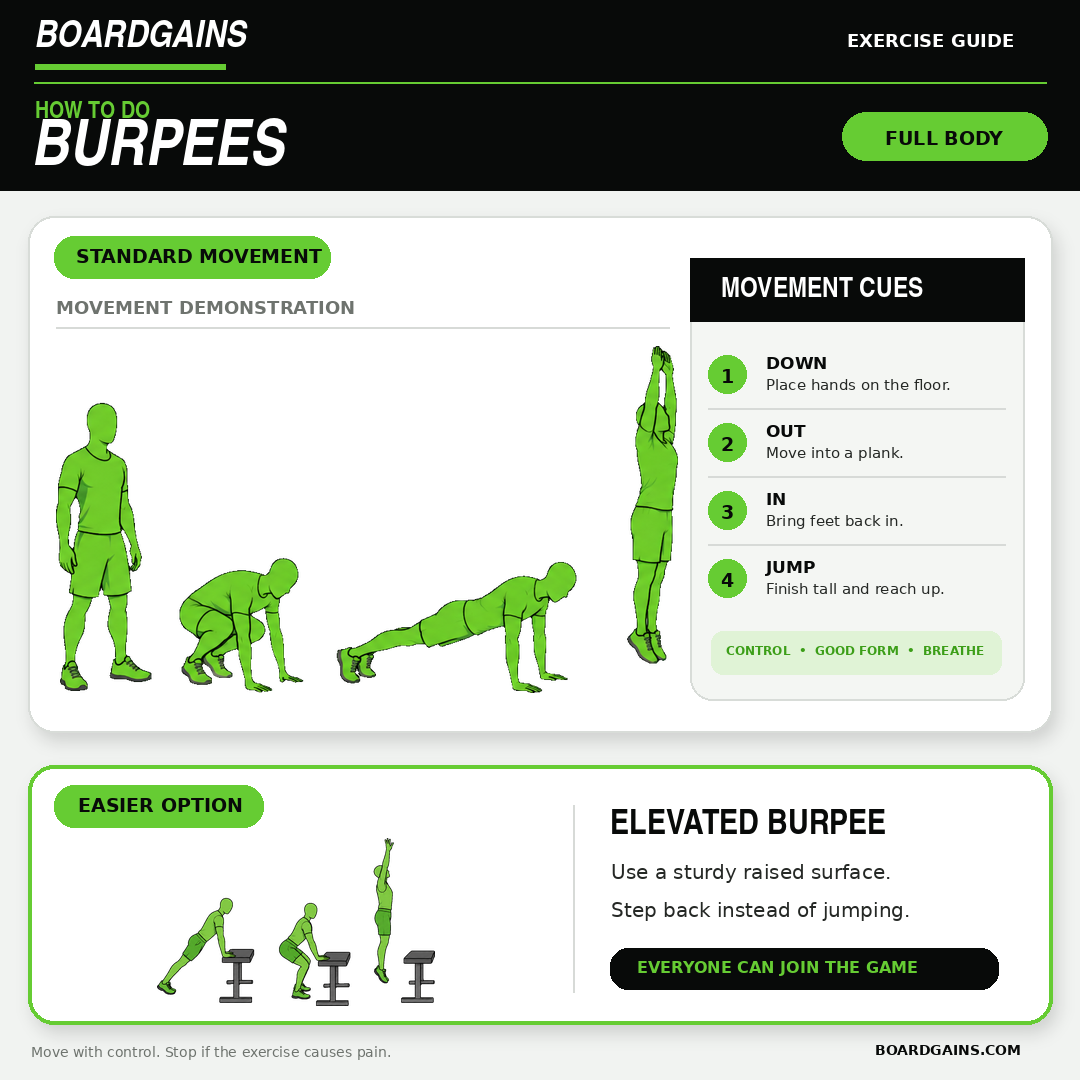
A burpee is a full-body exercise that moves you from standing to a plank or push-up position and back to standing. Some versions also include a vertical jump.
The BoardGains burpee includes one push-up but does not require a jump at the top. Players can jump or step their feet backward and forward based on their fitness level.
Burpees can quickly raise your heart rate because several large muscle groups work while your body changes levels. The movement is useful in circuits, PE classes, bootcamps and fitness games, but control should come before speed.
This guide explains every part of the burpee, how to count repetitions and how to use step-back, no-push-up, no-jump and incline modifications.
Written by Eric Mathura, B.Sc. Kinesiology and CSEP-CPT, with more than 10 years of experience as a personal trainer and group fitness instructor. Updated August 19, 2026.
Quick answer:
Stand tall, lower your hands to the floor and jump or step into a high plank. Complete one push-up, bring your feet forward and return to standing. A vertical jump is optional and is not required in BoardGains. One full down-and-up cycle equals one repetition.
Quick exercise overview
- Exercise: Burpee
- Level: Intermediate; beginner options are available
- Equipment: None; a stable elevated surface is optional
- Main muscles: Quadriceps, glutes, chest and shoulders
- Also works: Triceps, core, hamstrings and calves
- Movement type: Full-body strength and conditioning
- BoardGains rep count: Each complete burpee counts as one rep
Watch: How to Do a Burpee
Table of Contents
- What Is a Burpee?
- How to Do the BoardGains Burpee
- How to Count Repetitions
- Does a Burpee Need a Push-Up or Jump?
- Hand, Plank and Landing Form
- Muscles Worked
- Benefits
- Beginner Modifications
- Variations
- Common Mistakes
- Group Coaching Tips
- Frequently Asked Questions
What Is a Burpee?
A burpee is a bodyweight exercise that combines several familiar movements into one continuous sequence:
- Squat or crouch
- High plank
- Optional or required push-up
- Return to a squat or crouch
- Stand or jump
The exact definition differs between workouts. Some burpees include both a push-up and vertical jump. Others remove one or both parts.
That difference matters in a class or competition. Coaches should explain the chosen version before the set begins so every participant follows the same standard.
How to Do the BoardGains Burpee
- Stand tall with your feet about shoulder-width apart.
- Bend your knees and hips to lower toward the floor.
- Place your full palms on the floor in front of your feet.
- Jump or step your feet backward into a high plank.
- Position your shoulders over your hands.
- Brace your core and keep your hips controlled.
- Bend your elbows and lower into one push-up.
- Press back to the high-plank position.
- Jump or step your feet toward your hands.
- Place your feet flat enough to create a stable base.
- Press through your feet and return to standing.
- Begin the next rep when you are balanced and ready.
A vertical jump is not required for the BoardGains version. If another workout includes a jump, add a small controlled jump after standing and land softly before the next rep.
Movement cue: Hands down. Feet back. Push-up. Feet forward. Stand tall.
How to Count Burpee Repetitions
One complete movement from standing to the floor and back to a balanced standing position equals one repetition.
For the BoardGains version, one rep includes:
- Lowering from standing
- Moving into a high plank
- Completing one push-up
- Bringing the feet forward
- Returning to standing
Stepping instead of jumping during the transitions does not change the count. A modified burpee still equals one rep after the participant returns to standing.
Does a Burpee Need a Push-Up or Jump?
Does a Burpee Require a Push-Up?
Not every burpee includes a push-up. A movement that goes from standing to plank and back without a push-up is often called a squat thrust.
The BoardGains standard includes one push-up. However, removing it is a useful modification for beginners or anyone who cannot maintain a controlled plank and press.
Does a Burpee Require a Vertical Jump?
No. A burpee can finish by returning to standing. The BoardGains version does not require a jump at the top.
Adding a vertical jump increases the impact, landing demand and conditioning challenge. Teachers and trainers should state clearly whether it is included.
Burpee Form Tips
How Should You Place Your Hands?
Place your full palms on the floor with your fingers spread. Avoid supporting your body only on your fingertips.
After your feet move backward, your shoulders should finish close to stacked over your wrists. Hands placed far forward can make the plank and push-up harder to control.
What Should the Plank Look Like?
Create a long line from your head through your hips to your heels. Brace your core and gently squeeze your glutes before starting the push-up.
Do not allow your lower back to sag or your hips to remain high in a pike. If you cannot hold the plank, step back more slowly, remove the push-up, lower your knees or use an incline.
Where Should Your Feet Land?
Bring your feet far enough forward that you can plant them before standing. The feet do not have to land beside your hands.
If your heels cannot lower or your body feels crowded, step forward one foot at a time. A stable foot position is more important than copying someone else’s range.
How Should You Stand Up?
Press through your feet and extend your knees and hips until you are tall. Finish under control before beginning the next repetition.
Avoid staying on your toes or rushing directly into the next rep without balance.
How Should You Jump and Land?
If your variation includes a jump, use a comfortable height. Reach upward, then land softly with your hips and knees slightly bent.
A maximum-height jump is not required. Remove the jump when landing quality declines.
How Should You Breathe?
Breathe throughout the sequence. Exhale as you press up from the push-up and again as you return to standing. Slow down if the changing positions cause you to hold your breath.
What Muscles Do Burpees Work?
Quadriceps
Your quadriceps help lower your body, bring your feet forward and return you to standing.
Glutes and Hamstrings
The glutes and hamstrings assist with hip control and hip extension during the lowering and standing phases.
Chest
Your chest works during the push-up. A no-push-up burpee places much less demand on it.
Shoulders and Triceps
Your shoulders support the high-plank position. The triceps help straighten your arms during the push-up.
Core Muscles
Your abdominal and back muscles help stabilize your trunk in the plank, push-up and transitions.
Calves
Your calves assist during the foot transitions and contribute more when the burpee includes a vertical jump.
The exact muscle demand depends on the version. Removing the push-up or jump changes which portions provide the greatest challenge.
Benefits of Burpees
Combines Several Movement Patterns
A burpee combines lowering, planking, pushing and standing. This creates a complex full-body movement without equipment.
Can Raise Your Heart Rate Quickly
Moving repeatedly between the floor and standing can increase breathing and heart rate. The effect depends on the version, speed, duration and individual.
Uses Multiple Muscle Groups
Your legs, core and upper body all contribute during different parts of the sequence.
Challenges Coordination
You must organize several movements in the correct order while changing body position and maintaining balance.
Requires No Equipment
The standard burpee requires only enough clear floor space to move from standing into a plank.
Easy to Adjust
You can step instead of jump, remove the push-up, remove the vertical jump or use an elevated surface.
Works Well in Groups
Everyone can complete the movement at the same time in their own space. Different modifications can be used while the group follows the same rep target.
Burpees can add intensity to a complete exercise program, but one movement alone cannot guarantee weight loss, athletic performance or protection from injury.
Burpee Modifications for Beginners
Modification 1: Step-Back Burpee
Step one foot backward at a time instead of jumping both feet. Step one foot forward at a time when returning to standing.
This slows the transition and reduces its impact while keeping the full down-and-up movement.
Modification 2: No-Push-Up Burpee
- Lower your hands to the floor.
- Step or jump into a high plank.
- Hold the plank briefly.
- Step or jump your feet forward.
- Return to standing.
This variation removes the upper-body pressing phase and is often called a squat thrust.
Modification 3: Knee Push-Up Burpee
After reaching the high plank, lower your knees, complete one knee push-up and return to the high plank. Move your feet forward and stand.
Modification 4: No-Jump Burpee
Complete the floor phase and finish by standing tall. This is already the standard BoardGains finish and reduces the impact of the final phase.
Modification 5: Incline Burpee
- Stand facing a stable bench, box or sturdy table.
- Place both hands on the surface.
- Step or jump backward into an incline plank.
- Complete an incline push-up if appropriate.
- Step or jump forward.
- Return to standing.
A higher surface generally reduces the upper-body and floor-mobility demand. Make sure the surface cannot tip or slide.
Modification 6: Standing Down-and-Up
For participants avoiding floor work, lower into a partial squat, reach toward the floor or place your hands on your thighs, then stand and reach overhead. This is not a traditional burpee, but it follows a similar down-and-up pattern.
Modification cue:
Step back. Step forward. Remove the push-up or use an incline. A smooth modified burpee still counts.
Burpee Variations
Burpee With Vertical Jump
Complete the burpee and add a small jump at the top. Land softly and regain balance before the next rep.
Squat Thrust
Move from standing to a high plank and back without completing a push-up. You can finish by standing or jumping.
Chest-to-Floor Burpee
Lower your chest and thighs to the floor before pressing back up. This version is common in conditioning workouts and requires strong control during the floor transition.
Burpee Broad Jump
Complete a burpee and jump forward instead of upward. Use only when there is enough open space and everyone can control the landing.
Burpee With Knee Drive
After standing, drive one knee upward. Alternate the knee used at the end of each repetition.
Burpee With Mountain Climbers
After reaching the plank, complete a chosen number of mountain climbers before returning your feet forward.
Burpee Box Jump
Complete a burpee and then jump onto a stable box. This advanced variation combines two demanding exercises and requires suitable equipment, space and experience.
Regular Burpee Versus Navy SEAL Burpee
A regular burpee moves from standing to a plank or push-up and back. A Navy SEAL burpee is a harder variation that usually adds extra push-ups and alternating knee drives.
The BoardGains exercise is a regular burpee—not a Navy SEAL burpee.
Common Burpee Mistakes
1. Confusing Speed With Good Form
The problem: Rushing causes poor hand placement, a dropping lower back or uncontrolled landings.
The fix: Pause briefly in the plank and standing positions.
2. Placing Only the Fingertips Down
The problem: Your hands create an unstable support base.
The fix: Place your full palms down and spread your fingers.
3. Placing the Hands Too Far Forward
The problem: Your hands finish well ahead of your shoulders.
The fix: Reset so your shoulders are close to stacked over your wrists in the plank.
4. Letting the Hips Sag or Pike
The problem: Your lower back drops or your hips remain high as you enter the push-up.
The fix: Brace your core and find a long plank before pressing. Modify the push-up if needed.
5. Forcing the Push-Up After Form Breaks
The problem: You continue pressing after losing your plank position.
The fix: Remove the push-up, lower your knees or use an incline.
6. Landing the Feet Too Far Back
The problem: Your feet land in a position that makes standing difficult.
The fix: Step or jump to a position where you can plant your feet before standing.
7. Forcing a High Jump
The problem: You chase height even when the landing becomes stiff or uncontrolled.
The fix: Use a small jump or finish by standing.
8. Landing With Straight Knees
The problem: Your landing is loud and rigid.
The fix: Land quietly with your hips and knees slightly bent.
9. Holding Your Breath
The problem: Breathing stops during the push-up or transition.
The fix: Slow down and exhale as you press and stand.
How Many Burpees Should You Do?
The right amount depends on your experience and the version being used.
- Beginner: 2 sets of 3 to 5 controlled reps
- General fitness: 2 to 3 sets of 5 to 10 reps
- Timed circuit: 15 to 30 seconds
- Experienced participant: 20 to 40 seconds with controlled form
- BoardGains: Complete the number shown on the board
Burpees create fatigue quickly. Stop or modify when your plank, push-up, landing or floor transition becomes difficult to control.
How to Teach Burpees in a Group
- Give every participant enough floor and overhead space.
- Demonstrate the movement slowly before adding speed.
- Explain whether the push-up and vertical jump are included.
- Practise the squat-to-plank transition first.
- Show the step-back, no-push-up and incline options.
- Remind players to place their full palms down.
- Ask participants to plant their feet before standing.
- Encourage control instead of racing.
- Let each person choose an appropriate modification.
Coach it in five cues:
Hands down. Strong plank. Push-up. Feet forward. Stand with control.
Burpees in BoardGains
Burpees are one of the 20 bodyweight exercises included in the BoardGains Pro game. The exercise combines lower-body, upper-body and core work without adding equipment to the workout.
When a player lands on burpees, one complete trip from standing to the floor and back to standing equals one rep. The BoardGains standard includes one push-up and does not require a vertical jump.
Before gameplay, demonstrate the step-back and no-push-up options. Players can modify the transition while continuing to move with the group and complete the number shown on the board.
Turn Your Workout Into a Game
BoardGains combines bodyweight exercises, teamwork and friendly competition for trainers, PE teachers, families and fitness groups.
Burpee FAQs
Are burpees good for beginners?
They can be challenging because they combine several movements. Beginners can use an incline, step back one foot at a time or remove the push-up.
Do all burpees include a push-up?
No. Burpee styles differ. A burpee without a push-up is often called a squat thrust. The BoardGains standard includes one push-up.
Do burpees require a jump?
No. You can finish by standing. The BoardGains version does not require a vertical jump.
What muscles do burpees work?
Burpees use the quadriceps, glutes, hamstrings, chest, shoulders, triceps, core and calves. The exact demand depends on whether you include a push-up or jump.
Why are burpees so difficult?
Burpees move your body between standing and floor positions while several large muscle groups work. This can quickly increase breathing rate and muscular fatigue.
Are burpees bad for your knees?
Burpees include squatting and may include jumping. Use a step-back, no-jump or incline option if the standard movement is uncomfortable. Stop if you feel pain and seek individual guidance when needed.
Are burpees bad for your wrists?
The floor phase places body weight through your hands and wrists. An incline burpee may reduce this load. Stop if pain continues.
Can burpees help with weight loss?
Burpees can increase the activity and intensity of a workout, but no single exercise causes weight loss. Total activity, nutrition, sleep and consistency also matter.
How many burpees should a beginner do?
Start with three to five controlled repetitions. Rest before another set and use a modification before your form breaks down.
Can I perform burpees every day?
Daily practice is not required. Frequency depends on the version, number of repetitions, workout intensity and your recovery.
What is the difference between a burpee and a Navy SEAL burpee?
A regular burpee moves from standing to a plank or push-up and back. A Navy SEAL burpee is an advanced variation that usually includes extra push-ups and knee drives.
What counts as one BoardGains burpee?
Lower from standing, move to plank, complete one push-up, bring your feet forward and return to standing. That complete sequence equals one rep. No vertical jump is required.
Final Form Checklist
- Feet set in a stable standing position
- Full palms placed on the floor
- Feet stepped or jumped backward
- Shoulders close to stacked over wrists
- Long plank before the push-up
- Feet brought forward to a stable base
- Return to balanced standing
- Optional jump landed softly
- One full down-and-up cycle counted as one rep
Break the burpee into positions before adding speed. Control the squat, plant your hands, find your plank and return your feet to a stable position before standing. A smooth modified burpee is better than a rushed repetition.







Leave a comment
This site is protected by hCaptcha and the hCaptcha Privacy Policy and Terms of Service apply.