

Updated August 2026
Fitness games can turn an ordinary workout into a high-energy experience. Instead of asking people to complete another standard circuit, give them a mission, a team, a timer, and a reason to cheer each other on.
This guide features 15 fitness games from The gainsBOOK, updated for PE classes, bootcamps, camps, sports teams, and group workouts. Every game includes clear setup, rules, timing, coaching tips, and options for different fitness levels. Most need only cones, hoops, a soft ball, or open space.
Quick answer: What are the best fitness games for groups?
Try Cone Reaction, Ab Twist Relay, Red Light Green Light, Burpee Cone Relay, Fitness Duck Duck Goose, Tornado Tag, Hold It Challenge, Fitness Train, Plank Circle Relay, Cone Shuttle Race, Fitness Tic-Tac-Toe, Caterpillar Relay, Steal the Cones, Ice Cream Cone Relay, and Burpee Ladder Relay. Keep rounds short, explain the win condition clearly, and provide movement options so everyone can play.
Table of contents
- Why group fitness games work
- Choose the right game
- How to create healthy competition
- 15 fun fitness games for groups
- Ready-to-use 45-minute session
- Safety and inclusion checklist
- Frequently asked questions
Why group fitness games work
A game adds a purpose beyond counting repetitions. Participants may solve a strategy problem, race a clock, protect a teammate, balance an object, or work toward a shared total. These small changes can make familiar movements feel new.
- More energy: short challenges create natural excitement and faster transitions.
- More connection: team goals encourage communication and support.
- Easy variety: changing one movement or rule creates a fresh round.
- Flexible intensity: people can share the same game while choosing different exercise levels.
- Less planning: once you build a small game library, you can reuse it with different movements.
The game should support good coaching—not replace it. Demonstrate the movements, define the space, provide modifications, and run one short practice round before tracking points or speed.
Choose the right fitness game
| Game | Time | Group size | Equipment | Main focus |
|---|---|---|---|---|
| 1. Cone Reaction | 6–10 min | Pairs | One cone per pair | Reaction time |
| 2. Ab Twist Relay | 8–12 min | 8+ | Soft ball | Core and teamwork |
| 3. Red Light Green Light | 8–15 min | Any | Boundary cones | Control and movement |
| 4. Burpee Cone Relay | 10–16 min | 8+ | Cones, markers | Cardio and teamwork |
| 5. Fitness Duck Duck Goose | 8–12 min | 8–20 | None | Warm-up and fun |
| 6. Tornado Tag | 8–12 min | 5–10 per circle | None | Agility and teamwork |
| 7. Hold It Challenge | 6–10 min | Any | Timer | Muscular endurance |
| 8. Fitness Train | 10–15 min | 6+ | Optional ball | Strength and rotation |
| 9. Plank Circle Relay | 8–12 min | 8+ | Cone per team | Core and team pacing |
| 10. Cone Shuttle Race | 8–15 min | Any | Cones | Agility and cardio |
| 11. Fitness Tic-Tac-Toe | 10–15 min | 6–30 | Grid, markers | Strategy and speed |
| 12. Caterpillar Relay | 10–15 min | 8+ | Hoops, cones | Coordination |
| 13. Steal the Cones | 8–14 min | 6+ | Many cones | Strategy and cardio |
| 14. Ice Cream Cone Relay | 10–15 min | 8+ | Cones, soft balls | Balance and control |
| 15. Burpee Ladder Relay | 8–15 min | 6+ | Cones | Conditioning |
How to create healthy competition
Competition should increase engagement without making less-experienced participants feel like a burden. Use these rules across all 15 games:
- Run short rounds so every team gets another chance.
- Avoid elimination; rotate partners or restart the round instead.
- Do not assign exercise as punishment for losing or making an error.
- Offer walking, seated, supported, lower-impact, and advanced movements.
- Score safe completion, teamwork, or personal improvement—not only speed.
- Keep teams small enough to reduce waiting.
15 fun fitness games for PE, bootcamps, and teams
1. Cone Reaction Challenge
Equipment: one cone or small object per pair
Time: 6–10 minutes
Setup: Partners face each other in an athletic stance with the cone centred between them. Leave enough space between pairs for safe reaching.
How to play: Call body parts such as “head,” “shoulders,” “knees,” or “hips.” Participants touch the named area. When you call “cone,” both try to touch or pick up the cone first. The faster player earns one point. Reset and play best of five before changing partners.
Coach it: No diving, pushing, or reaching through a partner. Replace elimination with rotating matchups so everyone keeps playing.
Modify it: Place the cone on a raised stable surface, use a pool noodle to tap it, or call colours and directions instead of body parts.
2. Ab Twist Ball Relay
Equipment: one lightweight ball per team
Time: 8–12 minutes
Setup: Teams sit or stand in lines. Participants should be close enough to pass without throwing hard.
How to play: The first person rotates with control and passes the ball to the next teammate. Continue to the end of the line and back. The first team to return the ball earns one point. Play several short rounds.
Coach it: Keep the chest tall and rotate through a comfortable range. Feet may stay on the floor; lifting the legs is optional, not required.
Modify it: Use a standing pass, seated chair pass, lighter ball, or overhead-and-under relay.
3. Red Light, Green Light: Fitness Edition
Equipment: boundary cones
Time: 8–15 minutes
Setup: Mark clear start and finish lines. Choose a travel movement before each round.
How to play: On “green light,” participants move forward. On “red light,” they freeze. Use marching, side shuffles, walking lunges, bear crawls, or another suitable movement. The first person to reach the line earns a point, then everyone resets.
Coach it: If someone moves on red, ask them to return one marker rather than leaving the game. Keep crawl rounds short to protect wrists and shoulders.
Modify it: Use “yellow light” for slow movement, add an accessible walking lane, or let participants move in place while a partner advances a marker.
4. Burpee Cone Relay Challenge
Equipment: eight cones and eight floor markers per team
Time: 10–16 minutes
Setup: Create separate lanes. Place eight empty markers 10–15 feet from each team’s start line.
How to play: The active player completes one exercise, carries one cone to any empty marker, returns, and tags the next teammate. Once all cones are placed, teams retrieve them one at a time. The first team to place and return all cones wins.
Coach it: Choose an exercise the group can repeat with quality. Burpees can become squats, wall push-ups, step jacks, or standing body crunches.
Modify it: Walk instead of run, shorten the lane, or give each participant a 20-second turn.
5. Duck, Duck, Goose: Fitness Edition
Equipment: none
Time: 8–12 minutes
Setup: Participants form a large circle with safe space around the outside. The group performs a low-intensity movement instead of holding a difficult position for a long time.
How to play: One person walks around the circle and selects the “goose.” Both complete three controlled repetitions, then travel in opposite directions around the circle. The first person back chooses the next movement; the other becomes the caller.
Coach it: Use marching, heel raises, step-touches, or gentle mobility for the circle. Avoid long maximal planks or squat holds while participants wait.
Modify it: Remove the chase and use a fast walk, partner mirror movement, or roll-and-reach race.
6. Tornado Tag
Equipment: none
Time: 8–12 minutes
Setup: Groups of five to eight form a loose circle. One person stands outside as the tagger, and one person in the circle is the target.
How to play: The circle moves slowly together to keep the target away from the tagger. The tagger has 15 seconds to make a gentle tag. Rotate the tagger and target every round, whether the tag succeeds or not.
Coach it: Do not link arms tightly, shove, shield with contact, or spin quickly. Participants keep personal space and move as one group.
Modify it: Use walking only, make the circle larger, or have the tagger try to touch a cone carried by the target instead of the person.
7. Hold It Team Challenge
Equipment: timer and optional stable wall or benches
Time: 6–10 minutes
Setup: Teach several hold options: wall sit, shallow squat hold, wall plank, bench plank, glute bridge, or balance hold.
How to play: Teams collect seconds. Every participant chooses a position and holds it with good form. When someone needs to stop, their recorded time is added to the team total. Complete two or three rounds and try to improve the team score.
Coach it: Do not make “last person standing” the only goal. Stop holds when posture changes, shaking becomes excessive, or discomfort appears.
Modify it: Use shorter 15–30 second rounds, supported positions, or alternating work and recovery.
8. Team Fitness Train Challenge
Equipment: optional medicine ball and wall target
Time: 10–15 minutes
Setup: Teams of three to six line up. The first player stands at the work station while teammates perform a manageable active recovery.
How to play: The first person completes five repetitions, moves to the back, and the line advances. Continue until each teammate has completed two turns. Use bodyweight squats, wall-ball throws, standing punches, or another movement.
Coach it: Avoid making the rest of the team hold a plank for the full event. Rotate between marching, mobility, wall planks, and complete rest.
Modify it: Reduce repetitions, use a lighter ball, or run timed 20-second turns.
9. Plank Circle Cone Relay
Equipment: one cone per team
Time: 8–12 minutes
Setup: Teams form circles with one cone in front of the first player. Give everyone a plank, wall plank, tall-kneeling, or standing recovery option.
How to play: The active player carries the cone around the outside of the circle, returns to their space, and passes it to the next person. Continue until every teammate completes a lap.
Coach it: Use short rounds and allow participants to leave the hold whenever needed. More difficult holds should not earn extra points.
Modify it: Walk, side-step, or march around the circle; replace the plank with a standing athletic stance.
10. Cone Shuttle Race
Equipment: four or five cones per lane
Time: 8–15 minutes
Setup: Place cones in a straight line, three to five metres apart. Create enough lanes to keep teams small.
How to play: The active player travels to the first cone and returns, then the second and returns, continuing until all markers are completed. They tag the next teammate. Record the team time or race another evenly matched group.
Coach it: Teach deceleration and turning before adding speed. Use touch lines beside the cones so participants do not collide with equipment.
Modify it: Walk, side-step, march, or use shorter distances. Avoid long duck-walk or backpedal races when control is poor.
11. Fitness Tic-Tac-Toe
Equipment: nine hoops or a taped grid, three markers per team
Time: 10–15 minutes
Setup: Build a three-by-three grid and place team start lines 10–20 feet away. Use teams of three to five.
How to play: One player completes a short movement, carries a marker to the grid, places it, and returns. After all three markers are down, each new turn moves one existing marker. The first team to create a row of three wins.
Coach it: Create several grids for large groups. Use two-minute rounds so participants can test new strategies.
Modify it: Offer different exercises and travel distances. Every approved movement earns one turn.
12. Caterpillar Hoop Relay
Equipment: one hoop per team and a turnaround cone
Time: 10–15 minutes
Setup: Teams of four to six line up behind a start line. Place a turnaround marker 10–15 metres away.
How to play: The first player places the hoop on the floor and steps inside. The next player joins, and together they move the hoop forward. Continue adding one teammate at a time until the full “caterpillar” travels to the marker and back without anyone leaving the hoop.
Coach it: Use a large hoop or two connected hoops. Teams must communicate and move at the pace of the most cautious participant.
Modify it: Shorten the route, use a rope loop instead of a hoop, or have teammates pass the hoop down a stationary line.
13. Steal the Cones
Equipment: many cones and collection-zone markers
Time: 8–14 minutes
Setup: Scatter cones in a large central zone. Give each individual or team an equal collection area around the outside.
How to play: On the signal, one active player per team collects one cone at a time from the middle. After the centre is empty, allow one cone to be taken from another team’s unguarded zone per trip. The team with the most cones when time ends wins.
Coach it: No guarding, body contact, throwing, or taking a cone from someone’s hand. Use 60–90 second rounds.
Modify it: Choose walking, marching, or side stepping; keep all cones in the centre for a non-stealing version.
14. Ice Cream Cone Relay
Equipment: one pylon and lightweight ball per team, five floor cones per lane
Time: 10–15 minutes
Setup: Build a short slalom lane. Balance the ball on top of an upside-down or safely held cone.
How to play: The active player weaves through the course without dropping the “scoop,” turns around, returns, and passes it to the next teammate. If the ball falls, they stop, replace it, and continue from the same spot.
Coach it: Control matters more than speed. Use a soft ball and keep lanes far apart.
Modify it: Use a larger ball, carry the cone with two hands, remove the slalom, or time the whole team against its previous score.
15. Burpee Ladder Relay
Equipment: five cones per team
Time: 8–15 minutes
Setup: Place five cones in a lane. Teams line up behind the first cone.
How to play: The active player moves from cone to cone while completing an increasing exercise ladder: one repetition at cone one, two at cone two, and three at cone three. For most groups, stop at three, return, and tag the next teammate.
Coach it: The original 1–5–1 burpee ladder creates 25 burpees per person, which may reduce movement quality. Start with a 1–3 ladder or use squats, step jacks, wall push-ups, or standing body crunches.
Modify it: Use a time ladder of 10, 20, and 30 seconds, or let each participant select an approved exercise.
Ready-to-use 45-minute fitness game session
- 0–5 minutes: Welcome and readiness check. Explain the session goal and movement options.
- 5–11 minutes: Cone Reaction warm-up. Use three short partner rounds and rotate partners.
- 11–16 minutes: Movement review. Demonstrate safe turning, squats, step jacks, wall push-ups, and travel choices.
- 16–28 minutes: Main game one. Run Fitness Tic-Tac-Toe, Cone Shuttle Race, or Burpee Cone Relay.
- 28–38 minutes: Main game two. Use Ice Cream Cone Relay, Steal the Cones, or Fitness Train.
- 38–41 minutes: Cooperative finisher. Complete one Hold It team-total challenge.
- 41–45 minutes: Cool-down and reflection. Lower the pace and ask what helped the team succeed.
Safety and inclusion checklist
- Inspect the floor, field, equipment, walls, and travel lanes.
- Demonstrate movement and stopping technique before racing.
- Use soft, lightweight equipment and clear boundaries.
- Keep teams small and duplicate stations when possible.
- Offer seated, standing, supported, lower-impact, and advanced choices.
- Use short work periods for planks, crawls, and static holds.
- Build recovery and water breaks into the rules.
- Do not use exercise as punishment or remove people for losing.
- Stop if someone feels pain, dizziness, or unusual shortness of breath.
- Follow the policies and supervision standards for your facility or school.
Frequently asked questions
What are fitness games?
Fitness games combine exercise with teams, points, strategy, chance, races, or shared challenges. They can be used as warm-ups, main workouts, finishers, or team-building activities.
Which fitness games require the least equipment?
Cone Reaction, Red Light Green Light, Fitness Duck Duck Goose, Tornado Tag, and Hold It Challenge require little more than open space, a timer, or a few markers.
How long should a group fitness game last?
A warm-up game may last 5–10 minutes, a main game 10–25 minutes, and a finisher 4–8 minutes. Include time for teaching and a practice round.
How do I adapt games for mixed fitness levels?
Offer different movement choices, ranges of motion, distances, and speeds. Use timed turns and count all approved versions equally.
How can I keep everyone active during relay games?
Use teams of three to five, duplicate lanes, and give waiting teammates a light movement or coaching role. Avoid long maximal holds while one person completes a long course.
Should losing teams complete a penalty exercise?
No penalty is needed. Exercise should remain part of the game, not a punishment. Use a new matchup, cooperative bonus, recovery task, or quick reset instead.
Can these games be used with kids and adults?
Yes. Adjust the instructions, movement difficulty, field size, equipment, and work time to suit the group’s age, experience, and needs.
What is an easy ready-to-play alternative?
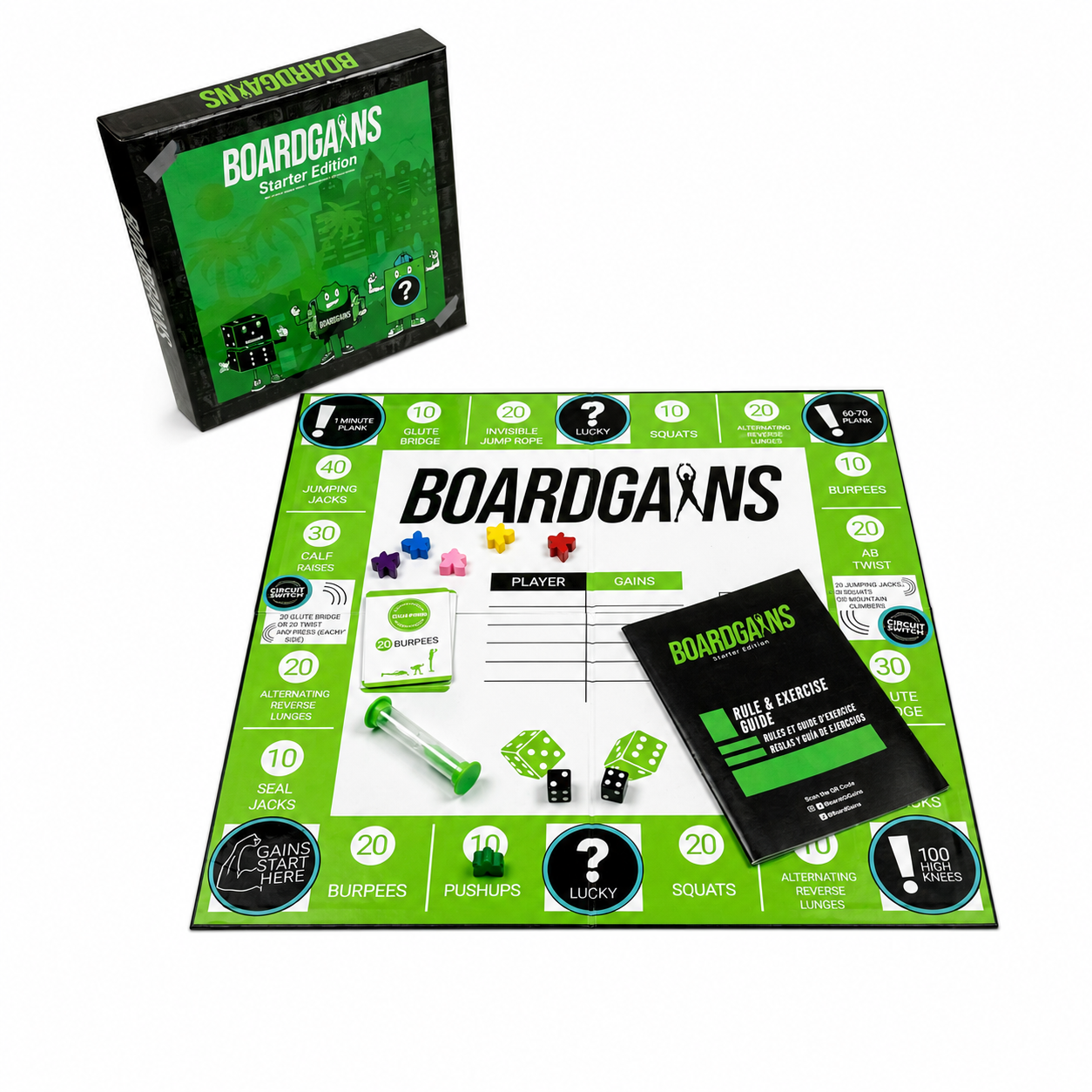
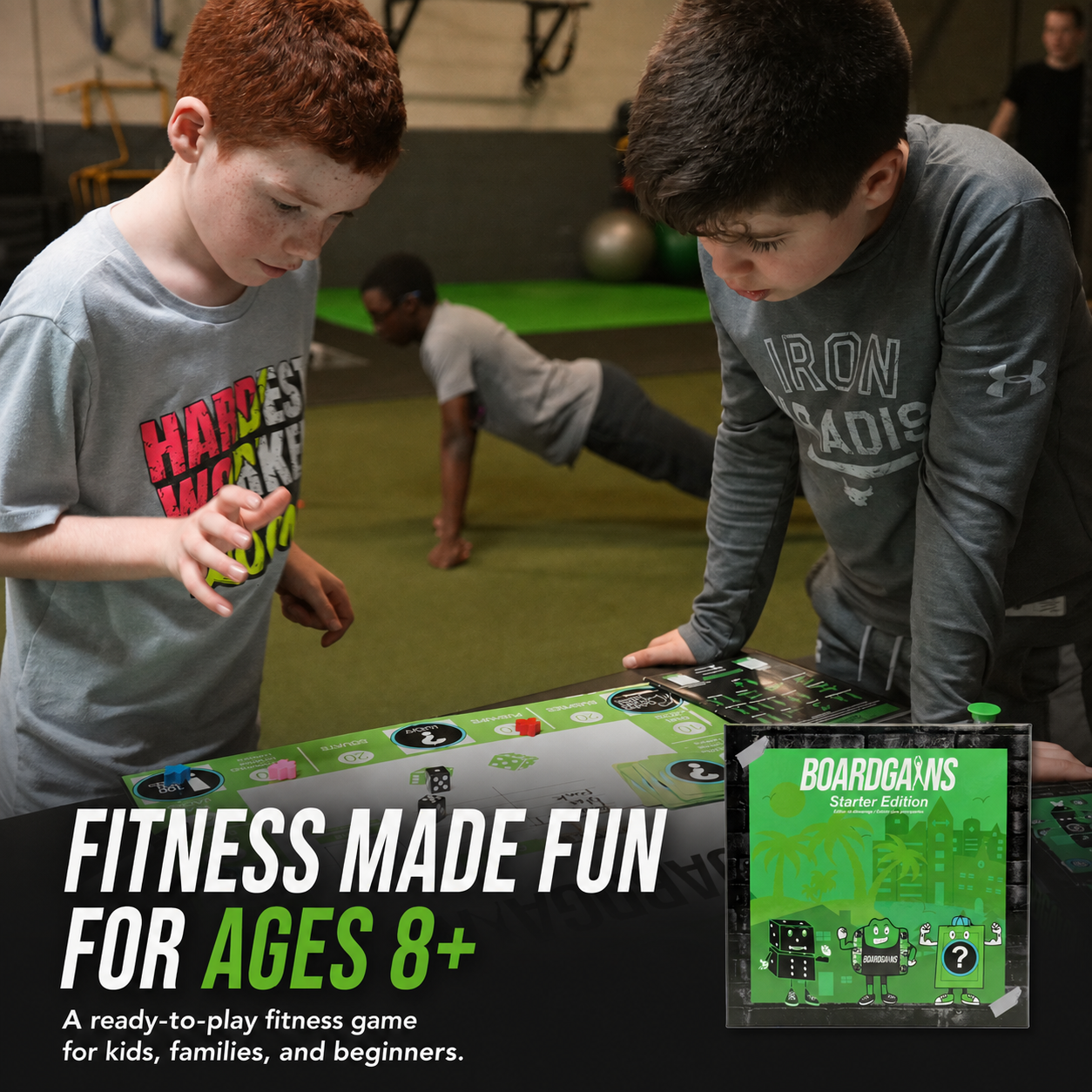
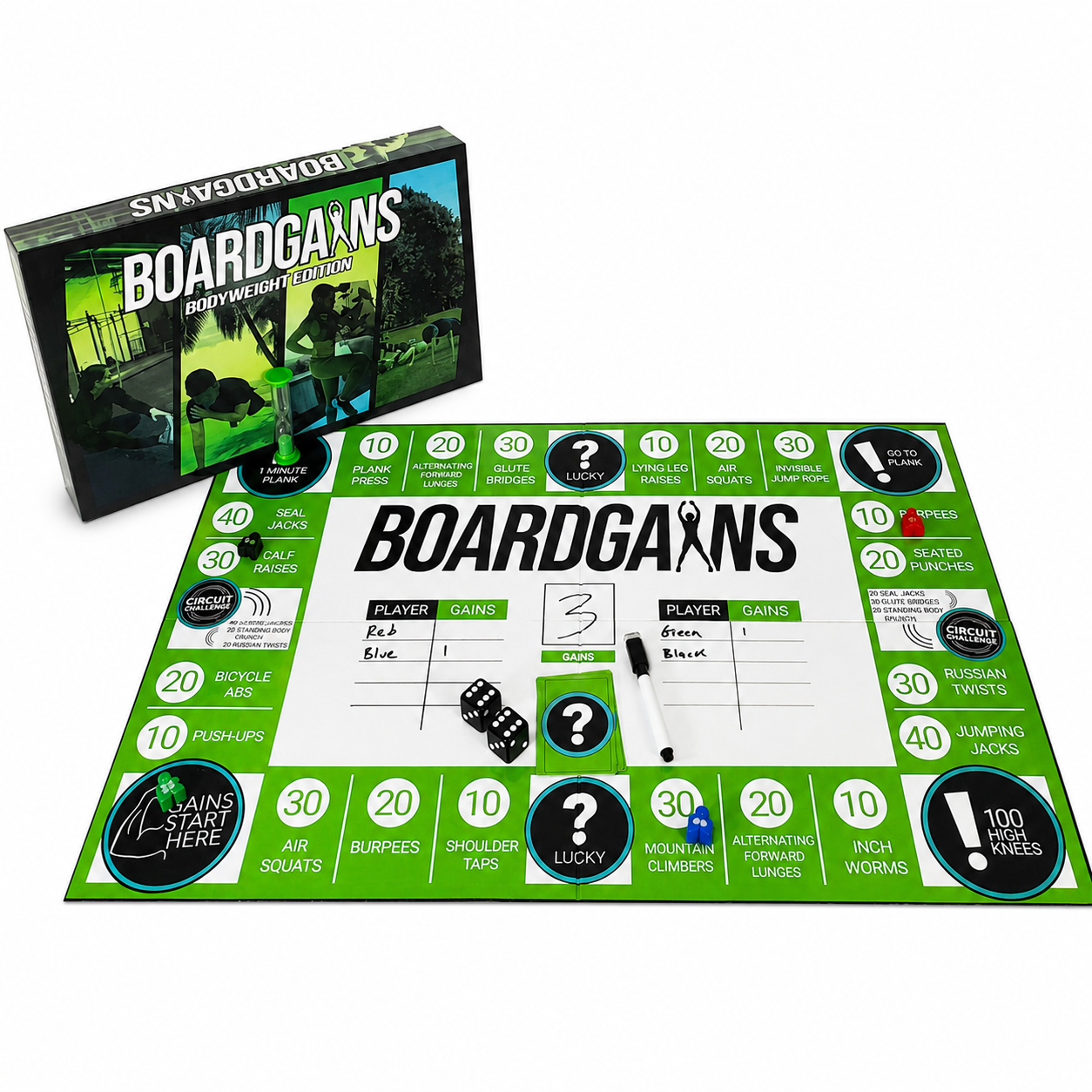
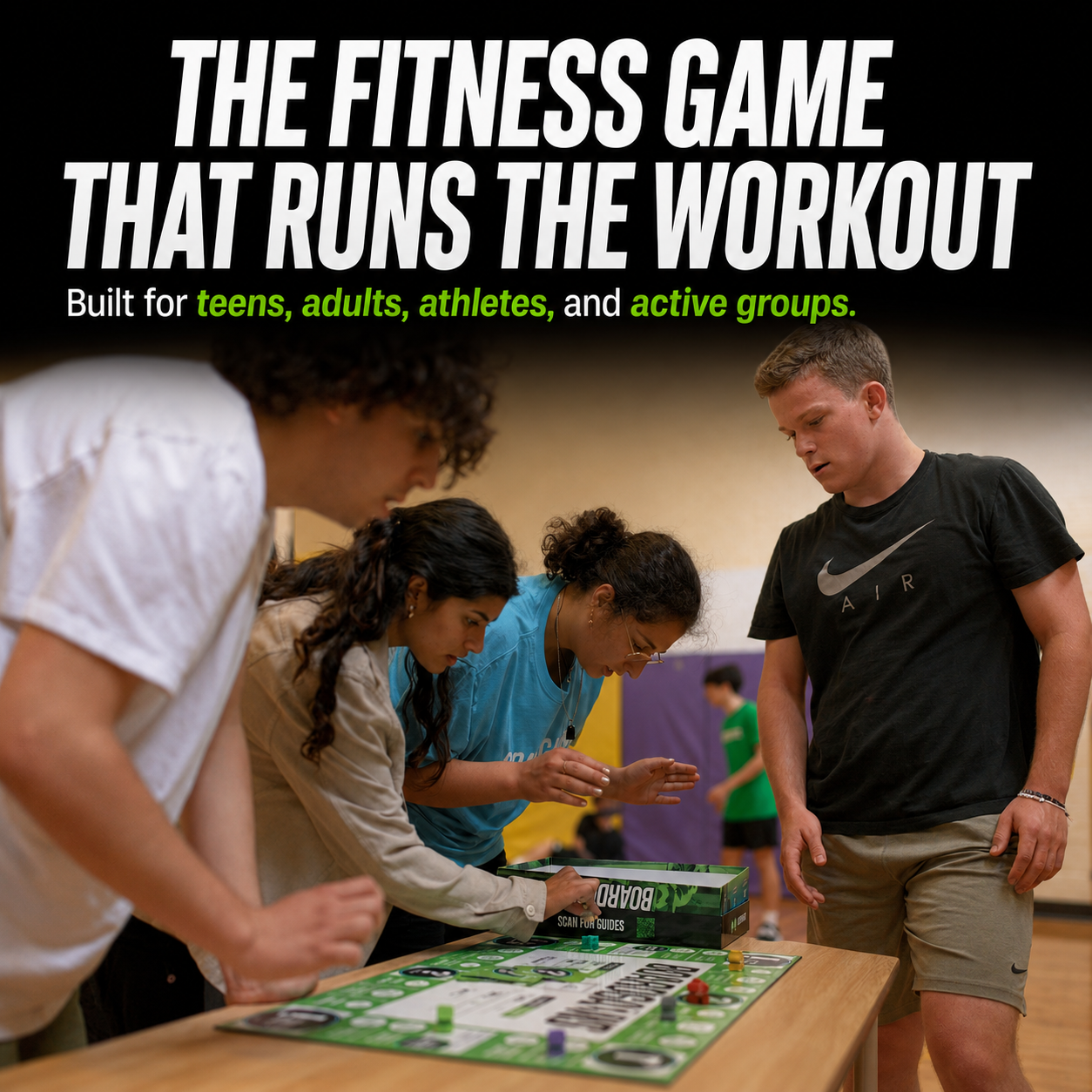
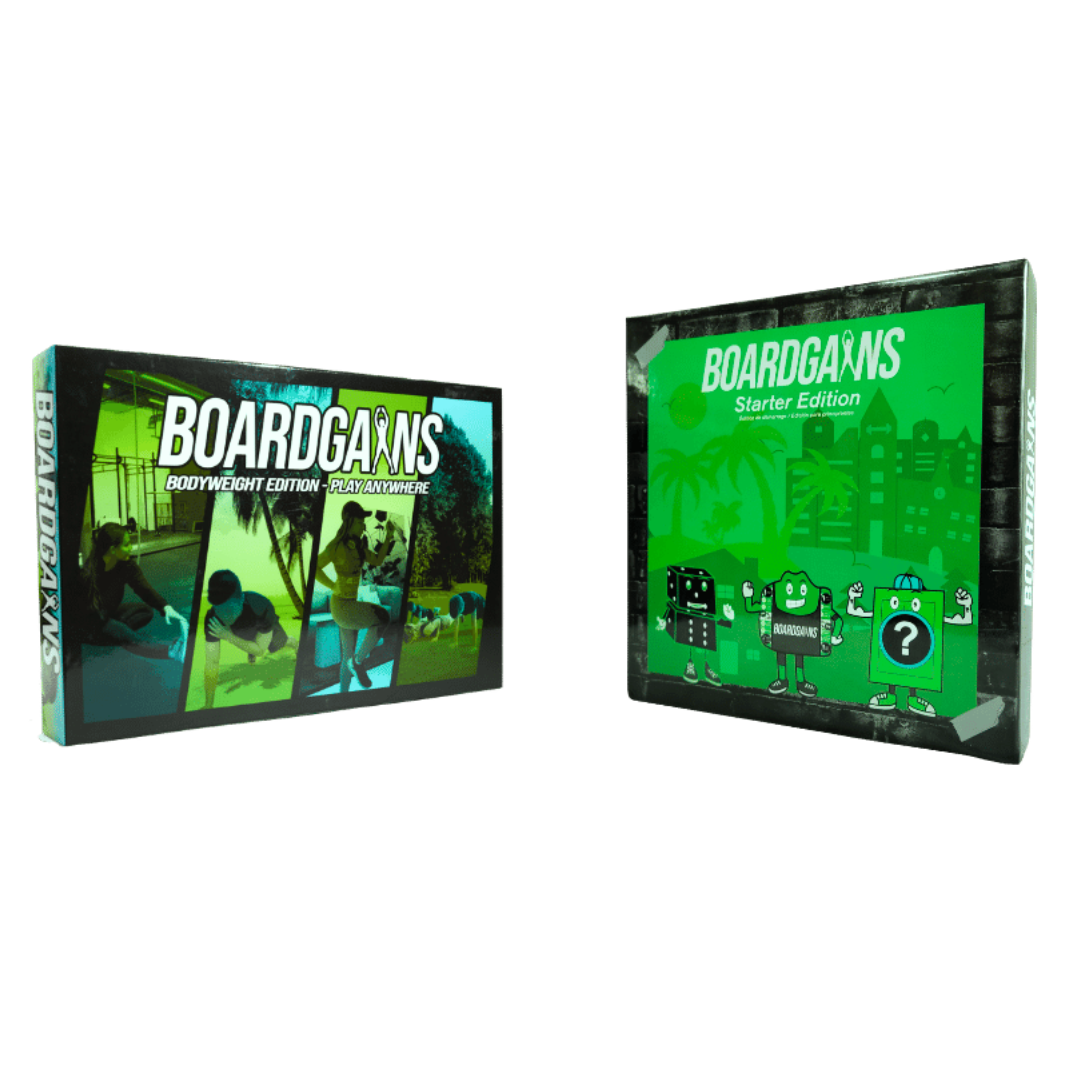
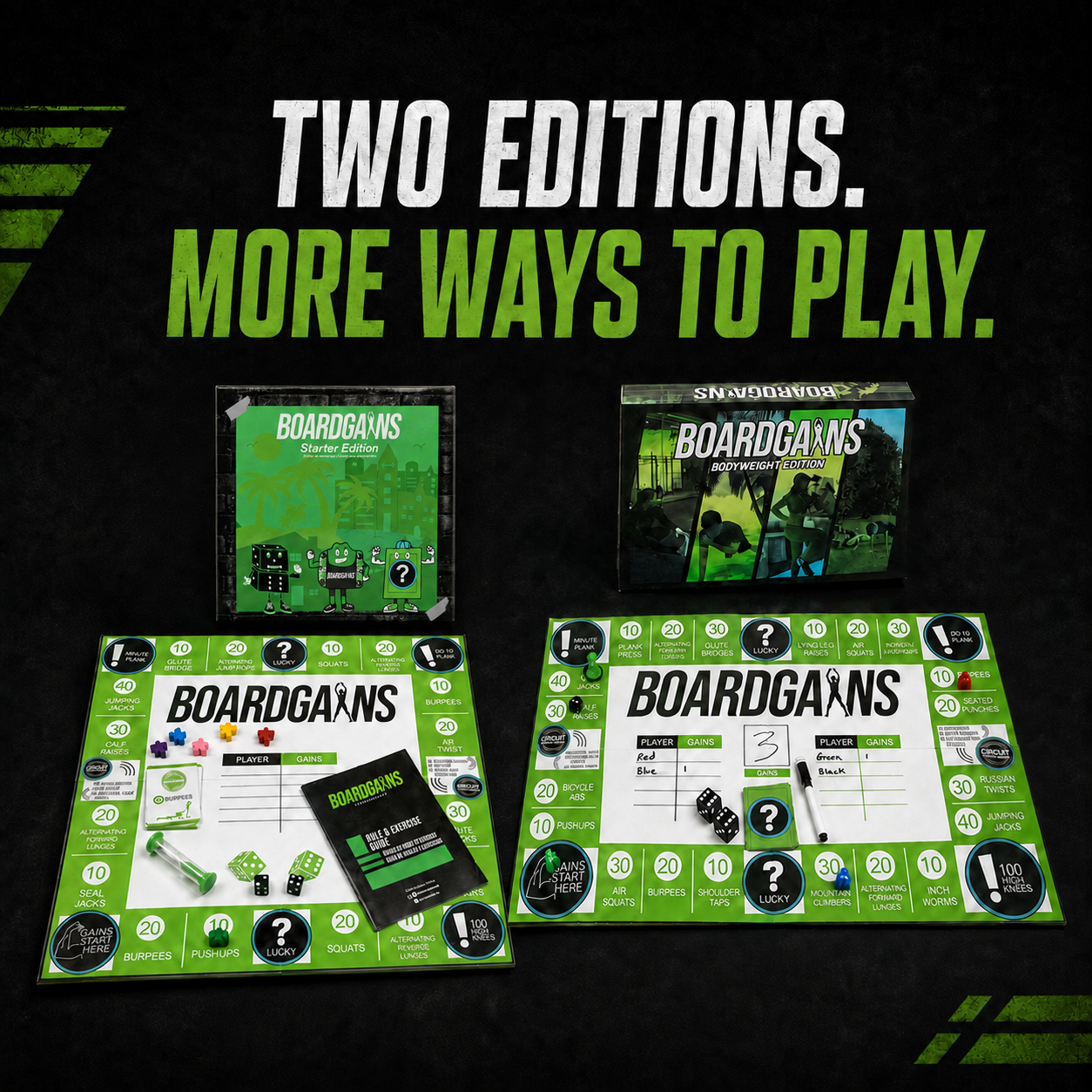
BoardGains provides a complete fitness game using bodyweight exercises. Players or teams set a Gains Goal, roll the dice, move their game pieces, complete the exercise they land on, and collect one Gain for every lap.
Turn your next workout into a game
Start with one game that matches your class goal and available space. Keep the rules short, practise before scoring, and adjust the next round based on what you observe. The goal is not only to find a winner—it is to help the whole group move, connect, and want to play again.
Want the game structure ready to go? Explore BoardGains for group fitness or BoardGains for PE. Set your Gains Goal, organize players or teams, review the exercises, and start everyone together. The game runs the workout while you coach the group.
About the author: Eric Mathura is the founder and creator of BoardGains. He holds a BSc in Kinesiology and has more than 10 years of experience as a personal trainer and group fitness instructor. He created BoardGains to make fitness more fun, social, and inclusive.

Leave a comment
This site is protected by hCaptcha and the hCaptcha Privacy Policy and Terms of Service apply.