
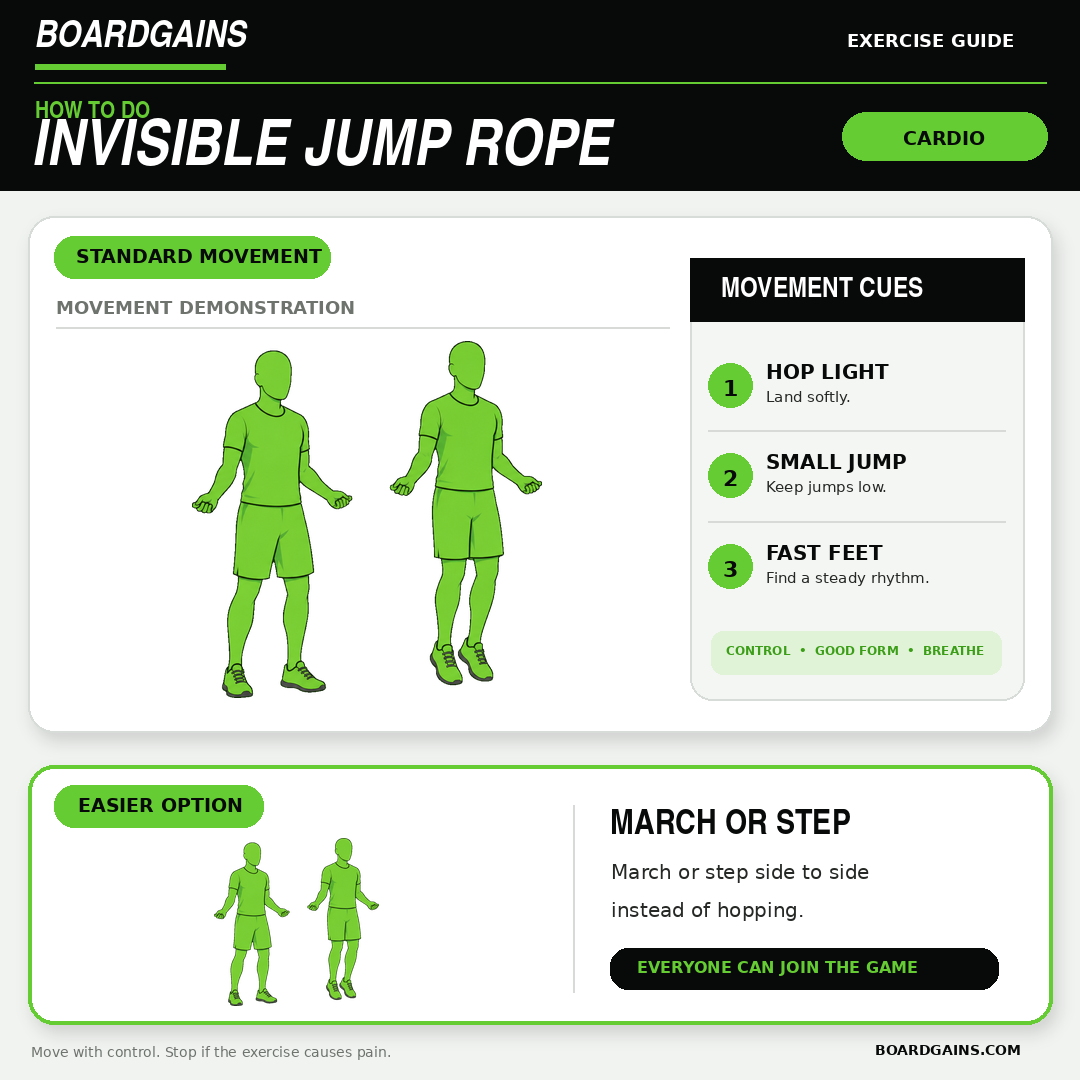
No rope? No problem! The invisible jump rope exercise copies the rhythm and movement of skipping without using an actual rope.
You perform small jumps while turning your wrists as if a rope were passing underneath your feet. This makes the exercise easy to add to PE classes, group fitness sessions, home workouts and BoardGains games.
You will not trip over a rope, but your jumping and landing technique still matter. This guide explains how to perform invisible jump rope with proper form, count each repetition and use a no-jump modification.
Written by Eric Mathura, B.Sc. Kinesiology and CSEP-CPT, with more than 10 years of experience as a personal trainer and group fitness instructor. Updated August 18, 2026.
Quick answer:
Stand tall with your elbows close to your sides. Turn your wrists as if you are holding a rope, perform small jumps and land softly with your knees slightly bent. Each completed jump and landing counts as one repetition.
Quick exercise overview
- Exercise: Invisible jump rope
- Also called: Imaginary jump rope, shadow skipping or no-rope skipping
- Level: Beginner to advanced
- Equipment: None
- Main muscles: Calves and thighs
- Also works: Glutes, core, feet, ankles and shoulders
- Rep count: Each completed jump counts as one rep
Watch: How to Do Invisible Jump Rope
Table of Contents
- What Is Invisible Jump Rope?
- How to Do Invisible Jump Rope
- How to Count Repetitions
- Jumping and Landing Form
- Muscles Worked
- Benefits
- No-Jump Modifications
- Exercise Variations
- Common Mistakes
- Group Coaching Tips
- Frequently Asked Questions
What Is Invisible Jump Rope?
Invisible jump rope is a no-equipment cardio exercise that mimics traditional jump rope. Instead of holding rope handles, you pretend that you have one handle in each hand. You make small circles with your wrists while jumping over an imaginary rope.
The exercise may also be called:
- Imaginary jump rope
- Invisible skipping
- Shadow skipping
- Jump rope without a rope
- No-rope skipping
In BoardGains, the exercise is called Invisible Jump Rope.
How to Do Invisible Jump Rope With Proper Form
- Stand tall with your feet together or a few inches apart.
- Keep a small, comfortable bend in your knees.
- Bend your elbows and position them close to your sides.
- Hold your hands slightly outside your hips as if you were holding rope handles.
- Relax your shoulders and look forward.
- Begin making small forward circles with your wrists.
- Push gently through the balls of your feet.
- Jump only one or two inches away from the floor.
- Land softly with your feet underneath your body.
- Keep your knees slightly bent as you land.
- Continue turning your wrists and jumping at a steady rhythm.
Your wrist circles and jumps should move together. Imagine that the rope passes underneath your feet during every jump.
Movement cue: Small circles. Small jumps. Soft landings.
How to Count Invisible Jump Rope Repetitions
Each completed jump and landing counts as one repetition.
- Jump and land = 1 rep
- Jump and land again = 2 reps
- Continue until you complete the total shown
Your imaginary rope should make one forward turn during each jump. Do not count extra wrist circles that happen without a completed jump.
During BoardGains, complete the number of jumps shown on the board before continuing the game.
Invisible Jump Rope Form Tips
How High Should You Jump?
You only need to jump high enough for an imaginary rope to pass underneath your feet. For most participants, this means leaving the floor by approximately one or two inches.
Jumping higher than needed can:
- Make the exercise harder to control
- Increase landing impact
- Slow down your rhythm
- Cause faster fatigue
- Turn the movement into repeated vertical jumps
Think about quick, light jumps instead of big jumps.
How Should You Land?
Land softly through the front or middle of your feet with your knees slightly bent. Your heels may lower toward the floor, but they should not slam down after every jump.
Try to land quietly. A loud landing can be a sign that the jump is too high or that the return to the floor is not controlled.
Keep your:
- Feet underneath your hips
- Knees tracking in the same direction as your toes
- Chest tall
- Core gently braced
- Head steady
Avoid landing with completely straight or locked knees.
Should You Jump From Your Toes?
Push away from the floor using the balls of your feet, but do not balance on the tips of your toes.
The movement should come mainly from your ankles, with a small amount of knee and hip movement to control each landing. Avoid turning every repetition into a deep squat.
How Should Your Arms Move?
Keep your elbows bent and close to your sides. Most of the imaginary rope turn should come from small wrist circles. Your forearms can move slightly, but you do not need large circles from your shoulders.
Imagine holding the handles of a real jump rope beside your hips. Large arm circles waste energy and make it harder to match the arm rhythm with your jumps.
What Muscles Does Invisible Jump Rope Work?
Invisible jump rope uses muscles throughout the lower body while the upper body helps create the skipping rhythm.
Calves
The calf muscles help push the feet away from the floor and control each landing.
Quadriceps
The quadriceps help keep the knees stable and assist with repeated jumping.
Hamstrings and Glutes
The hamstrings and glutes help control the hips and maintain a tall body position.
Core Muscles
The abdominal and back muscles help keep your torso steady while you jump.
Foot and Ankle Muscles
The smaller muscles around the feet and ankles help control takeoff, landing and balance.
Forearms and Shoulders
The forearms and shoulders stay active while the wrists make the imaginary rope circles. However, invisible jump rope is not mainly an upper-body strength exercise.
Benefits of Invisible Jump Rope
Raises Your Heart Rate
Continuous jumping can increase your heart rate and breathing rate. The intensity depends on your speed, jump height, duration and current fitness level.
Builds Lower-Leg Endurance
Your calves, feet and ankles work repeatedly to push away from the floor and control your landings.
Practises Rhythm and Coordination
Your hands and feet must work together. This creates a simple rhythm and coordination challenge without worrying about catching a rope.
Requires No Equipment
You do not need a rope, machine or gym membership. The exercise can be used in a gym, classroom, home or outdoor workout area.
Works Well for Groups
There are no ropes to hand out, size or untangle. Everyone can begin moving at the same time.
Easy to Adjust
Participants can change the speed, jump height, duration or foot pattern. A no-jump option can also be provided when needed.
Is Invisible Jump Rope Low Impact?
The standard version is not a no-impact exercise.
Even without a physical rope, both feet repeatedly leave the ground and land again. That still creates impact.
Invisible jump rope may be easier to organize than traditional jump rope because there is no rope to catch on the feet. However, it should not automatically be recommended to someone with an injury or joint problem.
Participants who need to avoid jumping can use a heel-raise or alternating-step modification.
Invisible Jump Rope Modifications
No-Jump Heel-Raise Modification
This modification copies the wrist rhythm without leaving the floor.
- Stand tall with your feet about hip-width apart.
- Bend your elbows and keep them close to your sides.
- Begin turning your wrists as if you were holding a rope.
- Slowly lift both heels away from the floor.
- Pause briefly on the balls of your feet.
- Lower your heels with control.
- Repeat at a steady rhythm.
Each completed heel raise counts as one repetition. Participants can lightly hold a stable wall or chair if they need balance support.
Modification cue: Turn the wrists, lift the heels and stay on the floor.
Alternating-Step Modification
- Begin turning your wrists.
- Lift one foot a few inches away from the floor.
- Return it to the floor.
- Lift the other foot.
- Continue alternating in a marching rhythm.
Each foot lift counts as one repetition. Keep the steps light and controlled.
Invisible Jump Rope Variations
Master the standard two-foot jump before adding faster or more complex footwork.
Alternating-Foot Invisible Rope
Shift between the right and left foot as if jogging lightly in place.
Boxer-Step Invisible Rope
Shift your weight gently from one foot to the other while maintaining the wrist-turning rhythm.
Front-and-Back Jumps
Jump a few inches forward and then backward. Keep the movement small and make sure the floor is clear.
Side-to-Side Jumps
Jump a few inches to the right and left while keeping your feet close together. Land with your knees tracking over your toes.
High-Knee Invisible Rope
Alternate lifting your knees higher while turning your wrists. This variation is more demanding and changes the exercise into a running-style movement.
Fast-Feet Invisible Rope
Use quicker, lower jumps while maintaining soft landings. Increase the speed only after the regular version is controlled.
Common Invisible Jump Rope Mistakes
Jumping Too High
Large jumps create extra fatigue and may increase landing impact.
Fix: Imagine that the rope is thin. Jump only high enough for it to pass underneath your feet.
Landing Loudly
Heavy landings may mean the participant is jumping too high or losing control.
Fix: Reduce the jump height and aim to land quietly.
Locking the Knees
Landing with straight knees reduces the body’s ability to control the landing.
Fix: Maintain a small, natural bend in the knees.
Letting the Knees Collapse Inward
The knees may move toward each other as fatigue increases.
Fix: Keep the knees tracking in the same direction as the toes.
Making Large Arm Circles
Swinging from the shoulders uses unnecessary energy.
Fix: Keep the elbows near the body and make smaller circles with the wrists.
Holding the Hands Too High
Hands positioned near the chest or shoulders do not copy traditional jump-rope mechanics.
Fix: Keep the hands slightly outside the hips.
Turning the Wrists Without Matching the Jumps
The arms and feet may move at different speeds.
Fix: Use one wrist turn for each jump.
Performing Deep Squat Jumps
Invisible jump rope should use small ankle-driven jumps, not repeated deep squats.
Fix: Keep the jump low and the knee bend small.
Looking Down at the Feet
Looking down can cause the chest to drop and the body to lean forward.
Fix: Look ahead while keeping your head steady.
Using an Unsafe Surface
Slippery, uneven or crowded areas can make repeated jumping harder to control.
Fix: Use a clear, level and non-slip surface.
How Long Should You Do Invisible Jump Rope?
The right amount depends on the participant’s fitness level and jumping experience.
- Beginners: 2–3 rounds of 15–30 seconds
- General fitness: 3–5 rounds of 30–60 seconds
- Rep-based workouts: 10–30 controlled jumps
- BoardGains games: Complete the number shown during play
Take a break when landing quality begins to change. Participants who are new to jumping should start with shorter sets because repeated jumps can tire the feet, calves and lower legs quickly.
What Surface Should You Use?
Use a level, non-slip surface with enough space around each participant. A gym floor, rubber exercise floor or firm exercise mat may work well.
Avoid thick, soft mats that make the feet unstable. Concrete and other very hard surfaces may also feel less comfortable during repeated jumping.
Always check the area for:
- Water
- Loose equipment
- Bags
- Game pieces
- Uneven flooring
- Other participants
Invisible jump rope requires less room than a real rope, but everyone still needs enough personal space to jump safely.
How to Coach Invisible Jump Rope in a Group
Invisible jump rope is easy to organize because you do not need to hand out, size or untangle ropes.
For a smoother PE class or group workout:
- Give every participant a clear workout space.
- Demonstrate a small jump instead of a high jump.
- Show the wrist movement from the front and side.
- Ask participants to keep their elbows close.
- Practise the arm movement before adding jumps.
- Encourage soft, quiet landings.
- Show the heel-raise and alternating-step options.
- Use shorter work periods for beginners.
- Stop the set if landing control begins to change.
- Keep game pieces and equipment away from the jumping area.
Group coaching cue: Wrists turn, feet jump and land like a ninja.
Invisible Jump Rope in BoardGains
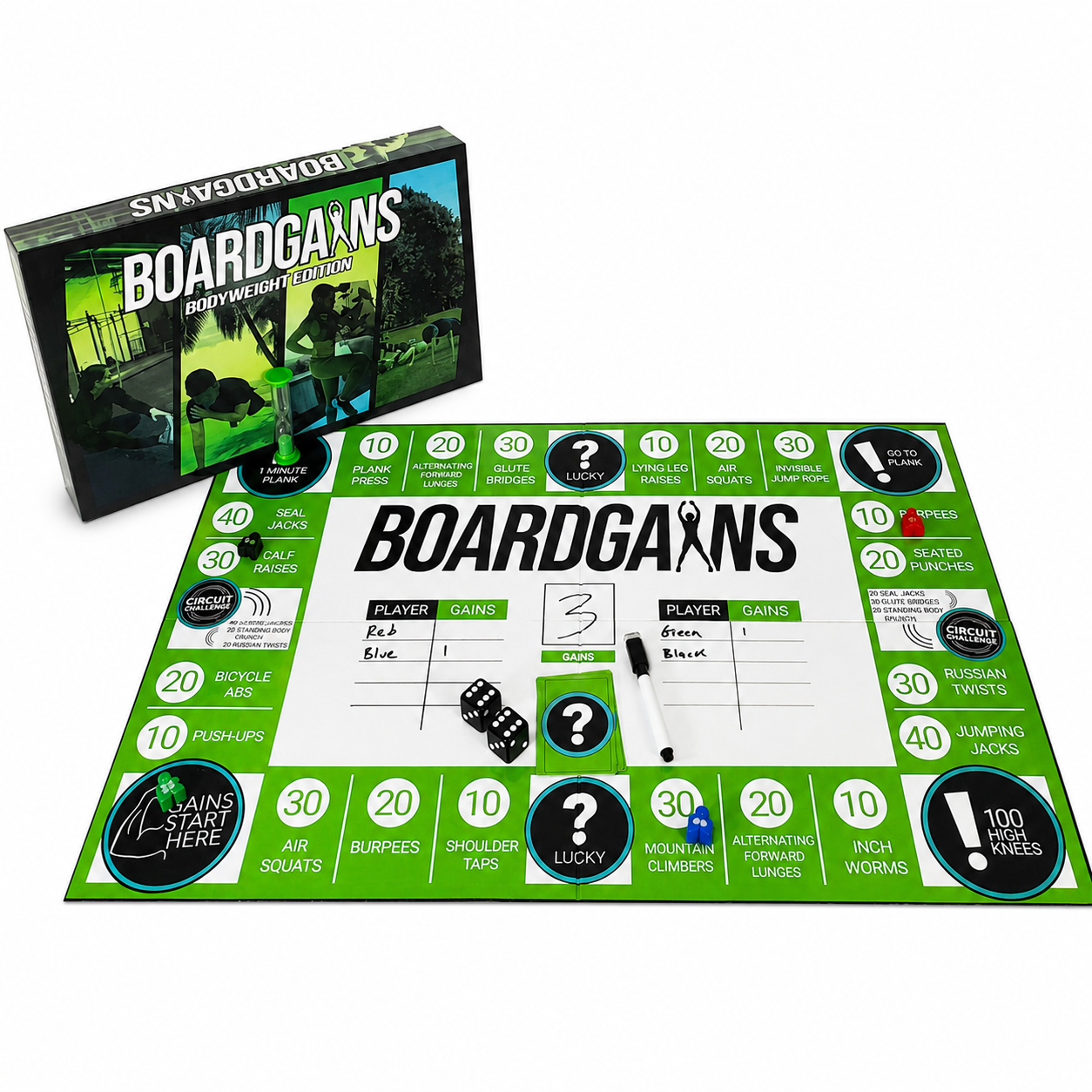
Invisible Jump Rope is one of the 20 bodyweight exercises included in the BoardGains Pro Edition.
When a player lands on Invisible Jump Rope:
- Stand tall with your elbows close to your sides.
- Turn your wrists as if you were holding rope handles.
- Perform small, controlled jumps.
- Land softly after every jump.
- Count each completed jump as one repetition.
- Use heel raises or alternating steps if a no-jump option is needed.
- Complete the total shown and continue playing.
Since everyone plays at the same time, each player or team should have enough space to jump without contacting another participant.
Turn Your Workout Into a Game
BoardGains is a ready-to-play fitness game for PE classes, group workouts, teams and families. No workout planning. No equipment. Everyone moves.
Frequently Asked Questions
What is invisible jump rope?
Invisible jump rope is an exercise that copies the jumping and wrist-turning action of skipping without using an actual rope.
Does invisible jump rope count as cardio?
It can. Continuous jumping can raise your heart rate and breathing rate. The intensity depends on your pace, duration and fitness level.
Does one jump count as one repetition?
Yes. Each completed jump and landing counts as one rep.
How high should I jump?
Jump only one or two inches away from the floor—just enough for an imaginary rope to pass underneath your feet.
Should I land on my toes?
Land softly through the front or middle of your feet. Avoid staying on the tips of your toes or slamming your heels into the floor.
Is invisible jump rope low impact?
Removing the rope does not remove the impact of jumping. The standard version still includes repeated takeoffs and landings. Use heel raises or alternating steps when a no-jump option is more appropriate.
Is invisible jump rope easier than using a real rope?
It removes the challenge of clearing a physical rope and may be easier for beginners. However, a real rope provides useful feedback about timing, wrist position and jump height.
Can beginners do invisible jump rope?
Yes. Beginners can start with heel raises, alternating steps or short sets of small jumps.
Can children do invisible jump rope?
It can be included in age-appropriate PE and fitness activities when children have enough space, a stable surface and clear instructions.
Can I do invisible jump rope indoors?
Yes, if the floor is stable and the area is clear of furniture, equipment and other people.
Why do my calves get tired?
The calf muscles repeatedly help push your feet away from the floor and control each landing. Begin with shorter rounds and build the duration gradually.
Does invisible jump rope burn the same calories as a real rope?
Not necessarily. Energy use depends on speed, jump height, duration, body size and effort. A physical rope can also change the skill and intensity of the exercise.
What should I do if jumping causes pain?
Stop if you feel sharp, increasing or unusual pain. Use a no-jump option or choose another exercise that can be performed comfortably.
Final Invisible Jump Rope Form Checklist
- Feet together or a few inches apart
- Knees slightly bent
- Elbows close to the body
- Hands beside the hips
- Small wrist circles
- Low jumps
- Soft, quiet landings
- Knees tracking with the toes
- One wrist turn per jump
- Each completed jump equals one rep
Keep it light and rhythmic: small circles, small jumps and soft landings.





1 comment
Craig Monosmith
Jump Rope workout are very important thing for everyone. Just before 20 days i started and lose around 3 kg of weight by doing 600 skipping per day, which is very effective for me. Also sometimes taking help of Creatine or glucose liquid can help to improve more energy.
Leave a comment
This site is protected by hCaptcha and the hCaptcha Privacy Policy and Terms of Service apply.